
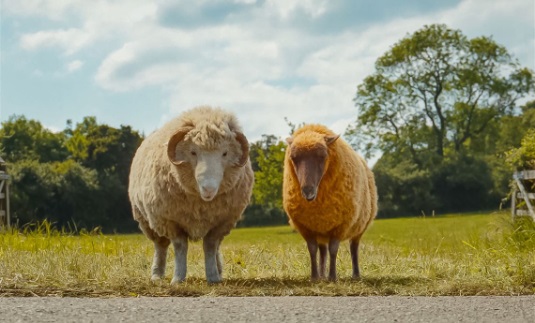
Photo courtesy of Amazon/MGM Studios
Film Review
The Sheep Detectives
| published July 9, 2026 |
By Sandi Jerome,
Thursday Review contributor
The breakout success of The Sheep Detectives (2026) stems from its masterful ability to thread a notoriously difficult needle: balancing a whimsical, animal-led whodunit with an emotionally resonant, sophisticated narrative. Adapted from Leonie Swann's bestselling novel Three Bags Full by screenwriter Craig Mazin (The Last of Us) and directed by Kyle Balda, the film charmed critics earning a staggering 97% on Rotten Tomatoes, and audiences alike by treating its bizarre premise with genuine heart rather than cheap gags. For me, they had me at "sheep." I used to raise them as a 4-H member when I was young.
The sheep, with their irresistible personalities, were the stars of the show, thanks to the next-level animal animation by Framestore, paired with a powerhouse voice ensemble including Julia Louis-Dreyfus, Bryan Cranston, and Chris O'Dowd. Julia Louis-Dreyfus gives the flock's de facto leader, Lily, a bright, slightly anxious energy that carries much of the film's comic momentum, while Bryan Cranston finds real tenderness underneath Sebastian's gruffness. Patrick Stewart, as the flock's oldest and most self-regarding ram, Sir Ritchfield, is inspired casting; his Shakespearean register turns the character's pomposity into one of the film's funniest running notes.
I'm a huge fan of Brett Goldstein from Ted Lasso, who turns in one of the film's most purely fun performances, voicing twin Norfolk Horn rams Ronnie and Reggie in a dual role that gives the flock's younger generation its comic spark. The pair are pugnacious and a little bro-y, forever finding any "probable cause" to butt heads and bash whatever is nearby with their horns, and Goldstein leans into that chaotic energy without letting it curdle into pure slapstick. It's a nice change of pace for an actor best known for the wounded gruffness of Roy Kent, and it shows a lightness that has been mostly hidden under Goldstein's more brooding roles, including his voice work as Hercules in the MCU. Paired against Bella Ramsey's earnest, question-asking Zora, Ronnie and Reggie are proof that even the film's smallest characters were written with real personality rather than filler.
Around the human cast, Emma Thompson and Nicholas Braun anchor the village storyline with just enough procedural seriousness to keep the mystery from floating away entirely. But Hugh Jackman, as the tragically doomed shepherd George Hardy, anchored the film's rustic charm. Jackman isn't given much screen time (the plot depends on that), but he uses it efficiently, building a warmth and specificity into George that the rest of the film leans on for its emotional stakes. It's the kind of performance that could easily have been an afterthought in a film with this much star wattage surrounding it, and instead becomes the quiet foundation everything else is built on.
By tackling mature themes like grief, mortal awareness, and community through the innocent lens of the sheep, the film transcended the standard "talking animal" trope to become a cross-generational hit, grossing over $130 million theatrically before dominating streaming charts worldwide as the No. 1 movie on Amazon Prime Video.
That achievement is even more impressive given how long the project sat in development, and how easily it could have gone wrong. Producer Lindsay Doran first brought Leonie Swann's novel to Craig Mazin back in 2007, but it took her nearly a decade to secure the film rights, and Mazin didn't write his first draft until 2016, years before Chernobyl and The Last of Us made him one of Hollywood's most sought-after writers. That patience shows on screen. Rather than flatten Swann's slow-burn, philosophical humor into broad studio comedy, Mazin preserves the novel's central conceit: that a flock's understanding of the world, however limited, might still be sharper and more honest than the humans around them. Director Kyle Balda, making the leap from animated fare like Minions and Despicable Me 3 into a live-action-and-voice hybrid, brings an animator's patience for physical behavior to the flock, letting the sheep's herd instincts do quiet character work that a lesser director might have rushed past for the next joke.
What elevates The Sheep Detectives above a simple novelty premise is its willingness to sit with loss rather than rush past it. Just as Remarkably Bright Creatures used its octopus to help a grieving widow finally be seen, and just as Babe used a pig's outsider perspective to quietly interrogate how a farm decides who matters, this film uses its flock's limited but earnest understanding of death to ask something genuinely moving: what does it mean to keep going after someone who cared for you is gone? The sheep don't solve George's murder because they're clever plot devices. They solve it because they loved him, and grief, even woolly and four-legged, wants an answer.
The Sheep Detectives isn't a perfect mystery. A few of the human suspects get simplified in the jump from page to screen, and the pacing occasionally rushes past beats the novel lets breathe. But as an adaptation, and as a film willing to take its talking animals seriously, it's a real triumph, and one more entry in a small, wonderful genre of films that use animals to say what humans can't quite manage to say themselves.
Sandi Jerome is a screenwriter, author, and former technology company founder whose diverse background as a UCLA Advanced Screenwriting graduate, former CPA, and novelist shapes her insightful analysis of book-to-screen adaptations. She is a frequent contributor to Thursday Review.
Related Thursday Review articles:
Remarkably Bright Creatures; film review; Sandi Jerome; Thursday Review; June 2, 2026.
Project Hail Mary: Why Grounded Science Makes for Better Sci-Fi; Sandi Jerome; Thursday Review; June 23, 2026.