
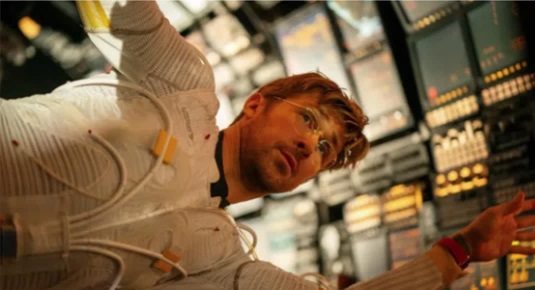
Photo courtesy of Amazon MGM
Film Review
Project Hail Mary:
Why Grounded Science
Makes The Martian
Superior
| published June 23, 2026 |
By Sandi Jerome,
Thursday Review contributor
When The Martian first hit theaters, Thursday Review editor R. Alan Clanton noted that despite a seemingly "hyper-predictable template," Ridley Scott scored big by grounding the narrative in the sheer grit of human ingenuity. Eleven years later, looking back at that masterpiece alongside the cinematic adaptation of Project Hail Mary, Clanton’s original praise holds up perfectly. I agree with Clanton’s assessment that the film thrives on realistic tension rather than sci-fi gimmickry. The Martian is a masterclass in realistic survival because Mark Watney solves problems using high school chemistry and botany. When he burns hydrazine to make water or uses his own waste to grow potatoes, the audience can easily follow the logic. The danger feels terrifyingly real because we know Mars is a real place, and the equipment he uses is only a few years away from existing.
Project Hail Mary, which stars Ryan Gosling, scales up the stakes to a global apocalypse, but in doing so, it loses that intimate connection to reality. The film relies on "Astrophage," a fictional space parasite that breaks the known laws of physics by storing impossible amounts of energy. While highly imaginative, this requires a massive leap of faith. Instead of watching a man manipulate reality, we watch a man manipulate magic disguised as biology. The core differences in how both films handle their science explain why The Martian delivers a more satisfying experience for those who prefer grounded science. The Martian uses local geography and distance as the enemy. Project Hail Mary introduces a solar-dimming microorganism, turning a survival story into a race against a speculative ecological clock. The Martian respects orbital mechanics and atmospheric pressure accurately. Project Hail Mary introduces "Taumoeba" and relativistic space travel, moving firmly into the realm of fantasy.
By staying inside the lines of modern aerospace engineering, The Martian makes the viewer feel like they could survive alongside the protagonist. As a scientist, I even planted my own "Martian garden" to test feeding myself from a similar section of my backyard. Project Hail Mary is an excellent spectacle, but its reliance on convenient sci-fi tropes makes it feel like a comic book compared to the documentary-like grit of Watney’s journey.
While Andy Weir wrote both books and Drew Goddard adapted both for the screen, Goddard noted that Project Hail Mary presented a unique difficulty compared to The Martian, famously calling the challenge of writing a compelling relationship with a completely faceless, non-verbal alien a “screenwriter’s nightmare.” While The Martian features zero aliens, keeping the focus entirely on human isolation, Project Hail Mary centers heavily on Rocky, a companion from another star system, shifting the genre from hard survival to first-contact sci-fi. This character "knocks it out of the park" in Project Hail Mary! Sure, the alien doesn't have a face and being made out of rocks reminds us of everything from the terrifying, boulder-rolling Gorignak in Galaxy Quest to the hilariously laid-back Korg from Marvel's Avengers universe, but instead of leaning into those mindless monsters or pure comic relief tropes, Andy Weir manages to give this faceless, xenomorphic entity a profound sense of heart and vulnerability, turning an intimidating pile of space-rocks into an unforgettable symbol of genuine friendship. I cried during a scene featuring a hug between the two.
The Martian succeeds where Project Hail Mary falters because its hard science feels earned, immediate, and firmly rooted in real-world physics. While both films deliver spectacular space tension, The Martian remains the superior cinematic achievement because it honors the boundaries of current human technology. Clanton was right in his original 2015 Thursday Review piece: sticking to real science is what makes a survival story truly soar.
Sandi Jerome is a screenwriter, author, and former technology company founder whose diverse background as a UCLA Advanced Screenwriting graduate, former CPA, and novelist shapes her insightful analysis of book-to-screen adaptations.
Related Thursday Review articles:
The Martian: Ridley Scott Scores Big; R. Alan Clanton; Thursday Review; October 6, 2015.
2001: A Space Odyssey: Fifty Years Ago Science Fiction Changed Our World; Thursday Review; April, 12, 2018.