
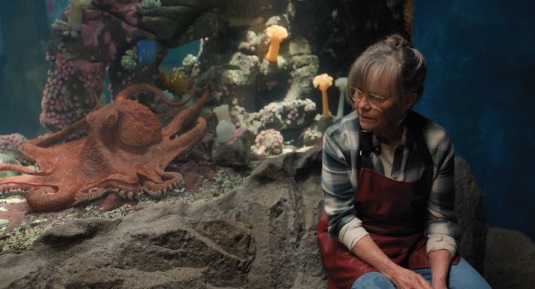
Photo courtesy of Netflix
Film Review
Remarkably
Bright
Creatures
| published June 2, 2026 |
By Sandi Jerome,
Thursday Review contributor
The journey from a beloved bestselling novel to a successful screen adaptation is notoriously difficult, but the newly released film version of Remarkably Bright Creatures manages to capture the exact spirit that made readers fall in love with the book. Now streaming on Netflix, this heartfelt production balances the heavy reality of human loss with a whimsical, deeply moving touch that makes it an absolute three-hankie experience.
At the center of this project is director and co-writer Olivia Newman, who previously proved her skill at translating nature-centric literary worlds to the screen with Where the Crawdads Sing. Newman, who collaborated on the screenplay with John Whittington, did not follow the traditional indie route of personally purchasing the film rights. Instead, Netflix backed the high-profile adaptation, attaching the legendary Sally Field to star early in development. To secure the directing job, Newman famously pitched her visual vision directly to Field, bringing a deck of concept images and fresh-baked banana bread to show exactly how she planned to ground the story's unique premise. Author Shelby Van Pelt also served as an executive producer, reviewing script drafts to ensure the adaptation remained faithful to the source material.
The film serves as a brilliant reminder that major stars truly earn their salary. Sally Field delivers an incredibly grounded, quiet emotional truth as Tova Sullivan, a woman masking deep, paralyzing grief behind a rigid routine of nighttime cleaning. Her performance anchors the entire narrative, allowing the movie to explore heavy themes without ever feeling melodramatic.
Equally brilliant is the casting of the film's most unusual character, a giant Pacific octopus named Marcellus. Voiced by Alfred Molina, Marcellus is infused with a perfect blend of curmudgeonly wit, superior intelligence, and deep empathy. The dynamic between the stoic Tova and the observant octopus forms the beautiful, unexpected core of the story.
The human cast is rounded out by Lewis Pullman, playing the role of Cameron, a young drifter searching for purpose and identity. Pullman brings the same soulful, grounded, vulnerable energy that made him so lovable in the early episodes of Lessons in Chemistry, another fantastic book adaptation. His onscreen chemistry with Field provides a beautiful, cross-generational spark that drives much of the emotional narrative.
Ultimately, the film succeeds because it leans completely into its central themes of grief, connection, and the unspoken burdens of the past. Every human character in the story is stuck in place by something they have lost or never found. Tova is isolated by the long-ago disappearance of her son and the recent death of her husband, while Cameron is paralyzed by childhood abandonment. The narrative beautifully demonstrates that healing cannot happen in isolation, and that moving forward requires letting someone, or in this case, something, truly see you.
This focus on transformation creates profound character arcs for everyone in the story except for the octopus. Marcellus does not need an arc because he is already completely self-aware from his very first scene. Instead, he acts as an omniscient catalyst, a brilliant observer using his final days to orchestrate the healing of the blundering humans around him. Remarkably Bright Creatures is a rare adaptation that honors its roots while delivering a uniquely cinematic, emotionally resonant triumph.
Sandi Jerome is a screenwriter, author, and former technology company founder whose diverse background as a UCLA Advanced Screenwriting graduate, former CPA, and novelist shapes her insightful analysis of book-to-screen adaptations.
Related Thursday Review articles:
Diane Keaton: A Film Legacy Spanning 55 Years; R. Alan Clanton; Thursday Review; October 14, 2025.
Jaws at 50: How a 1975 Summer Blockbuster Changed the Movies, and the Beach; Thursday Review; August 5, 2025.