
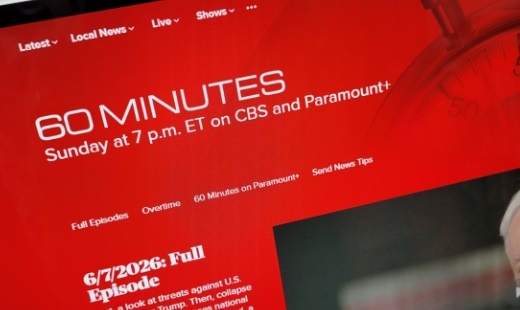
Screenshot of 60 Minutes webpage week of June 7, 2026
Scott Pelley's Departure:
"CBS News is on Fire"
| published June 9, 2026 |
By R. Alan Clanton Thursday Review editor
Longtime 60 Minutes correspondent and former CBS Evening News host Scott Pelley says that the news division's top editor at CBS, Bari Weiss, has been attempting for many months to put her "thumb on the scale" in order to make 60 Minutes reporting more favorable reporting to the administration of President Donald Trump.
In an extensive interview with the New York Times, Pelley suggested that Weiss should be removed from her job. "My hope is that the leadership of Paramount will say to themselves, this isn't working," Pelley said.
Pelley was fired from his job at 60 Minutes last week after clashing with Weiss, and with newly appointed executive editor Nick Bilton, in meetings which Weiss and CBS News have officially described as efforts to mend fences. CBS News says Pelley was uncooperative despite efforts to "find a way back." Pelley has said of those meetings that there were no attempts at reconciliation or rapprochement, and that he was simply fired.
Weiss was given the role as top executive for CBS News in October of 2025. Since then, the hallowed conference rooms and editing bays at 60 Minutes have seen significant turmoil, especially during the last season, with several notable dismissals of producers and reporters. Among those who have been ejected from 60 Minutes: veteran reporters Sharyn Alfonsi and Cecilia Vega, executive producer Tanya Simon, and several other producers. In all instances, there had been clashes with Weiss over editorial policy.
Weiss and other top executives at CBS have differed with this narrative, insisting that the clashes have been about how to modernize and reinvent programing for the streaming and digital ages, especially the CBS Evening News and the network's longstanding flagship newsmagazine, 60 Minutes. Weiss has suggested that the infighting has come from an irrational resistance to her goal of renovating the show. Weiss has insisted that she only wants the show to remain relevant in an age when viewing habits have drastically evolved since the show's debut in 1968.
Pelley's interview with the New York Times—published last Sunday—clearly shows that Pelley has no intention of riding quietly into the sunset after his ouster from CBS. One of his most explosive claims is that the "new management has instructed me to inject falsehoods and bias into a politically sensitive story." Pelley added, "I've been told to include assertions that are unverified." Pelley also told the NYT that the recent practice by 60 Minutes of inviting the subject of the interview to choose the correspondent with whom they would prefer to work was "giving politicians control over 60 Minutes."
Alfonsi's departure, which came after CBS refused to renew her contract, came about after multiple clashes between Weiss and Alfonsi, including a particularly contentious debate over a December 2025 report covering ICE, Venezuelan migrants, and the notorious CECOT prison in El Salvador. As the show approached its air date, Weiss insisted the program be set aside until officials in the Trump administration—most of whom had been refusing to participate in the segment—be offered an opportunity to make official comments. In particular, Weiss wanted Trump's point-man on the CECOT program, Stephen Miller, to have a chance to appear or at least respond.
Weiss felt the piece was incomplete and unfair without that opportunity for on-the-record rebuttal, though Alfonsi and her producers had apparently repeatedly reached out for comment by the White House. That segment was eventually aired later, in mid-January 2026, but was laden with complex and heavy addenda explaining all the attempts to obtain an official response. Among the government agencies that declined requests to comment included Homeland Security, the State Department, and the Justice Department.
Earlier in 2025, executive producer Bill Owens resigned, stating that he no longer felt he was able to operate with journalistic independence, and cited frequent interference from CBS management. Owens indicated that he felt that the then-impending merger talks between Paramount and Skydance were exerting sway over CBS News since the merger required the approval of the Trump administration, and since there was still an outstanding lawsuit between Trump and CBS News over the editing of a 60 Minutes interview of vice-president and presidential candidate Kamala Harris.
Other members of the 60 Minutes team have clashed with Weiss in recent months, leading to what have called the May massacre, when several reporters and producers were let go.
Some business analysts point out that such skirmishes can often escalate when significant management changes occur—in this instance, a major corporate shake-up when CBS and CBS News came under the control of new parent company Paramount Skydance, a massive media conglomerate with little patience with the insular, rarified culture within the backrooms of 60 Minutes. New owners have the prerogative, and sometimes the urgent need, to make sweeping changes.
But Paramount Skydance owner and CEO—David Ellison—is a political ally of President Trump, and it was Ellison who installed Bari Weiss in her role at CBS. The recent insider narrative has been that Weiss has been systematically leaning on her correspondents, editor and producers to skew the news more to the liking of President Trump and the White House.
Pelley told the New York Times that the traditions found in the CBS News culture and within the 60 Minutes mandate is being undermined from above. "Now the new owner of our network is casting this legend aside, apparently to curry favor with the Trump administration."
Pelley, who has been with CBS News for 37 years, has worked with 60 Minutes for more than 20 of those years, joining the show in 2004 and becoming a host, and member of a team of storied and legendary hosts such as Harry Reasoner, Dan Rather, Morley Safer, Ed Bradley, Diane Sawyer, Steve Croft, and Anderson Cooper. Correspondents have included Eric Sevareid, Roger Mudd, Bill Plante, Bob Sheiffer, Christiane Amanpour, Lara Logan, Katie Couric, and Bob Simon.
Officially, Pelley was fired by new executive editor Nick Bilton, who was reportedly offended by Pelley's strident and aggressive exchanges during Bilton's first full meeting with 60 Minutes staff earlier last week. At that meeting were scores of other correspondents and producers, along with CBS News managing editor Charles Forelle. After Pelley chastised Nilton, Forelle told Pelley he was "being rude." Pelley told the New York Times that Bilton had clumsily attempted to start the meeting by simply reading a statement from his cell phone, and that Weiss was not even present in the room.
Pelley also said that Weiss's firing of Tanya Simon was a shock to everyone at 60 Minutes. Pelley pointed out to the New York Times that Simon had been the first woman to serve as executive producer of 60 Minutes, and that she overseen a remarkable comeback in ratings, nudging viewship up by some nine percent in the last season.
Anderson Cooper left 60 Minutes just last month for what Cooper described as "personal reasons," though most who know Cooper seem to believe Cooper's exit was also the result of the interference from Weiss. Vega released a statement last week explaining the context of her departure, and expressing her concern about the changes at CBS.
"In recent months, my producing teams and I have experienced efforts to insert political bias into our stories. Reporting teams have held back on submitting story pitches about important news topics out of fear of the internal repercussions. Let's call this what is is: censorship, both imposed and self-driven."
Related Thursday Review articles:
Scott Pelley Out of CBS Evening News Post; Thursday Review staff; Thursday Review; June 19, 2017.
Washington Post to Cut 300 Staffers; By R. Alan Clanton, Thursday Review editor; February 4, 2026.