
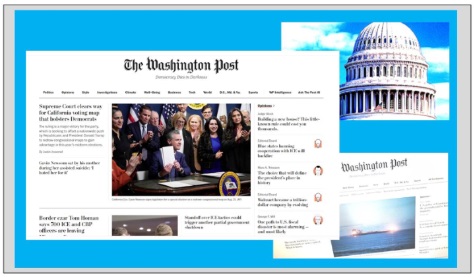
Screenshot of The Washington Post digital edition
Washington Post
to Cut 300 Staffers
| published February 4, 2026 |
By R. Alan Clanton,
Thursday Review editor
The Washington Post will cut some 300 jobs immediately, reducing its staff by about one third. The layoffs were announced Wednesday by Post owner Jeff Bezos and his firm Nash Holdings.
The Washington Post has been struggling in recent years to remain financially viable, and owner Bezos—who bought the venerable newspaper and its subsidiary publications in 2013—has been pressing Post management to return the paper to profitability. Both traditional print and online/digital subscriptions have declined in recent months.
The Post saw a previous round of staff cutbacks in 2023 when it offered buyouts and voluntary separation packages to some 200 employees, and another smaller wave of 100 layoffs early in 2025. During that two-year period, the newspaper lost millions of dollars each month. Post CEO and publisher William Lewis, who was brought aboard to stave off further hemorrhaging, has been unpopular with some staffers and writers for his sometimes controversial approach to handling the Post’s current fiscal challenges.
Most of the current layoffs are immediate. Among the most noticeable impacts: The Post will shutter both its sports department and its literary and books sections. Several podcasts will also stop immediately, and the Metro desk will be downsized substantially, cutting out some local and regional news. The Post traditionally has a large following in the neighboring suburban areas of Maryland and Virginia.
Rumors of cuts had been circulating since the start of the year, but the full impact of the 300 firings today left many journalists and employees bitter. Executive editor Matt Miller sent an internal memo to all employees early on Wednesday explaining the cuts, and many employees reported receiving emails or text messages in the wee hours suggesting they “stay home” until the complete list of those being fired could be collated and communicated.
In his internal memo, Murray said the “moves include substantial newsroom reductions impacting nearly all news departments.” Calling the layoffs a “restructuring,” Murray also told staffers that the cuts “will help secure our future in the service of our journalistic mission and provide us stability moving forward.” Murray also offered a slightly more detailed plan for shifting the newsroom’s priorities: less interest in sports, local, and foreign news; more focus on politics, national affairs, and technology and medicine.
Bezos had no comment himself about the layoffs. The Amazon founder and billionaire owns a large stake in several other major ventures, and his $250 million purchase of The Washington Post was seen by some as an opportunity for the newspaper to regain its financial footing and find ways to remain relevant in a digital age and in a time of increasing media fragmentation. During Bezos’ tenure as owner, the paper has seen a variety of management shifts and changes among its top editors.
Some former top Post editors, though lamenting the cuts and the drastic shrinkage, acknowledge the complex challenges many newspapers faced in recent years. Marty Baron, veteran editor of the Miami Herald and the Boston Globe before coming to Washington in 2012 to helm the Post, agreed that “there were acute business problems that had to be addressed. No one can deny that.” But Baron also said he was disappointed that this recent round of layoffs undercuts Bezos’ original pride-of-ownership in The Washington Post.
Founded in 1877, The Washington Post faced financial troubles off and on went through a variety of ownerships until it was bought in 1933 at the height of the Great Depression by Eugene Meyer. Meyer rescued it from bankruptcy and slowly rebuilt the business side of the paper. Later, Meyer’s daughter Katharine Graham, and Meyer’s son-in-law, Philip Graham, took ownership of the paper. Among their notable coups was the acquisition of several competing publications in the D.C. metro area and in neighboring Virginia, shoring up the Post’s subscriber base.
Among The Post’s biggest achievements: the paper won 76 Pulitzer Prizes, second only overall to the New York Times. In 1971, The Post published part of the so-called Pentagon Papers (first published for a few days by the New York Times), and later joined the Times in a lawsuit that moved quickly to the Supreme Court after the administration of then-President Richard Nixon sought an injunction against further publication of the Pentagon Papers.
The Washington Post was also arguably the most aggressive and thorough in its reporting during the Watergate scandals that would eventually lead to the resignation of Nixon in 1974. Under editor Ben Bradlee, Post reporters Bob Woodward and Carl Bernstein investigated and reported on Watergate almost continuously throughout the period between the June 1972 break-in at the Watergate office complex and Nixon’s resignation two years later.
In an interview with PBS's Geoff Bennett, former Post editor Baron says that the staff cuts will shut down entire departments, while "eviscerating" others, such as foreign news, local reporting, and most arts, books, and film.
While Baron commends the current editor and staff for doing a great job journalistically, he casts a doubtful eye on this latest set of moves. "They seem to have announced a new strategy just about once a year now, saying that it would better position themselves for the future. And none of those things have worked." Baron says that this current wave of layoffs will "diminish the coverage" and "offer less to their readers."
Related Thursday Review articles:
The Post Brings News & Political History to Life; By R. Alan Clanton; Thursday Review editor; February 8, 2018.
Tampa Bay Times Buys Tampa Tribune; Ends Two Paper Era; By R. Alan Clanton; Thursday Review editor; May 4, 2016.