
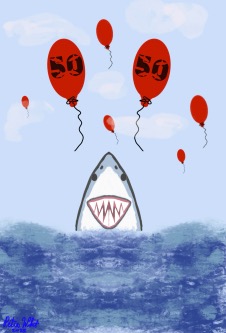
Image courtesy of Lisa Whitten
Jaws at 50:
How a 1975 Summer Blockbuster
Changed the Movies, and the Beach
| published August 5, 2025 |
By R. Alan Clanton Thursday Review editor
Five summers before we founded Thursday Review, I went with best friend John Herndon to the opening showing of Jaws in our hometown of Jacksonville, Florida. We were among the first to arrive that day, having staked out our parking place and a spot in the line only minutes before dozens—then scores, then hundreds—of others began to show up. Within an hour the parking lot was filled with cars and a line of people line stretched for hundreds of yards along a sidewalk on the backside of the Regency Square Mall, a single-file queue which was still growing by the time the doors finally opened. Mall security cops were directing the overflow cars to a Barnett Bank office parking lot adjacent to the mall, even as more people were trickling in from all directions. It was opening day of the movie Jaws.
That was 1975. That theater was demolished years ago. The bank sold, then, re-sold after decades of mergers. Even the mall became defunct, largely empty, and just recently sold again to a new developer after a brief resurgence of fame as a location for vaccines during the Covid-19 era. But the legacy of Jaws is stronger than ever. The original Jaws, which opened in June 1975, spawned what is arguably the biggest and most infamous recalibration of popular understanding of a species in the twentieth century, converting the shark into one of the greatest monsters of Darwinian evolution and setting in motion innumerable movie sequels, reboots, and competing film franchises unmatched even by dinosaurs and the all-time most dreaded apex predator, the T-rex (it’s not a coincidence that Steven Spielberg directed the box-office record-breaker Jurassic Park two decades after he made his fame with Jaws).
For millions of people, Jaws changed the way we looked at the beach, and altered especially our fears of what was out there in the water. Jaws also vastly impacted how Hollywood films are made, and shattered what was the traditional template for motion picture production, especially the Action/Adventure genre. Jaws also thrust Spielberg into the movie-going public sphere in a way that few previous directors had even experienced, largely because Jaws so greatly exceeded expectations by almost instantly becoming the biggest movie of the year, surpassing the big budget films with the A-Listers, including The Great Waldo Pepper (Directed by George Roy Hill and starring Robert Redford), Breakheart Pass (starring Charles Bronson), Barry Lyndon (directed by Stanley Kubrick; starring Ryan O’Neal and Marisa Berenson), and Walt Disney’s Escape to Witch Mountain, which made $20 million at the box office but another $8.5 in video rentals in the following decades..
To put this in perspective, consider this: shot mostly in Ireland, Germany, England and the Netherlands, the lavish and beautiful period piece Barry Lyndon cost $12.5 million to produce and brought in $20 million in sales during its original theatrical run. The original budget for Jaws was $3.9 million, but cost overruns, technical problems, and heavy marketing brought the final total to roughly $9 million.
Jaws, however, recouped all of that in less than ten days, and within two months had already exceeded $100 million at the box office. But it didn’t stop there: within 11 weeks, Jaws had toppled The Godfather from its perch as the number one biggest movie of all time, and set yet another record by early fall 1975 when it achieved 14 consecutive weeks as the most popular film in theaters. According to Box Office Mojo, Jaws is the 7th highest grossing film of all time (adjusted for inflation), and accounting for its re-releases in theaters—most famously in 1979—and its many overseas showings across Europe, Asia and South America, and subsequent video rentals beginning as early as 1979, Jaws has earned over $420 million.
After the astounding box office success of Jaws, Spielberg’s reputation as a director became forever secure, and gave him and other younger directors a broad path forward. Over the years Spielberg directed many of the movies we now consider classics, from Close Encounters of the Third Kind to E.T.: The Extraterrestrial, from Saving Private Ryan to Lincoln, from the Indiana Jones series to Schindler’s List. Likewise, composer John Williams himself became a household name after his famous score—and its iconic, foreboding two-note tension-builder—launched him to the top of his musical game. Spielberg and Williams forged a lifelong partnership, with Williams scoring all but five Spielberg movies. Indeed, Williams won an Oscar for his theme music for Jaws.
Spielberg had made his theatrical debut with 1974’s Sugarland Express, though his first major film is generally regarded as Duel, shot for television in 1971 but later expanded and re-edited for the theater markets. Sugarland Express was also Spielberg’s first full-fledged collaboration with Williams. And the successes of both movies prompted Universal and the producer team of David Brown and Richard Zanuck to consider the young Spielberg for what they hoped would be a commercial home run after they optioned Peter Benchley’s best-seller, the 1974 novel Jaws.
Coupled with Gorge Lucas’s Star Wars only two years later, the two films literally reinvented Hollywood and rewrote the book of how films were made. Indeed, that radical re-structuring the movie-making business model has endured to such a degree that for many film historians it has become its own undoing, substituting originality and inventiveness with a story franchise mentality that mandates the pursuit of high profit. For where in the middle 1970s Jaws and Star Wars represented a reboot of Hollywood, the legacy 50 years later may be how little things have changed since that summer we stood in those long lines waiting to see a monstrous, terrifying shark.
So what was it about Jaws that drew such crowds, and kept them packing into theaters for what was—up to that point—the biggest movie event in American cinema?
For starters, there was the plot. It was adapted straight from Benchley’s hugely successful novel, which in that first season sold more 125,000 in hardcopy form (eventually more than five million in paperback), and included additional marketing and after series of runs through the Book of the Month Club and a Reader’s Digest version. The screenplay for Jaws required very little tweaking or adjusting. Some book critics had balked at Jaws the novel: it was widely regarded as clumsy, dumbed-down, even poorly-written in places, with flattened characters throughout and an abundance of writing clichés. However, even hostile critics acknowledged the suspense and the terror, and agreed the book effectively seized upon one of those innermost human emotions, fear.
The novel also arrived at the great apex of American cultural escapism: the Vietnam War was coming into its final months, the Watergate scandal was in its penultimate moments (President Richard Nixon resigned on August 9, 1974), oil prices were spiraling upward, and a domestic terror group called the Symbionese Liberation Army robbed a San Francisco Bank accompanied by a machine-gun-armed Patricia Hearst. Many Americans just wanted to escape. A July Fourth-themed book written to read on the beach—and about the beach—seemed as effective an antidote to the dreary world as many readers could imagine. In 1974 only Watership Down stayed ahead of Jaws in books sales, though Jaws remained on The New York Times bestseller list for 44 weeks. We just knew that someone in Hollywood was waiting to grab this book (in fact, the producers had already bought the rights to the book even before the first editions of the book had been printed).
Then, there was the cast—the three principals, each likeable but each curmudgeonly in their own ways. Two were veterans, one American and one Englishman.
Roy Scheider had impressed millions of moviegoers with his appearance in The French Connection in 1971. The French Connection had swept the Oscars, winning for Best Picture, Best Director, Best Actor (Gene Hackman), Best Editing, and Best Screenplay. Scheider had been nominated (but did not win) for Best Supporting Actor. Robert Shaw had been acting and writing for decades, and much of his body of work was classical, to say the least, including a long list of Shakespeare’s works for film, TV and stage. He had, however, struck his best chord with American audiences with his portrayal of a sophisticated Chicago gangster named Doyle Lonnegan in Gorge Roy Hill’s masterful The Sting. Shaw had held his own in The Sting opposite a cast which included Paul Newman and Robert Redford, each at the top of their games.
And there was Richard Dreyfuss. After a very early career with small parts in TV shows and in a few movies—in 1967 he got one line in a bit part in The Graduate, and he played Baby Face Nelson in the 1973 Dillinger—Dreyfuss came to the attention of writer/director George Lucas, who gave him one of the key ensemble parts in American Graffiti, by some accounts the central part. Dreyfuss had also received uniformly positive reviews for his role in The Apprenticeship of Duddy Kravitz. By the time Dreyfuss appeared in Jaws, he had become one of the most likeable young actors in Hollywood.
One of Spielberg’s early decisions, against the advice of producers Zanuck and Brown, was to keep A-List names out of the cast, for Spielberg made it clear from the start that he wanted the shark to be the headliner, and he wanted no baggage to come along with well-known actors. Shaw, Dreyfuss and Scheider were established names, but they would not eclipse the source of the tension and the horror (Jon Voight and Timothy Bottoms were considered for the role of Hooper, as were Sterling Hayden and Lee Marvin for Quint). Furthermore, Spielberg realized from the start that to achieve the look needed to complete the film with a credible shark, he would need that money for special effects, not for big name actors.
Though the lack of chemistry screen between Shaw and the two others is, of course, deliberate in the beginning, the casting proved to be effective, with Shaw’s over-the-top portrayal of a curmudgeonly, irritable big game fisherman grating (literally and on a chalkboard in his first appearance before the town council and a room full of panicked citizens), but balanced neatly with the rich-kid-academic eagerness of Dreyfuss, and the pragmatic sheriff who simply wants the beaches to be safe and to prevent more lives being lost.
Aside from Benchley’s best-seller and the trio of cast members who portray the team in search of the killer shark, there is the genius of a summer movie with a simple, easily-grasped story: a monster is terrorizing a beach community whose annual economic fortunes hinge on the arrival of tourists on summer weekends. Toss in the Fourth of July, and a newcomer sheriff who left New York City for the small seaside town to get away from the stress of violence and crime.
And thus we come to the core of the simple story: Sheriff Martin Brody must contend with a gruesome death of a young woman killed by a shark a few days before the big holiday weekend. The town’s mayor, played by Murray Hamilton, is reluctant to close the beaches since this action will no doubt put a damper on the summer fun and by extension tourist spending. But after still another death by shark attack, this time in front of scores of people at the beach, Brody must act, with or without the consent of the mayor. An oceanographic expert named Matt Hooper (Dreyfuss) arrives just as town officials offer a bounty for the shark, and Hooper makes it clear that the shark which has done the killing is a Great White. A local game fisherman and self-styled shark expert named Quint (Shaw), offers to catch the shark, and though he prefers to do it alone, the sheriff insists that Quint include both Brody and Hooper on the expedition.
In short: there is a monster on the loose terrorizing a small town, and now the townspeople want the monster killed (a formula well-tested through decades of Hollywood history). The trio of shark hunters set off in Quint’s boat, which is now loaded with Hooper’s high tech equipment, including a shark cage. After eluding the hunters for a day or two, then, skillfully toying with them—imparting an unlikely mix of cunning, wisdom and strategic planning to a large shark—the monster arrives and takes over center stage. Brody immediately suggests they seek additional help, but Quint—now obsessed with killing the shark (hubris, another time-honored movie theme, and the core story of Moby Dick)—wants the team to bag the fearsome monster themselves without outside help. The struggle becomes, immediately, a fight to the death.
Spielberg’s ability to make this wildly entertaining was magical. But it was not without an epic challenge, and the movie was fraught with problems from the start.
By his own admission in years past, Spielberg’s naiveté and inexperience invited fearlessness. Among the challenges: he insisted on shooting most of the film on open water. Though this seems intuitive to most moviegoers, few films were actually shot primarily in the open seas: aside from the substantial cost, logistical issues, weather, unpredictable seas and tides, and inaccessibility of the typical land-borne resources of moviemaking had always limited “ocean” movies to only carefully chosen sequences at sea, or, the time-honored stock footage. Otherwise, water movies were shot in tanks, pools, tubs, enclosed bays, and crafted from special effects such as miniatures. Spielberg wanted none of this.
Perhaps the most legendary challenge was the shark itself. Jaws employed not one, but three mechanical sharks; two were built for side-only shots, basically a lefty and a righty, each with a lot of exposed hydraulics, wiring and robotic hardware. The third shark was what the team called the sea-sled mechanism, a full-sized replica which could be towed with steel cables, 90 foot lines designed to work at a depth lower enough to be concealed from most camera shots. All three sharks broke down more-or-less continuously, and many hours of time was spent with cast and crew waiting for repairs. Furthermore, the shark bodies were largely made of a spongy neoprene foam-composite material which—despite efforts to seal adequately—would quickly become saturated with water, spawning yet more wasted time as the foam was dried or replaced and the skin repaired and repainted. To create the look and movement of a real shark, all three models had a complex set of hydraulic and pneumatic systems for all features, including the body movements and the fearsome jaws. But these systems frequently malfunctioned. Seawater caused immeasurable damage to the mechanical features, and the sea-sled version often broke down due to being pulled through the water at speeds Spielberg deemed adequate to demonstrate the shark’s power. Much of the unseen hardware—those frames and fixtures and devices below the water line—became entangled in seaweed, and the sled itself got jammed and broken in the sea bottom; Spielberg and crew had deliberately chosen the waters off Martha’s Vineyard for their shallow depths, which would make production safer and less complex.
Filming had to be adjusted constantly to accommodate not only erratic weather and the (predictable) tides, but also background images, with other fishing boats or pleasure boats wandering into the shot. Also unpredictable was the water itself, with some days of shooting on calm waters following by days of choppiness. Even now these inconsistencies can be spotted by the careful movie fan, as action sequences include scenes of the boat Orca moving through choppy blue waves, then, in the next cut, passing along a glassy stillness; other scenes bear odd differences in the light, with scenes which feel like “golden hour” colors, and others with clear blue sky and cumulus clouds. The problems of continuity continued throughout all the outdoor shooting, but were especially troublesome on the open water. Cast and crew all complained of the 12 hour days, out of which only a tiny amount of footage would be shot. In all, the movie took three times longer to shoot than had been budgeted—nearly 160 full days—which further drove the cost upwards. Indeed, a few scenes had to be shot or re-shot later in MGM using stand-ins for Dreyfuss.
But in later years Spielberg acknowledged that the hardships and technical problems proved to be one of his most valuable learning experiences as a young director: after all was said and done and hundreds of feet of film was shot using the mechanical sharks, surprisingly few of the movie’s frames include the shark itself. Forced to edit creatively, Spielberg decided the tension worked better if we saw less of the shark, not more. In this minimalism, the monster became more fearsome. Some of the most terrifying scenes show only a fin cutting along the waterline, or a shadow moving through the water, accompanied by John William’s simple (now famous) two-note musical theme. Spielberg also found that the “shark’s eye perspective” proved equally terrifying for audiences, as the camera moves upward from the depths toward a swimmer’s legs and feet.
The movie did contain some footage of real sharks. These were mostly filmed in Australia by Ron and Valeria Taylor. Spielberg was careful to add these brief scenes where needed, but again, he decided that less-was-more, and used the real shark scenes sparingly, as a visual bridgehead between reality and the monstrous creature which struck terror in audiences in theaters.
Jaws also succeeded in large part because of Williams’ iconic score. Both for Spielberg and Williams, the collaboration was transformative, and Spielberg has often said that the movie would have been largely ineffective without the minimalist genius of those two notes played at varying cadences. Williams has acknowledged that when he first proposed that two-note ostinato, Spielberg thought it was a put-on, and then went on to suggest that Williams develop something with more melody and more elaboration. But after viewing a rough cut of the film, William was adamant: keep it simple and linear, and let those two notes serve as the continuous signature and tension-builder, forming more musical power atop the strident theme. Eventually, Spielberg caught the mastery of this approach, and deferred to Williams’ preferences. It was a decision Spielberg never regretted.
Over the decades many musical historians have pointed to classical echoes in the Jaws soundtrack: Stravinsky’s "The Rite of Spring"; Dvorak’s "New World Symphony"; other impressionists such as Maurice Ravel, Dimitri Shostakovich, and Frederick Delius. Furthermore, Williams took the musical minimalism a step-further by injecting audio “white-space,” sudden empty quarters of negative aural action in order to elevate the next round of tension. Indeed, some of the most effective visual moments in the film come when each build-up is then swept aside, leaving our three principal shark hunters staring across the empty sea, or gazing in silence, often with only sky or sea behind them. Wisely, Williams exploits this with musical stillness, a scoreless interval leaving only the ambient whispers of breeze or waves or water.
Again, this lent an escape path for Spielberg during the editing process, allowing for “less shark, more fear,” and making effective use of the dead space found after each flurry of excitement. By the time the audience witnesses the final, epic battle between men and killer shark, the music has done as much to prime us for the struggle as the visuals.
The music became one of the most famous soundtracks in American motion pictures. Williams won an Oscar for Jaws in 1976 (his second Academy Award since Fiddler on the Roof in 1972), and later that year a Grammy Award for Best Soundtrack. Sealing his collaborations with Spielberg for life, Williams was able to raise his game over and over again, with stunning musical achievements in many of Spielberg’s biggest achievements: Close Encounters of the Third Kind; E.T. the Extra-Terrestrial; Raiders of the Lost Ark; Schindler’s List; Saving Private Ryan.
After the initial editing was finally complete, Spielberg made only a couple of changes. One of the film’s most famous lines—uttered during a reaction shot as Sheriff Brody, having seen the shark lunge at him from the water, backs up in shock into Quint’s cabin (“You’re gonna’ need a bigger boat!”)—was drowned out by audience screams in two test screenings, the first in Dallas, Texas, the second in long Beach, California. Spielberg edited Scheider’s terrified backward walk to take a few seconds longer, enabling audience uproar to settle down and for the words to be heard with less distraction. Following Scheider’s deadpan delivery of the famous line, the scene sets-up our first full viewing of the true size and power of the shark as all three men look on in horror and amazement.
After a month of advertising and teasers, the suits at Universal made the decision to release the film without any more test screening or limited premiers. Jaws opened across the U.S. and Canada on June 20, skillful and fortuitous timing since the July 4 weekend was in ten days, a convergence that many thought lent more-than-the-usual level of audience excitement, if not experiential connection. A movie about a killer shark eating people on the Fourth of July! Most U.S. theaters reported packed houses throughout not only the first weekend, but the entire following week—and this included theaters which added additional early morning matinees and extra showing later at night. Within only ten days its gross surpassed $21 million, and it famously toppled The Godfather from its pedestal in 11 weeks. The movie was so successful, that before the end of that year Universal released versions in Japan, the U.K., New Zealand, Spain, and Mexico.
As is often the case the great movies, Jaws stands the test of time as a work of cinema, though it has famously withered under practically all forms of scientific and environmental scrutiny. Benchley himself regretted having vilified the great white shark, and for having spawned an entire epoch of fear crafted around a species which biologists believe predates the dinosaurs. The shark presented in Jaws was the perfect monster for its time: prior to Jaws, all cinematic monsters had had ranged from the classical to the highly dubious—and all in some way abstracted from our realities. Dracula, Frankenstein’s monster, werewolves, mummies, and the like, had come from our literary subconscious and from a place where ancient myths converged with great story-telling. After World War II and as we entered the nuclear age and the space race, the monsters of movie theaters morphed headlong into dysfunctional science and mutations run amok: oversized insects, unwelcome aliens, atomic giants, dystopian eruptions of creatures and zombies clawing from their graves, buildings toppling as panicked crowds run through the streets.
These were all fine formulas each in their own ways, and, well, at least a few of these themes made for decent movies, a rarer few for great films.
But sharks were real—a very real thing living in the same oceans where millions swam each day, and in that summer of 1975, as we all sat on beach towels and rubbed sunscreen or lotion on our arms and backs, and as we donned our sunglasses with the sea oats and dunes at our backs, most of us stared ahead into the waters and shuddered, dreading (perhaps only briefly) what monsters swam in those salty waters.
Related Thursday Review articles:
Superman The Movie at 40: How it Changed Our View of Super Heroes; R. Alan Clanton; Thursday Review; March 1, 2018.
Barry Lyndon: A Look Back at a Stanley Kubrick Classic; R. Alan Clanton; Thursday Review; Sept. 3, 2017.