
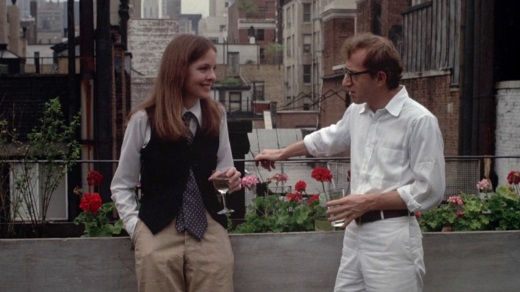
Image courtesy of United Artists
Diane Keaton:
A Film Legacy
Spanning 55 years
| published Oct. 14, 2025 |
By R. Alan Clanton, Thursday Review editor
For stage actress Diane Keaton, it was a short transition from her film debut in 1970 in Lovers and Other Strangers (a comedy which earned four Oscar nominations) to The Godfather in 1972 (the highest grossing film in U.S. history up to that point), but as a testament to her skill, she accomplished this metamorphosis seemingly without effort. Though her role in The Godfather was deemed by some critics as small, she would go on to land a part in the sequel, The Godfather Part II, a film in which her place in the family’s story becomes larger and stronger, a testament perhaps to writer-director Francis Ford Coppola’s intuition that Diane Keaton had much more to offer filmgoers.
Then, it was an even shorter walk to Annie Hall in 1977, the Woody Allen classic that was Allen’s most important cinematic turning point.
Seven years. Seven years total between a film debut and an Academy Award of her own—a Best Actress win for what many historians regard as one of the greatest and most groundbreaking comedies ever produced. For some movie buffs and film historians, that would just about wrap it up for anyone else working in Hollywood. The Godfather, Annie Hall. The greatest gangster-drama movie ever produced, and what some regard as the best film comedy ever written and produced. Not bad.
But Diane Keaton’s long and dazzling career was just getting started. She would collaborate with Coppola once again for The Godfather Part III, a sequel that—while not on the same grand scale as the first two installments—clearly offered Keaton an even bigger opportunity to take viewers into the spirit and soul of Kay Adams. And Keaton would collaborate with Woody Allen several more times, including Interiors (alongside Mary Beth Hurt and Kristin Griffith) which won five Oscar nominations, and in the 1979 landmark film Manhattan, one of the most beautiful black-and-white films ever produced, and a staggering visual achievement as well as great contemporary movie comedy..
Diane Keaton was born Diane Hall (yes, Hall!) in Los Angeles in 1946, another paradox for an actress for whom so many of her greatest parts placed her squarely in New York City. Her mother was an amateur photographer, an aspect of the character she plays in Annie Hall, and a hobby for which Keaton remained active throughout her life. Her father worked as both a civil engineer and a real estate broker in southern California (Keaton would later in her life dabble in real estate, buying homes, remodeling them, then putting tham back onto the market). And perhaps not surprisingly, her favorite actress on the big screen during her formative years was Katharine Hepburn—someone she admired for Hepburn’s strong-willed independent streak and her formidable roles in so many Hollywood movies where the men got the top billing.
Like many actors and actresses of the 1960s, she accepted the parts that paid. She worked in the Broadway production of Hair, but famously declined to perform nude in the final scenes. Keaton worked in other plays, earning a small amount of money, including a breakout role in Woody Allen’s Play it Again, Sam—a part she almost didn’t get because she was nearly two inches taller that Allen. She took small guest parts in a variety of TV shows, among them Mannix and Love, American Style.
Then, Francis Ford Coppola took note of her unique charisma—a quirky style and mannerism coupled with an inner strength—and decided she would be perfect to play Kay Adams, the long-suffering fiancé and wife of Michael Corleone in The Godfather. She would play alongside a heavyweight cast which included Marlon Brando, Al Pacino, James Caan, Robert Duval, and John Cazale—and, Talia Shire—a cast top-weighted with men in a movie about a male-dominated world. Some critics noted that her part was not merely subdued, but subsumed by the weight of the patriarchal narrative—perhaps intentional by writer Mario Puzo and by director Coppola. Others have noted, however, her pivotal performance in several scenes, including the film’s final frames, as she witnesses—and perhaps concedes with grim apprehension—the dark progression of her husband’s place in a world of criminality, from third son to Vito Corleone to head of the family. This sets the stage not only for her character, but for Keaton—the actress—to reprise the role in 1974.
By all accounts The Godfather Part II is the mightier and more potent of the two films—more operatic, more artistic, grander in its effort to tell an epic multi-generational story (see “Francis Ford Coppola’s Best Year,” Thursday Review, December 22, 2014). The second film also gave the character of Kay far more screen time, and this helped Diane Keaton’s stock rise considerably among filmgoers and among those in Hollywood who continually track great talent. During the next couple of years Keaton appears in another Woody Allen classic, Love and Death, a parody of Russian literature at its height and a send-up of the pretentious and overwrought themes of literary study. Love and Death also gives Keaton an even bigger opportunity to shine—alongside Woody Allen, and on her own. In 1976, Keaton appears in I Will, I Will…For Now, alongside Elliot Gould, and later that year in the period piece Harry and Walter Go to New York, with James Caan, Michael Caine, and (again) Elliot Gould. Neither film was a hit at the box office, and neither was particularly well liked by movie critics, and despite heavy marketing and an even heavier cast of stars, Harry and Walter managed to lose money. Nevertheless, Keaton was the standout from the ensemble.
Then, in 1977, Annie Hall arrived in theaters. Generally regarded as Woody Allen’s greatest masterpiece of comedy, the film not only shone brightly that year at the box office, it bowled over critics and soon established itself as a classic.
The film took a long time (nearly a year) to shoot and edit, even by the standards of low budget filmmaking—Annie Hall cost only about $4 million to produce, understandable since almost the entire film was shot on location in New York City and in other locales on Long Island. Co-written by Allen and Marshall Brickman, the story is told more-or-less backward, with an opening monologue by Allen—in his character of Alvy Singer—commiserating with the audience about his recent (and presumably final) break-up with Annie. Then, through a series of vignettes, we learn about his relationship with Annie, and about the failures or his other relationships and marriages. The story pairs the character of Alvy—nervous, insecure, self-conscious, prone to regret and awash in self-pity—with Annie, a ticky, ditzy, eccentric young woman with a fanciful preference for men’s clothing and a chattering speaking style. A waspy mid-westerner by birth—Annie nevertheless tries to forge her path through New York City. Alvy, by contrast is a true New Yorker, attracted almost immediately by Annie’s quirky style and easy-going nature. Their relationship moves in ebbs and flows as their styles and outlooks at time mesh, then, at other times clash. In the end they face an inevitable but somewhat friendly break-up, though both regard as a victory their endurance, and, perhaps, their efforts to scale the steep learning curve of romance and love.
Annie Hall is widely considered one of the funniest movies ever made, as well as arguably Woody Allen’s masterpiece. The film was nominated for five Academy Awards, and won for Best Picture, Best Director, Best Screenplay, and Best Actress, a stunning achievement for Keaton, who had only performed in her first movie role in 1970. Annie Hall also resides at position 31 on the American Film Institute’s list of 100 greatest American movies. The success of the film solidified Diane Keaton’s place in film history, and also ensured her an ability to choose her roles on her own terms.
Keaton would go on to enormous success over the next decades, including another quirky, unconventional role in Woody Allen’s next masterpiece, Manhattan. An unapologetic homage to New York City, the film was shot not only entirely in black-and-white, but using an aspect ratio of 2.35 to 1, meaning it would be a true widescreen experience. Working with cinematographer Gordon Willis, Allen developed a visual theme for the film that persists throughout the movie—not merely among the close-ups and medium shots needed for general movement and more intimate dialog, but also for the wider, deep-focus shots of the city itself. In a long, opening montage—accompanied by Woody Allen’s character’s (Isaac Davis) deadpan, faux serious monologue (he is a writer paying particular, if not exaggerated comedic homage to New York)—filmgoers are treated to what are arguably some of the most beautiful cinematic compositions of the city ever filmed, all it rendered alongside the full orchestration of George Gershwin’s Rhapsody in Blue.
Keaton’s character—not unlike her previous role as Annie—is something of a cypher to our narrator Davis. Keaton plays Mary Wilkie, a somewhat ticky, brash intellectual with a tendency toward what might be described as a fusion of Freudian and Leftist judgmentalism, which immediately grates on the nerves of Davis. Still, they are attracted to each other inevitably, and another chance encounter seals the deal, as it were. Each character is involved in other relationships, which sets in motion a four-way triangle of intermittent romance and cellular deception (Mary is the mistress of Isaac’s best friend Yale Pollack, who is married to Emily; Isaac is dating a much younger woman still in school). Keaton excels in this role, allowing herself to get immersed in the on-again-off-again complexities of the affair within an affair, while also dithering between her affection for Isaac and her morbid attraction to Yale, the married man. Keaton also imbued more strength and less weakness the role, despite the fact that the character she portrays is caught in a terminal loop between two men, each of whom have well-placed passions for their other women. Keaton displays effectively her character’s vulnerability as well as her character’s own constant reality checks, and this too is threaded with resonance into the film’s ongoing feminist themes and exchanges (the second chance encounter between Mary and Isaac is at a fundraiser for the Equal Rights Amendment, a museum event hosted by Bella Abzug).
For all its cinematic beauty, Manhattan surely would have fallen far short without Diane Keaton, and the film solidified her strength as a top-billing star. And though many fans of Woody Allen (and many film historians) regard Annie Hall and Manhattan as set pieces of a sort—two movies deeply connected to each other in visual style, comedic themes, and character development—Keaton’s role as Mary clearly stands apart from her earlier roles. Both films have not only stood the test of time, but continue to hold their places in the pantheon of filmmaking as American classics.*
Keaton went to many other memorable roles, including the part of Theresa Dunn in the screen adaptation of Judith Rossner’s hugely popular novel, Looking for Mr. Goodbar, a controversial story (at the time, and to a degree now) for its portrayal of a woman who teaches school by day, but spends her after-hours seeking to pick up men in New York City singles bars. Written and directed by Richard Brooks, the film also stars Tuesday Weld, Richard Kiley, William Atherton, and a very young Richard Gere. Though the movie received mixed reviews and even some scorn for its violent ending, Keaton received universally positive reviews for her part in the movie, her most serious part in her career.
Keaton also starred in Woody Allen’s Interiors, another much more dramatic part, and in Shoot the Moon (1982), alongside Albert Finney and Karen Allen, another tour de force critically, though the film did not perform admirably at the box office (it raked in only about $9 million against its $12 million production cost). The film tells of how a dysfunctional, collapsing marriage eventually impacts the children, each in different ways, and each involving different contending flashpoints. Keaton delivers a powerful performance.
Another of Keaton’s most memorable performances came in 1981 with the release of Reds, the sprawling, epic story of journalist and author John Reed. Based on true events, the story follows the activities and adventures of Reed (played by Warren Beatty) and his longtime circle of friends which includes political activists, writers and playwrights, journalists, and leftwing politicians. Spanning multiple locations and multiple countries (though the majority of the story takes place in the United States, Russia both before and after the Revolution of 1917, and Finland), and tracks the longtime relationship between writer/activist/feminist Louise Bryant (Played by Keaton) and Reed. Keaton shines in a cast which includes no less than Jack Nicholson as Eugene O’Neill, Gene Hackman as Pete Van Wherry, Edward Herrmann as Max Eastman, Paul Sorvino as Louis Fraina, and Maureen Stapelton in one her greatest performances as Emma Goldman, the activist, writer, and revolutionary. Keaton embraces the part so well and with such skill that we soon forget this is the same actress who played Annie Hall and Mary Wilkie.
Reds was not easy to produce. Time-consuming to film and complex, it greatly exceeded its original budget and on more than one occasion required creative financial measures to secure its completion. For Keaton, the effort may have been more difficult than that of any other cast member; she was romantically involved with Warren Beatty at the time shooting began, and Beatty—employing his prerogative as writer-director—turned out to be an exacting taskmaster, famously requiring many takes of the same scenes for many of the other actors. This resulted in shooting going far over budget on time constraints, but also in friction among the crew and cast members, with some becoming upset with the constant re-shoots (Paul Sorvino, Maureen Stapleton and George Plimpton all complained directly to Warren about his tyrannical perfectionism). Keaton, surely suffering the most from the many retakes and the obsession over the delivery of her lines, nevertheless gives a stunning performance, a testament to her inner resolve and her gifts as an actress.
Famously, Beatty shot everything, by the time principal shooting ended generating a massive amount of film to be edited (not including the scores of contextual “interviews” which interspersed as narrative transitions throughout the film), and according to most film industry sources, the raw film for Reds exceeded 2 million feet of film. Editing Reds would ultimately require scores of people working to sort out the morass of film and decide what to keep, and a full year to complete. By the time Reds was released, it ran for over 200 minutes, but after a few initial screenings, it was cut slightly, leaving the finished version at about 194 minutes. All told, filming and production had taken one year and had cost over $30 million.
Despite the film’s ponderous length—which under normal circumstances might greatly impact ticket sales—Reds broke even and managed to make a profit, though slight, with a box office total of about $40 million.
Reds also went on to enormous critical success. Diane Keaton was nominated for Best Actress in the Academy Awards, as well as receiving a Golden Globe nomination and a British Academy Awards nomination.
Keaton took on several serious roles in the 1980s, including Mrs. Soffel, based loosely on the true story of Pennsylvania prison inmates Ed and Jack Biddle, who escaped in part through the help of the warden’s wife; Keaton also took on the role of Charlie in the screen adaptation of John le Carre’s novel The Little Drummer Girl, the story of a complex scheme by Israeli Mossad agents to identify and then lure a Palestinian bomb-maker into the open.
But many of Keaton’s most memorable performances through the 1980s and 1990s were in romantic comedies or comedy-dramas. The list is formidable, and includes some of the era’s most famous and well-loved comedies: Baby Boom (1987); The Lemon Sisters (1990); Father of the Bride (1991) opposite Steve Martin; Manhattan Murder Mystery (1993), another film in which she teams up with Woody Allen (the movie also stars Alan Alda and Anjelica Huston); and The First Wives Club (1996), in which Keaton plays alongside Goldie Hawn and Bette Midler.
Her other huge hits throughout the 1990s and the aught years include: Marvin’s Room (1996) alongside Meryl Streep and a young Leonardo DiCaprio; the comedy Hanging Up, (2000), with Walter Matthau, Meg Ryan, and Lisa Kudrow; Town & Country (2001), a heavyweight comedic cast which includes Warren Beatty, Goldie Hawn, Andie MacDowell, and Gary Shandling; and 2003’s bloackbuster, Something’s Gotta Give, which pairs Keaton with Jack Nicholson.
Something’s Gotta Give proved to be a huge success with both audiences and critics. Though the film cost some $80 million to produce—a significantly large budget for a romantic comedy (Nicholson and Keaton each commanded relatively high salaries for their headline roles, and that of co-star Keanu Reeves)—the movie was a box office hit, raking in some $270 million. The movie is still popular on streaming services, and remains one of the most likeable “adult” romantic comedies of the new millennia. Many critics and reviewers noted that the chemistry between Keaton and Nicholson is so effective as to make it almost certain the movie would be a success; still others pointed out the obvious logic of paring those stars, since the characters they portray so easily fit the real lifestyles of the two leads. Written and directed by Nancy Meyers, the film remains a testament to the director’s skill, as well as the magic delivered by the movie’s two leads.
Keaton’s career covered still more comedy and romantic comedy over the next years, and her notable roles include those in the crime comedy Mad Money (2008); the drama-comedy Morning Glory (2010) alongside Harrison Ford, Rachel McAdams, and Jeff Goldblum; Darling Companion with Kevin Kilne; and Book Club (2018), in which she stars alongside several other top female leads, including Jane Fonda, Candice Bergen, and Mary Steenburgen. Book Club was extremely popular with audiences, and managed to rake in more than $100 million against its relatively modest $10 million budget.
All told, Diane Keaton appeared in some 65 films and dozens of television roles. She was also the author of several books, among them Then Again and Let’s Just Say It Wasn’t Pretty.
Diane Keaton—who was throughout her career famously private about her personal life—died on October 11, 2025 at age 79.
*As a personal note: I can wax poetic for hours about both Annie Hall and Manhattan, but I should disclose that I wrote a long-form paper on Manhattan for one of my film classes while a student at Florida State University; one day soon, I will dig it from my filing cabinet, spruce it up, and republish it here with apologies to Dr. Tom Hoffer, my professor for that film class.
Related Thursday Review articles:
2001: A Space Odyssey: Fifty Years Ago Science Fiction Changed Our World; R. Alan Clanton; Thursday Review; April 12, 2018.
Die Hard at 30: Come Out to the Coast, Have a Few Laughs; R. Alan Clanton; Thursday Review; Sept. 19, 2018.