
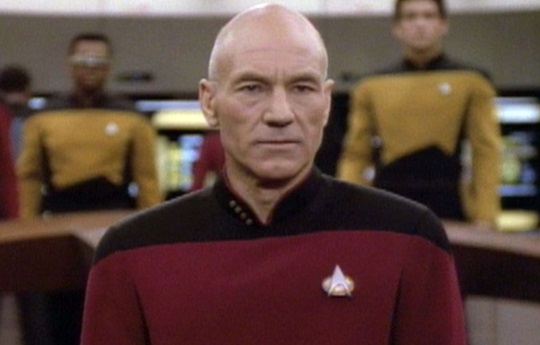
Image courtesy of Paramount Television
Patrick Stewart
and
The Great Reboot
| published October 30, 2026 |
By R. Alan Clanton and Sandra Jerome,
Thursday Review editors
As captain of the spaceship USS Enterprise he became nearly as famous as the face of his predecessor in a similar iconic role (the one played by William Shatner as Captain James Kirk), and by Hollywood TV standards, his role in that Star Trek reboot (technically, a sequel) was more successful, with some 178 total episodes (as compared to the original series with its mere 79 episodes).
Here’s some context: Star Trek (the original series) ran from 1966 to 1969, when it was unceremoniously killed by the execs at NBC. However, Star Trek: The Next Generation ran from September 28, 1987 to May 23, 1994, an astounding seven full seasons. The show’s enduring narrative kept audiences returning every week, and much of the show’s success was the astounding and commanding work of one actor—the man who portrayed Captain Jean-Luc Picard.
British actor Patrick Stewart passed away on Thursday after a long battle with Alzheimer’s disease and with Lewy Body Dementia. Stewart was 86.
The acclaimed Patrick Stewart cut across wide generational lines. For decades early in his career, he worked in classical theater and stage and film productions, and as a member of the Royal Shakespeare Company, appeared in numerous famous works and stage and on the screen, including Hamlet and Much Ado About Nothing. Stewart was not a household name when he appeared as Sejanus in I, Claudius, or as Vladimir Lenin in Fall of Eagles, or as the Soviet spymaster Karla in the BBC series Tinker Tailor Soldier Spy.
Stewart also starred in numerous Hollywood films, though often in supporting roles, such as John Boorman’s lavish and atmospheric Excalibur (1981), a visually stunning retelling of the Arthur legend, and in the equally lavish and big-budget Dune (1984), based on the classic sci-fi novels of Frank Herbert and directed by David Lynch.
Then came the long-awaited and much-promoted reboot of Star Trek for television, which, by the late 1980s had surpassed its cult following to become one of the most profitable movie franchises in history, and had by that time already drawn another generation of fans into its galaxy.
The Hollywood films had begun a bit creakily, with the not-so-well received Star Trek: The Motion Picture in 1979, a mega-budget retake on the original series with basically the entire original cast. At a cost of some $44 million to produce, it was one of the most expensive movies ever made. Still, despite some complaints about the film’s unsteady pacing and shaky narrative, it was a success. After that, the franchise grew with a long series of sequels using the same cast, and each film became a reliable money-maker for all involved, with Star Trek II: The Wrath of Khan and Star Trek III: The Search for Spock particularly noteworthy for quality and special effects.
By the middle 1980s, the original Star Trek series had become the most successful rerun franchise in television history, surpassing every other profitable rerun, from I Love Lucy to Andy Griffith to Bonanza, and in the expanding world of cable TV and videotape rentals, the executives at Paramount understood they would not damage the profitability of the movie juggernaut, meaning it was time to consider morphing that legacy into television.
So when creator Gene Roddenberry and Paramount Television began developing the next TV series, there was an understanding that the show must be both visually dazzling and filled with the sort of set and design elements that would meet the expectations of the increasingly demanding Star Trek crowd, as well as sci-fi fans in general. Still, there were some risks. Enter Patrick Stewart.
Stewart had lowered his expectations for Star Trek: The Next Generation. Not only was he unsure about working in American TV, he was reasonably certain—based on the short lifespan of the original Star Trek series—that the show might implode, possibly within only one season. Even with science fiction growing into its new Golden Age, a retreat of the original concept might be too much for audiences fully singed by the movie theater overload of the Star Wars franchise (by then an even bigger money maker), and scores of other sci-fi films.
Stewart did not think the gig would last long. He was wrong.
In addition, Stewart was grouchy, curmudgeonly, and imposing while working on those first dozen or so episodes: his classical stage training and his rigorous work ethic had taught him to memorize his lines, understand his role, and slip into his method before he arrived to work each day, which for Star Trek: The Next Generation meant showing up sometimes as early as 4:45 a.m.
Many of his American counterparts played it fast-and-loose with rehearsals and with shooting, a workplace culture which shocked and irritated Stewart, who once famously shouted to them “We’re not here to have fun.” But, eventually Stewart settled into the group comradery, and according to some of the other cast members, Stewart’s imposing work ethic set the standard for the others, who quickly grew to respect Stewart’s stout dedication. The outcome of that is clear from the chemistry seen in the show, which combined state-of-the-art special effects and graphics with innovative set designs with a cast of characters far more complex and resonant that what had been developed for the original series. As captain of the new Enterprise, Stewart’s commanding presence as Picard became the glue which held all of it together.
Star Trek: The Next Generation became a huge success, itself spawning television spinoffs and several large budget movies. Though Paramount had originally hoped for eight full seasons, the show was canceled after seven; the decision was not due to poor ratings, but instead reflected Paramount’s belief that more cash could be made producing movies. This brought Stewart’s commanding presence as Captain Picard to theater audiences across the world, and may have expanded the fan base even further. Eventually Stewart starred in four Star Trek films.
A few years later, Stewart would again successfully merge into another great franchise, the much-praised X-Men series of films. Stewart got the role of team leader Charles Xavier—mentor, shepherd, in fact founder—of the group of hyper skilled mutants who become super heroes under his patient tutelage. Again, the role was not necessarily what Stewart would have preferred for his Shakespearean background and his classical training, but—somewhat stuck in his career as having been typecast as the indomitable Picard—he reasoned that as Xavier, he might find a way to build a path back toward a greater diversity of roles, and different challenges.
The X-Men films were themselves hugely successful, despite a few critical ups-and-downs. Based on characters created by Stan Lee and Jack Kirby in the 1960s, the aught year films became some of the box office hits, and the overall franchise became a massive success.
During these years, Stewart was able to take on more roles that pleased him, including more drama and more iconic parts, among them: Ebenezer Scrooge in the 1999 version of A Christmas Carol; the father of Hamlet in ghost form in the 2009 film which starred David Tennant as Hamlet; King of Texas (2002), an American western loosely modeled after Shakespeare’s King Lear; and Tobi Powell in Match, a suspense-drama directed by playwright Stephen Belber.
Stewart’s career flourished in the decades of the New Millennia, so much so that it became another very large chapter within his already-large body of quality roles and performances. And these years enabled him to move effectively past what could have easily been a long stagnation at the hands of the mega-franchise that Star Trek had become.
Some regard Stewart’s final chapter as his best, and the sort of reboot that every acting career deserves.
“For my money,” explains Thursday Review film and literary editor Sandra Jerome, “Patrick Stewart's best work came toward the end, right alongside the fresh energy of the broader modern Star Trek era like Strange New Worlds."
"It's hard to believe," Sandi writes, "that a kid who grew up in Yorkshire without an indoor toilet, and who lost all his hair to alopecia by age nineteen, would turn into one of the most commanding actors of our time. His early fear of hair loss was wiped away when a drama teacher famously tackled him and yanked off his toupee, forcing him to own his natural look. That bold, iconic presence launched a legendary career from Shakespearean theater to Captain Jean-Luc Picard in The Next Generation. But seeing him in this late-career era showed an unbelievable level of emotional depth, quiet authority, and warmth that proved his craft only got richer with age. Be sad, Make it so!"
Related Thursday Review articles:
Remembering Robert Duvall: A Look Back at a Great American Actor; R. Alan Clanton; Thursday Review; February 16, 2026.
Diane Keaton: A Legacy Spanning 55 Years; By R. Alan Clanton, Thursday Review editor; October 14, 2025.