
Image courtesy of Zoetrope Films/
United Artists
Remembering
Robert Duvall:
A Look Back
at a Great
American Actor
| published February 16, 2026 |
By R. Alan Clanton
Thursday Review editor
His career spanned almost seven decades and included acting in some of the most famous roles in movie history, and, in several of the most acclaimed films of the twentieth century, including The Godfather, The Godfather Part II, Apocalypse Now, and Network.
Robert Duvall died this week at his Virginia home at age 95, quietly, and surrounded by loved ones, according to a statement released to the media by his wife Luciana Duvall. The statement, which came first on social media, did not provide a cause of death.
Duvall was an actor with an astounding range and a powerful screen skillset that placed him in over a hundred movies, and many of the best films ever made.
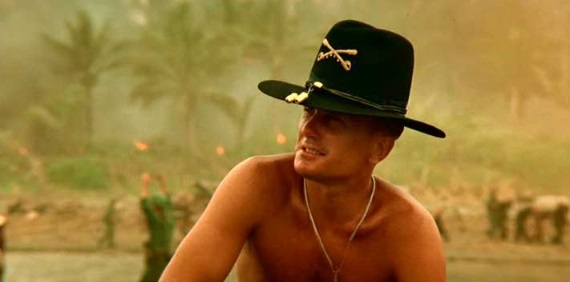
Among his most memorable roles: Tom Hagen, adopted brother, lawyer, and consigliere to Mafia boss Vito Corleone in the powerful Oscar-winning Godfather films; Lt. Col. Bill Kilgore in Francis Ford Coppola’s Vietnam masterpiece Apocalypse Now; Major Frank Burns in Robert Altman’s landmark M*A*S*H; country western singer Mac Sledge in Tender Mercies, a role for which Duvall won an Oscar; and ruthless corporate executive Frank Hackett in the film Network, written by Paddy Chayefsky and directed by Sidney Lumet.
Duvall was an actor’s actor—a changeling and a shape-shifter so skilled at immersing himself in his roles that even the directors with whom he worked were simultaneously dazzled and chilled by Duvall’s capacities. For the film Tender Mercies, for example, director Bruce Beresford recalled in the documentary Miracles & Mercies that “Duvall has the ability to completely inhabit the person he’s acting. He totally and utterly becomes that person to a degree which is uncanny.” Other directors, producers, and many fellow actors often expressed a similar professional judgment about Duvall, even noting that Duvall was hard to get to know once he had slipped into his character’s personality.
Legendary director and writer Francis Ford Coppola—with whom Duvall worked on numerous films—was more direct in his praise, telling the entertainment press in the 1970s that Robert Duvall was “one of the four or five best actors in the world.”
But sometimes to Duvall’s frustration, he was often cast in the number two billing for scores of his most iconic parts, a casting tendency that prompted People magazine in the late 1970s to dub Duvall “Hollywood’s Number One Number Two lead.” Still, by the 1980s, Duvall was gaining a few top-billing parts in slightly smaller films, among them the aforementioned Tender Mercies. Duvall gave the part every ounce of his passion and his skill, and the result was an Academy Award for Best Actor for his portrayal of singer-songwriter Mac Sledge. As a testament to his immersive style, Duvall insisted (legend has it he required it be written into his contract) that he perform his own singing for the movie, which he did.
Duvall’s shape-shifting—especially when viewed over the long arc of his career—can even now bring about chilling reminders of the first time one watched him in his most iconic roles. Duvall’s performance as Lt. Col. Kilgore in Apocalypse Now remains one of the most mind-blowing of all American film—a set of scenes which very nearly steals the film and all the scenery as well, and includes—after a brutal and violent helicopter attack on a village believed to be occupied by Viet Cong soldiers—one of the most famous movie monologues ever, a strangely revelatory passage which sums up the dark ironies and the illusive objectives of modern war.
His performance in Network was nothing less than staggering. As Frank Hackett, a corporate overlord tasked with turning around the news division of a fourth place network after the network’s takeover in a major merger, Duvall morphs into an aggressive, ruthless cost-cutter with little sympathy for any goal other than pleasing the parent company’s board of directors. Some film critics noted Duvall’s “shark-like” persona and his restless, impatient body language—something few actors could have accomplished with such ease. Watching Duvall performing in scenes alongside fellow cast members Faye Dunaway and William Holden—to name but two from Network’s stellar cast—is still a marvel to behold. Network effectively nudged Duvall’s Hollywood stock even higher. Still, though Network raked in four Oscar’s, including Best Actress to Dunaway and Best Supporting Actress to Beatrice Straight—none went to Duvall.
He rarely wasted time on bitterness or frustration, however, and strode continuously forward in a lifelong career that earned him the respect of hundreds of his colleagues and fellow actors.
Robert Selden Duvall was born in 1931 in San Diego, California to parents Mildred Virginia Hart, a part-time actress, and military dad William Howard Duvall, who retired from the U.S. Navy at the rank of Rear Admiral. He acknowledged he did not do well in school, and had little interests in any subjects or out-of-school activities. He lived the early part of his life in military towns like San Diego and Annapolis, Maryland before serving in the Army during the Korean War. By Duvall’s own admission, he saw very little action, but later grabbed a few small roles in on-post theater productions from time to time, including a choice part in the play Room Service while stationed at Camp Gordon in Georgia, where he appeared for several nights on stage in Augusta. He also picked up any local or regional acting gig he could find, appearing on small stages in Long Island, many of these plays staged at the famous Gateway Playhouse (also sometimes referred to as the Performing Arts Center of Suffolk County) near Bellport, New York.
Duvall was also able to use his G.I. Bill benefits to attend acting classes with the legendary Sanford Meisner, where Duvall met other very young newcomers James Caan, Gene Hackman, and Dustin Hoffman, with whom his friendships would remain intact for many decades.
Duvall continued to perform on stage, taking any parts he could get while working part time—like many young actors and actresses in their early days—at other jobs as a way to pay the bills and maintain an apartment. Duvall worked at a local post office, and drove a delivery truck. But Duvall was undaunted and determined to find his path forward. Eventually, in 1959, he landed his first television part on CBS in the Armstrong Circle Theater (its productions were originally on NBC, but CBS picked up the anthology in October of 1957) in an episode called "The Jailbreak." Within months, Duvall was able to pick up other roles in the rapidly-expanding world of TV, where new content was needed on an almost continuous basis.
And like a lot of young stars, he worked in all the usual venues, appearing in multiple small roles and guest roles on shows like Alfred Hitchcock Presents, Route 66, The Outer Limits, The Twilight Zone, The Fugitive, and Combat!.
Most movie historians point to Duvall’s catalyst into film as his appearance in 1962’s landmark film To Kill A Mockingbird, the movie adapted from the hugely successful book by Harper Lee, which had been published just two years earlier. Duvall was cast as Boo Radley, a reclusive mute who lives in the same small Alabama town as the storyteller (Scout) and her family and friends. As a testament to Duvall’s acting skills, he spoke no lines, yet his character proves pivotal in the penultimate moments of the movie. Duvall is not listed on the contemporary movie posters or advertising materials from 1962, and even some of Duvall’s biggest fans are surprised to learn that he had a part in the film.
Later, while still picking up small parts on movies and in television, Duvall would gravitate toward the fledgling work of independent directors and producers—some of whom would later begin to shatter many of the conventional business models for how films are made. Duvall appeared alongside James Caan in the 1967 sci-fi movie Countdown, directed by Robert Altman, and in the 1969 film The Rain People, written and directed by Coppola, and starring James Caan and Shirley Knight. The crew of The Rain People included a very young filmmaker named George Lucas, and other film practitioners who would become loyal to Coppola or to Lucas as their filmmaking careers exploded. Indeed, in1971 Duval would appear in Lucas’s Orwellian dystopian Sci-Fi movie THX 1138. In all these films, Duvall would disappear into the characters he portrayed, delivering performances that seem both effortless and indelible.
In 1969, Duvall would be cast in the landmark American western True Grit, directed by Henry Hathaway and based on the novel by Charles Portis. Duvall would have the role of Lucky Ned Pepper—leader of an outlaw gang on the old west—and this would place him opposite no less than John Wayne and Glen Campbell, U.S Marshal and Texas Ranger respectively. This would also put Duvall in the climatic gun fight near the end of the movie. Those involved with the filming say that director Hathaway and actor Duvall had their arguments and disagreements, though all those who worked with Duvall—Strother Martin, Kim Darby, Dennis Hopper, and others—agreed that Duvall was so deeply immersed in his Pepper character that it was hard to see or hear Duvall himself.
Duvall fell in closely with Coppola in the 1970s. His two most famous roles—as Tom Hagen in The Godfather and The Godfather Part II—secured his place in film history. In addition to the awards both films garnered, the first installment became the biggest money-maker in Hollywood history (it would be surpassed by Jaws a few years later), and The Godfather Part II would become what many regard as one of Coppola’s greatest masterpieces. Both films solidified Coppola as a master filmmaker and Duvall as one of the greatest American actors.
Duvall’s total devotion to the roles he took in movies included the sort of pre-shooting prep most actors wouldn’t dream of. As an example, for Tender Mercies, his preparative work ethic included famously driving with a friend all around parts of Texas seeking to glean the particulars of different Lone Star State accents and mannerisms in bars and restaurants and truck stops. Duvall used such methodologies to slip more completely into the characters he portrayed, seeking to absorb body language, dialect, hand motion and eye contact, and even facial tics into his performances. This shape-shifting gave him the on-screen power to oftentimes transcend his own less-than-classical looks as if he had put on a physical mask or undergone facial reconstruction, which clearly he had not. The tanned, chiseled, commanding, handsome chin and jaw and fearless glint of Lt. Col. Kilgore in Apocalypse Now was not so much the work of cinematographer Vittorio Storaro, as it was Duvall’s astounding skill as a changeling—immersing himself into the surreal role of that Air Cavalry commander at the height of an even more surreal war.
Likewise, we forget (and not because he was uncredited) that Duvall played that tormented CEO in Coppola’s masterful The Conversation (1974), a scant few scenes in which the imperious corporate leader of so few words pays surveillance expert Harry Caul (played by Gene Hackman) for his dirty work, and then sends him away as he darkly mulls the evidence of betrayal so meticulously prepared by Caul.
And Duvall earned a well-deserved Oscar nomination for his portrayal of Marine pilot Lt. Col. Wilbur “Bull” Meechum in the film The Great Santini, set in the early 1960s in South Carolina. Based on the award-winning 1976 novel by Pat Conroy and a screenplay by Lewis John Carlino, the film tells the story of an alcoholic, hardened war hero without a war, except that within his own family, whom he often treats as if they were military recruits. Though the film was very well received by critics, its release and distribution was problematic: executives with Warner Brothers were so flummoxed by Pat Conroy’s title, that they attempted variants on the movie’s name in different cities. Later, when it became apparent that the film was not going to perform well under any title, some of the studio execs blamed what they perceived as weak casting, especially since Duvall had not yet risen to top-billing status in their judgment. When Warner Brothers finally balked at the film’s potential to lose money, production company Orion pulled the film from theaters, then sold the rights to HBO, several laser disc companies, and even to commercial airline companies in an effort to recoup what would have been substantial losses.
Only after The Great Santini began to gain traction with viewers on cable TV did its legendary quality come to the attention of even more critics. Within a few years the film became a sort of cult classic—a gem of a movie which had the odd distinction of having spent precious little time on movie screens. And, despite the release problems and the back-and-forth about the movie’s title, The Great Santini racked-up numerous accolades, among them an Academy Award nomination for Best Actor for Duvall, and Best Actor nominations in both the New York Film Critics Circle Awards, and the Montreal World Film Festival Awards.
Again, Duvall had shifted into the role of “Bull” Meechum so completely, that even now first-time viewers of The Great Santini are stunned when the realize they are watching actor Robert Duvall. And the critical success of The Great Santini—long after the film had briefly foundered in theaters—can be almost entirely attributed to Duvall’s skill as an actor. (Conroy’s novel also benefitted mightily from the slow but steady growth of the movie’s popularity, as it sold more after the film’s release than it had between 1976 and 1979).
Despite his dazzling success in classic films like The Godfather, Network, and Apocalypse Now, Duvall often told reporters that his favorite role was one of his most subdued and understated—that of retired Texas Ranger Capt. Augustus “Gus” McCrae in the epic western mini-series Lonesome Dove. Starring alongside a stellar cast which included Tommy Lee Jones, Diane Lane, Anjelica Huston, and Danny Glover, Duvall commands his best persona yet, and is able to remain a transfixing character at the center of the epic narrative, which aired in four parts on CBS in early 1989. Lonesome Dove, based on the novel by Larry McMurtry and directed by William Wittliff, was a huge success for CBS (it drew between 35 and 44 million viewers during its initial airing), and for Duvall, placing him squarely in the sort of top-billing role he had so long deserved. Lonesome Dove also toppled the previous mini-series viewership record set by War and Remembrance (on ABC) the year before. This sealed the deal, as it were, for Duvall, whose tireless work ethic combined with his star power to give him far more control over his options going forward.
This very issue would come into play before the year was to end. After complex and circuitous negotiations, and ending his longstanding edict that he would make no further Godfather movies, Francis Ford Coppola—facing some degree of financial difficulty—finally agreed to Paramount’s request to tackle another Godfather film. As in the first two installments, Coppola would work with Mario Puzo to write the screenplay, and he would direct it himself. But casting issues had to be settled, since the third installment could not move on until some of the original cast members were secured. Diane Keaton, Talia Shire, Richard Bright, Al Martino, and a few others from Parts I and II were secured, along with Al Pacino, who was promised an astounding $8 million to reprise his role as Michael Corleone. But when Duvall was approached and offered $2 million, he balked. He later told 60 Minutes that he understood that Pacino would receive higher pay for his crucial reprise of Michael, but that he found it unacceptable that he (Duvall) would only be paid one fourth what Pacino was to be paid. In the end Duvall demurred, and Coppola was forced to write the character of Tom Hagen out of the storyline. Duvall said he never regretted the decision, but The Godfather Part III would suffer from a narrative standpoint without the Hagen character.
Duvall’s career would include many memorable, indelible roles in classic films. He played cynical sportswriter Max Mercy in the Barry Levinson’s beautiful and atmospheric mythic-baseball film, The Natural, alongside a dazzling cast which included Robert Redford at Roy Hobbs and Glenn Close as Iris Gaines. Duvall also appeared as veteran LA police officer “Uncle” Bob Hodges in the 1988 police action drama Colors, directed by Dennis Hopper and based on the story by Richard Di Lello. Starring alongside Sean Penn, this was another role in which the immersive Duvall studied the talk, the moves, and the cultural body language of Los Angeles cops before the shooting began. The movie’s story centers on two police officers who attempt to tamp down street violence and gang action between LA’s largest rival gangs, the Crips and the Bloods.
One of Duvall’s most memorable roles was as editor Bernie White in the 1994 newspaper drama-comedy The Paper, acting alongside an ensemble cast that included Michael Keaton as metro editor Henry Hackett, Randy Quaid as columnist Michael McDougal, and Glenn Close as managing editor Alicia Clark. Duvall so completely takes on the role as editor that he appears to have come with the building which the (fictional) New York Sun has its offices. Not only did director Ron Howard spend time in the newsrooms of real papers, The New York Post and The NY Daily News, but so did Duvall, who wanted to make certain his character fully embodied the hard-bitten, pragmatic news veteran that was editor Bernie White.
But, no look back at the life of Robert Duvall can be complete with mention of The Apostle, the 1997 quasi-Southern Gothic look at the life-changing events in one smalltown preacher’s life. Written and directed by Duvall himself, the film also stars Farrah Fawcett, Billy Bob Thornton, John Beasley, June Carter Cash, and Walton Goggins. Produced on the relatively small budget of $5 million, the film would earn $21.3 million. The film was an huge success and won over critics, and it secured Duvall’s place also as a writer-director of high caliber independent film. Duvall plays in the central part, that of Pentecostal preacher Euliss “Sonny” Dewey, who has learned his wife is having an affair with a younger man in the same church congregation. After a series of confrontations, Sonny kills his wife’s suitor by beating him with a baseball bat at a local ballpark. Sonny leaves everything behind, flees his small Texas town, and starts his life over as a penniless wanderer in Louisiana. The Apostle is Duvall at his best, immersed—sometimes literally—in the role of a man seeking redemption, and eventually forgiveness, as a way to start his life over despite a terrible deed.
Filled with gospel music and country music, the film is a remarkable gem (it includes music performed by Lyle Lovett, Johnny Cash, The Gaither Vocal Band, and a song sung by Emmylou Harris and Duvall himself; the soundtrack reached number four on the U.S. Christian music charts). The Apostle was a remarkable film, and—based on its robust earnings—popular with both religious as well as entirely secular audiences. Writing in The Christian Science Monitor, reviewer Robert Marquand called the movie a “phenomenon—an usual achievement for a film that deals directly with religion and redemption.” Marquand went on to suggest that even religious scholars were impressed, with some declaring Duvall’s masterpiece “the first authentic portrayal of a religious style whose believers are a large, growing subculture in the United States.”
Duvall’s passion for making The Apostle dates back to his younger days when he witnessed church services and revival meetings in rural Arkansas—and in much of the cultural eavesdropping and regional immersive study he had done for decades for movies like Tender Mercies. In some ways he had always wanted to make just such a film. Duvall found the challenges substantial, however, since no major studios and few producers wanted to be a part of what they deemed an overtly spiritual story. So Duvall financed it independently, much of it with his own money, and kept the budget small by keeping the production costs low. As is sometimes the case with very small, tight-budget films—when placed in the hands of a visionary artist—the modest budget begets simplicity of storytelling, which invites a closer look into the human soul. (For example: Breaking Away, written by Steve Tesich and directed by Peter Yates, cost only $2 million to produce, but generated $21 million in revenue; an even more dramatic example can be found in George Lucas’s American Graffiti, which cost less than $800,000 to produce, but raked-in some $140 million).
Duvall was also Kevin Costner’s first—and reportedly only choice—for the role of “Boss” Spearman in the beautifully-shot western Open Range, which was released in 2003. Based on the novel by Lauran Paine, and a screenplay by Craig Storper, Open Range is a lyrical, poetic, revisionist Western produced with a meticulous eye for the beauty and ruggedness of the old American West. The film is considered both a artistic success for director Costner (who also starred in the movie but gave Robert Duvall top billing), but another astounding example of how deeply Duvall could vanish into the characters he portrayed. Like many classic westerns, this handsomely produced revisionist variant still includes a penultimate showdown—in this case a protracted violent gun battle in the small Montana town where much of the action takes place. The film is also a love-story in making, and Duvall plays a pivotal role in mentoring his colleague Charley Waite (Costner), on the ways of human contact, attraction, and love in a world of gunplay and hardscrabble life; Costner’s character is drawn towards, then, falls in love with Sue Barlow, the sister of the town’s doctor.
Duvall’s performance in Open Range is so believable that we forget we are watching Robert Duvall, and we slip inexorably under his spell as the wise, grizzled, somewhat ragged mentor that he portrays. Costner has joked in interviews that if he had not been able to secure Duvall for the role of Boss Spearman, he may not have had the stomach to complete the movie. Peter Bradshaw wrote in The Guardian, “Duvall gives his best performance in ages.”
Over the decades, Robert Duvall appeared in hundreds of movies. Others not previously mentioned here include A Civil Action (1998), The Judge (2014), Gone in 60 Seconds (2000), Sling Blade (1996; written and directed by Billy Bob Thornton), and Days of Thunder (1990) alongside Tom Cruise.
Related Thursday Review articles:
Reflections Upon the 40th Anniversary of Apocalypse Now; R. Alan Clanton; Thursday Review; January 25, 2019.
Go Set a Watchman; Harper Lee; Book review by Karen Franklin; Thursday Review; August 30, 2015.