
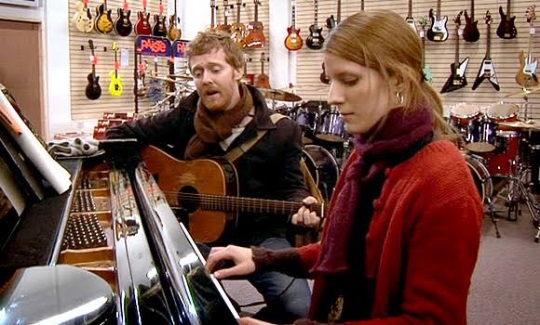
Image courtesy Samson Films/Irish Film Board/RTE
Retrospective
Once: A Small Film
That Changed How
I Heard My Own Life
A review, and a remembrance
of Glen Hansard (1970-2026)
| published September 7, 2026 |
By Sandi Jerome,
Thursday Review contributor
I need to say this up front, because it changes the way I'm writing everything that follows: Glen Hansard is gone. He died on July 29, 2026, in a motorcycle accident outside Dublin. He was 56. In the days after, tributes came in from Bruce Springsteen, Bono, Billie Eilish, even Barack Obama, who opened his summer playlist that year with Hansard's "Song of Good Hope."
"It starts with a song Michelle and I love by Glen Hansard, a great musician who passed tragically this week. Our hearts go out to his family."--Barack Obama
Fans gathered near Grafton Street; the same corner where he used to busk and sang "Falling Slowly" together. So did Broadway performers at a memorial in Dublin. Don't watch it on YouTube if you don't want to cry. It's strange to write a movie review as an obituary, but for me the two things can't be separated anymore.
I took my four granddaughters to see Glen and Markéta during the Swell Season tour in Eugene, Oregon about 17 years ago. I didn't know, watching them that night, that they'd carry it with them, but when the news of his death came, they were shaken by it. That tells you something about what Hansard did on a stage. It wasn't a performance you watched. It was one you were a part of.
Once was written and directed by John Carney, who used to play bass in Hansard's band, The Frames. It was shot in Dublin in 17 days on a budget of roughly $150,000, which is practically nothing by film standards. The plot grew directly out of Hansard's own life as a teenage busker on Grafton Street. Hansard played the part essentially as himself, opposite Markéta Irglová, his real-life musical partner in the Swell Season. A fantastic scene is when Irglová's character walks home from the shop late at night in her pajamas, listening back to his song on a CD player and quietly writing her own lyrics to it as she walks. The song that comes out of that walk is "If You Want Me," and it's one of the most understated, devastating moments of songwriting-as-plot I've seen in any film. Nothing about that scene is staged for spectacle. It's just a woman discovering, in real time, what she wants to say. She's funny too—my husband and I often refer to our vacuum cleaner as the "Hoover sucky thing."
That's the thing that makes Once work: it isn't actors performing songs written for a script. Hansard and Irglová wrote the music together, out of their own actual creative relationship, and the film just pointed a camera at it. The budget was tiny and the box office ended up over $20 million worldwide. It won the World Cinema Audience Award at Sundance, and "Falling Slowly" won the Academy Award for Best Original Song in 2008. It was written, as Irglová said in her acceptance speech, "from a perspective of hope." For what it's worth; that song stayed with me at a point when my life felt like a sinking ship; it doesn't resolve the ache, it just keeps you company inside it, verse after verse, until you're somehow steadier for having lived it. If you want to hear it, just search on YouTube for one of the performances including one where Hansard brings out Rachel Zegler at a Bowery Ballroom show in April 2026 to sing "Falling Slowly" with him. It was one of his last performances before his death that July. Zegler posted afterward: "Oh I will love you forever."
That shoestring film also became a Broadway musical that won eight Tony Awards, including Best Musical. Not bad for something made for less than the catering budget of a studio picture. The best part is that Once refuses the ending Hollywood would have insisted on. Spoiler alert; the two leads don't end up together. Instead, he goes to London to try to record with the band she's helped him assemble; she stays in Dublin with her family. What they exchange isn't a declaration; it's a piano, bought with money he leaves for her, so she can keep making music after he's gone. It's a love story that ends in two people going on with their separate lives, made better and braver for having crossed paths. That restraint is the whole point. A tidier ending would have cheapened everything the songs had already said honestly. You can watch Once on Broadway HD - but I wouldn't be surprised to see it in theaters again; they had quite a cult following, including me.
Glen Hansard's last documented performance, by the way, was hours before the crash, playing guitar in a Dublin pub, the Wren's Nest, with local musicians, the way he'd been doing since he was a teenager. Not a stadium. Not an award show. A pub, on a Tuesday night, with people he liked to play with. Hansard did that for almost forty years, in pubs and on street corners and, once, brilliantly, on film. My granddaughters felt it as teens without being able to name it. I felt it as a woman who needed a song to hold onto when things felt like they were going under. That's the whole legacy, really; a song is still out there doing its job, long after the person who wrote it can sing it to you himself.
Sandi Jerome is a screenwriter, author, and former technology company founder whose diverse background as a UCLA Advanced Screenwriting graduate, former CPA, and novelist shapes her insightful analysis of book-to-screen adaptations. She is a frequent contributor to Thursday Review.
Related Thursday Review articles:
Remarkably Bright Creatures; film review; Sandi Jerome; Thursday Review; June 2, 2026.
Project Hail Mary: Why Grounded Science Makes for Better Sci-Fi; Sandi Jerome; Thursday Review; June 23, 2026.