
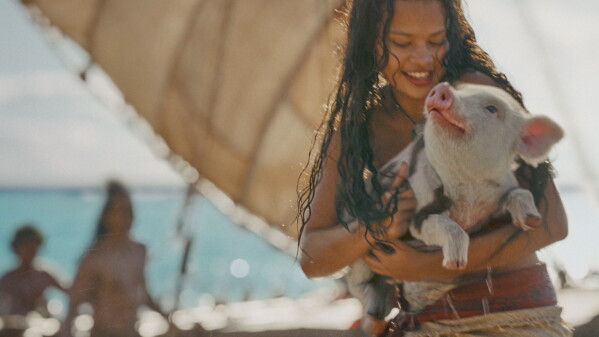
Image courtesy of Walt Disney Pictures
Film Review
Moana:How Can $300 Million Be Called a "Loss"?
| published November 11, 2026 |
By Sandi Jerome,
Thursday Review film editor
When headlines declared that the live-action remake of Moana had underperformed after grossing around $323 million worldwide, I had to ask: how can more than $300 million at the box office be considered losing money? Compare those numbers to The Little Mermaid (2023), which grossed over $569 million worldwide on a $240 million budget. While The Little Mermaid wasn't a runaway smash like The Lion King ($1.6 billion), it generated enough theatrical revenue and Disney+ streaming traffic to be considered a moderate financial success.
The answer lies in modern blockbuster economics. The live-action Moana carried a massive $250 million production budget. Once you factor in global marketing, distribution costs, and the fact that movie theaters keep roughly 50% of box office receipts, a studio needs a film to earn about 2.5 times its production budget just to break even. For Moana, that means somewhere north of $600 million.
I'm sure a healthy share of that budget went to Dwayne "The Rock" Johnson, and he was nothing short of fantastic in the role of Maui. He anchored the comedy with the kind of larger-than-life charisma and effortless presence that reminded me why my screenwriting instructor used to say, "Stars earn their money." He brought both the physical intensity and the grounding star power needed to carry such a massive production, proving once again that a true movie star brings value to every single frame.
Rising Australian-Samoan actress Catherine Laga'aia, whose father, actor Jay Laga'aia, brings strong New Zealand roots to her family's artistic legacy, sang with such stunning vocal beauty that she stole the screen. In fact, her vocal talent and screen presence make her my absolute dream choice to play Wilma Wallaby in a live-action adaptation of my Flick AI Animated Vertical Drama on SmilingFlick (I wish!).
What hurt Moana (2026) was its timing and cost structure. The live-action remake arrived only a short time after Moana 2, the 2024 animated sequel, hit theaters. Moana 2 itself was originally conceived as a Disney+ series before being hastily retrofitted into a theatrical feature, a move that inflated post-production costs while rushing the franchise back into the spotlight. Following an animated sequel so quickly with a live-action retelling meant audience fatigue was real. But where Moana missed the mark was originality. Unlike Toy Story 5, which offered an entirely new chapter, new hero with new conflicts, this live-action version retold a story audiences had already seen twice in recent years.
Financial spreadsheets aside, as someone who lived on Oahu's Windward side in Kailua for three years, I loved this film. The cinematography is a breathtaking love letter to the Hawaiian Islands. Listening to Catherine Laga'aia's soaring performance of "How Far I'll Go (Reprise)," I genuinely got goosebumps. The production didn't rely strictly on digital soundstages; it captured the real textures of the islands. You feel the trade winds, see the turquoise hues of the Pacific, fear the rolling surf, and hear the distinct natural rhythm of Hawaii.
The Oahu location work grounds the fantasy in real Hawaiian landscapes. Pokai Bay and Pokai Beach Park in Waianae were transformed into the coastal shoreline and village grounds of the fictional island of Motunui. The dramatic green valleys and jagged ridgelines of Kualoa Ranch frame the island's interior. Kualoa is legendary film terrain, famous for Jurassic Park, Jumanji, and Lost, and its guided tours remain a staple for anyone who wants to walk through Hollywood history in Hawaii. Having hiked the Mānoa Falls trail many times myself, I felt instantly nostalgic seeing those lush, misty rainforest canopy shots on the big screen. Makaha Beach Park and the Polynesian Cultural Center round out the picture, adding raw ocean power and an authentic cultural foundation to the visual backdrop.
Nothing in the original animated Moana makes you want to pack your bags and board a long flight to Hawaii to stay at Disney's Aulani DVC Resort quite like seeing these real, physical landscapes on screen. In fact, after watching it, my immediate reaction was to book a birthday stay at Disney's Polynesian Village DVC Resort back home, getting that tropical immersion without the grueling cross-country flight.
That is precisely why Disney's formula works, even when a single film appears to lose money at the box office. First, there are the theme park synergies. The movie serves as a two-hour commercial for Disney experiences, from the Journey of Water, Inspired by Moana attraction at Epcot to a stay at Aulani. Then there is the power of licensing and merchandise. Disney's business model has relied on licensing dominance since its earliest days. In the 1930s, Walt Disney hired Herman "Kay" Kamen, who transformed character licensing and made millions putting Mickey Mouse on Post Toasties cereal boxes and Ingersoll pocket watches. Today, Disney Consumer Products drives more than $60 billion a year in licensed retail sales.
So, back to the question I started with: how can $300 million be called a loss? On a spreadsheet, it can. But a spreadsheet doesn't capture the little girl twirling in her Moana costume on Halloween, the family booking a week at the Polynesian, or the soundtrack still playing on Amazon Music. My screenwriting instructor was right that stars earn their money, but at Disney, stories earn it too, long after the credits roll and the theaters move on. The live-action Moana may have fallen short of its break-even number, but for Disney, the box office was never the finish line. It was only the first leg of the voyage. And judging by how quickly I booked that stay at the Polynesian, the return on that $250 million is already sailing home.
Sandi Jerome is a screenwriter, author, and former technology company founder whose diverse background as a UCLA Advanced Screenwriting graduate, former CPA, and novelist shapes her insightful analysis of film and book-to-screen adaptations. She is a frequent contributor to Thursday Review.
Related Thursday Review articles:
Remarkably Bright Creatures; film review; Sandi Jerome; Thursday Review; June 2, 2026.
Project Hail Mary: Why Grounded Science Makes for Better Sci-Fi; Sandi Jerome; Thursday Review; June 23, 2026.