
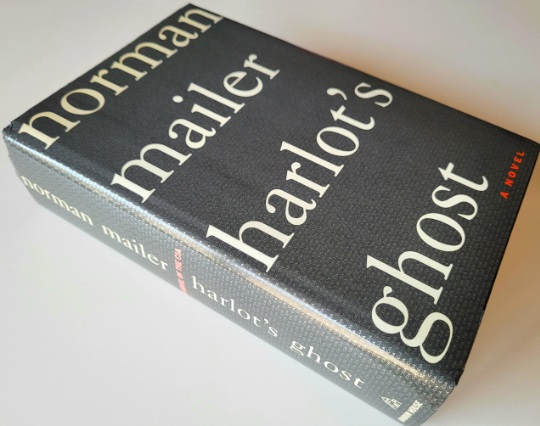
Photo by Alan Clanton for Thursday Review
The Colossus
of Norman Mailer:
A Look Back
At Harlot's Ghost
| published November 20, 2026 |
Book retrospective
By R. Alan Clanton, Thursday Review editor
The generally positive reviews of the new movie Wild Horse Nine—which stars John Malkovich and Sam Rockwell as down-and-out CIA agents—have not yet lured me into the theater to see the film. This is no reflection on the actors, both of whom are among my favorites, nor of director and producer Martin McDonagh.
I've just become a lot pickier and risk averse as I advance into the slightly-upperish parts of middle age. And no, I'm not getting cheap or cranky like my father. Risk-aversion is the prelude to cheap and cranky, and I'm not there yet.
But watching the trailers for Wild Horse Nine—in which the two CIA agents are sent to Easter Island in 1973 on a mission which becomes more a study in lifetime reflection and lost opportunities than an actual mission (it does involve a bit of skullduggery in Chile and Argentina)—triggered a strange desire to reread one of my favorite novels, a massive work of fiction which overlaps some of the historical fun found in Wild Horse Nine.
For regular Thursday Review readers, this retrospective comes with a warning: Norman Mailer's colossus of a novel, Harlot's Ghost, is not a book to trifle with as weekend reading or something to pass the time with while lounging in a chair on the beach. At well over 1000 pages, it may be the fattest novel I've ever read. The stout hardback edition, which I bought the same month it was published in 1991, weighs-in at 1282 pages, not counting the "Author's Notes" and other appendices which stretch it further. Harlot' Ghost is one of those rare American novels with includes, among other things, a glossary of terms, an appendix to sort out the acronyms and code words, and a bibliography, all of which then take the printed pages to 1312.
In today's world of publishing this would not be tolerated; indeed, Mailer's editors would have sent him packing back to his typewriter to reorganize the entire monster book into a multipart series, the sort of thing which is all the rage in the book world nowadays: a trilogy, or a nice four book series, complete with all the usual pleasing design elements.
But in those days Mailer was Mailer, operating in one of the rarified places in writing and publishing, a literary giant at the height of his skills and powers. Harlot's Ghost was his grand achievement, his magnum opus. By the time he was wrapping up Harlot's Ghost, his long career included novels, non-fiction, journalism, art, screenplays, stage plays, editing, criticism, and—as if that would not be enough to fill one's resume—co-founder in 1955 of The Village Voice. That long arc of an active and tractionable career meant that he was also moving gracefully (and at times not-so-gracefully) alongside many of the world events he describes (from the inside) with such dark humor in Harlot's Ghost.
The novel is told more-or-less from the mind and words of Harry Hubbard, an employee, functionary, and eventual upper echelon worker in the CIA. I say "more-or-less" because this is one of those challenging novels not told entirely in the voice of our narrator; the book is swollen with excerpts of letters, entire letters, telegrams and cablegrams, telexes, mimeographed summaries, transcripts, radio chatter, references to postcards, wiretaps, memoranda, field notes, journal entries, and a dozen other of the sorts of printed material that might pass in front of the eyes of a good and useful functionary within the CIA.
Spread as it is across multiple decades, the story brims with anecdotes that spring directly from the daily headlines, but also from that weird dark convergence of the truth, half-truth, make-believe, and mythology of America at its 20th century height. It is also a Cold War story as seen through that lens.
What makes the novel fun—and it may take you a few hefty chapters to get to the "fun" part—is the constant parade of real life characters. Mailer drops all the names we expect: Dean Acheson, Kim Philby, Guy Burgess, Dwight Eisenhower, Richard Nixon, Allen Dulles, Richard Helms, Richard Bissell, Johnny Rosselli, Santos Trafficante, Fidel Castro, Salvatore Allende, Sam Giancana, Robert Kennedy, John F Kennedy, Frank Sinatra, Sammy Davis, Jr., Peter Lawford, Robert Maheu, William King Harvey, David Phillips, Howard Hunt, and so on. If you can think of them, they'll be found in Mailer's story.
This is a novel which takes us into the modest spaces where power, prestige, outcome and results, and the chess moves of the Cold War are played out, complete with all the expected exile and recriminations when things don't go down well. And Hubbard, a mostly efficient but not particularly demanding case officer, has as his closest influencers (aside from the other active agents like Howard Hunt and David Phillips), his father, his godfather and protégé (Harlot, aka Hugh Tremont Montague) and his women, one of whom is among the strongest and most intriguing women found in all of Mailer's fiction, his soon-to-be-wife Kittredge. Harry Hubbard and Kittredge engage in a long-distance letter-writing dance of wills, and she is alternately Harry's confessor, his ally, his muse, his enemy. Whether she is in some way manipulating Harry (and to what degree), we learn only in slow stages and through their often combative, passionate letters.
For those readers who do not like the ruptures and fissures in their narrative flow, the novel can be something of a challenge, maybe even more than a challenge. In the broadest sense the novel is worth the effort, and despite its bulk, it moves quickly. However, based on the 1200-plus pages, it is not possible to judge "quickly" by the movement of your bookmark. I read the book in its entirety very slowly after I purchased it in 1991. I was living in Tallahassee, Florida at the time, working a full-time job in video production, so the reading was slow—maybe eight to ten pages each night. My goal was to feature this very review in our "literary" version of Thursday Review, the first edition of which took us months to finally roll out—and without a review of Harlot's Ghost. I never got around to it until now, and I grieved the loss of Mailer when he died in 2007 (in 2007, Thursday Review was all about politics).
What sustains such a massive book is the high level of entertainment value and pure readability Mailer is able to inject—vis-à-vis his narrator Harry—into the real and occasionally shadowy 20th century, especially the great background stage set known as the Cold War. The CIA in those days hired the best and the brightest, or so that was the plan. And everyone was trained in their special arts or sciences, and everyone was taught discretion, subterfuge, tradecraft, and secrecy. Therein rests the best part of our storyteller Hubbard: he is a chatty Cathy, revealing to us—his anonymous readers—all manner of inside secrets. And through his mentor Harlot, we learn how a newly minted recruit learns over the long arc of their career to balance suspicion and paranoia with real-world outcomes.
Hubbard also threads so many real characters into the real events of this era that it becomes blurry where the facts overlap into Mailer's fictional narrative. Still, this is not "historical fiction" in that old tradition; this is a tale of a fair-to-middling operative who has a job to do. It is a family tradition, as his father was an OSS agent; both father and son believe in their cause, and they take pride—sometimes cynically, sometimes with wry humor, sometimes coarsely—in their roles in the big post-War world.
Even the failures are fun to read. I may have learned more about the Bay of Pigs fiasco through Mailer's retelling than I learned through all the contemporary history books and all the Kennedy biographies I've ever consumed. Our man Hubbard is in Foggy Bottom, the dank, sweaty rooms in Washington, D.C. as the events build, commence, then, slowly, sickeningly unravel. Harry Hubbard must wander the wilderness as the blame game ensues. And in the real world words of one operative, John Kennedy is no longer a virgin.
Then comes Langley, Virginia: our character Hubbard takes us step-by-step (sort of literally) into the CIA's new headquarters, an immense, clinically clean, sterile, secure marble and stone edifice as overbuilt and over-conceived as anything imaginable even at the apex of the American Dream amok. The new ocean liner building is the comical opposite of the ramshackle charm of "I-J-K-L" near E Street: security goons roaming the long corridors, draconian rules about papers strewn about, a million dollar air conditioning system which won't work and can't be repaired since the building's internal design features prohibit average joes with HVAC training and tool belts from strolling around in search of where to make repairs.
Harlots Ghost covers a substantial stanch of time which adds to its heft. Mailer wants to leave nothing out, so there are substantial forays into places like Berlin, Vienna, Athens, Guatemala, Argentina, Paraguay, Uruguay, Cuba (multiple times), Nicaragua, Mexico, all the most romantic haunts and vaporous oases by the lights of the best and the brightest of U.S. intelligence.
The novel is also a love story: Harry's love of his aging father, for whom he has both admiration and a touch of fear; Harry's love for his mentor, the great Harlot; Harry's on-and-off love and terror of Kittredge.
After lugging this massive book around for 35 years (I moved three times in the period this book demanded space on my fiction shelf) I recommend—no insist—those who love Mailer's writing make the decision to wade into this great novel.
Related Thursday Review articles:
Why Does Catcher in the Rye Remain Such a Sturdy American Classic?; By R. Alan Clanton, Thursday Review editor; February 9, 2026.
Alas, Babylon, Revisited; By R. Alan Clanton, Thursday Review editor; December 1, 2025.