
Photo by Thursday Review
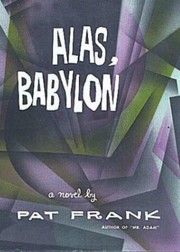
Alas, Babylon, Revisited
| published December 1, 2025 |
By R. Alan Clanton, Thursday Review editor
Several grim years into a protracted war between Russia and Ukraine and we have all heard or read the bellicose and not-so-veiled warnings from Russian President Vladimir Putin and from his top Kremlin spokesmen: Putin has nuclear weapons at his disposal and at the ready, and if Russia deems the situation appropriate, it is the right of Moscow to use these weapons.
Putin has cast a wide net of words to ensure everyone understands this ugly threat, and in his single-minded desire to take today’s Russia back to the glory days of the Soviet Union at the height of its reach and power, he engages a very deadly zero sum game with NATO and any would-be referees. Moscow has also invested much effort to showcase recent advances in weaponry and hardware, including hypersonic bombers, undetectable submarines, and unstoppable torpedoes which Putin himself claims can destroy entire coastal cities in seconds.
The end of the Cold War did not, of course, end the threat posed by nuclear weapons. Iran has for decades been engaged in a long-distance marathon with its efforts to acquire weapons of mass destruction. North Korea’s Kim Jong-Un—ignoring almost every sanction thrown at Pyongyang—continues to test rockets and missiles and the atomic devices he one day hopes to place in those warheads. And as recently as this year the nuclear powers India and Pakistan came to blows after militant attacks killed scores of tourists in the disputed Kashmir region—an area which has been claimed by both Pakistan and India for decades and which has been the source of at least three ground wars.
One could argue that we live in a world just as dangerous as it was at the height of the Cold War and the Arms Race, and at the time that author Pat Frank wrote his stunning novel Alas, Babylon, a book some still regard as the most chilling of the great post-apocalyptic works of the era.
When I first read the book as a high school student in the middle 1970s, the basic nuts-and-bolts of Frank’s novel were understandable, approachable, and so realistic as to be very nearly a how-to documentary. This was no cautionary tale; this was handbook of what to expect. The copy I bought came from a large used bookstore about two miles from Jacksonville Naval Air Station, meaning the store, its contents, and all its employees and customers would have been more-or-less vaporized had a Soviet missile detonated near or above that key military facility. It was a dark irony we joked about in our 11th grade Lit class. As Baby Boomers (the word “boom” was not lost on us even in the 1970s), we had been born and raised under the spectral reality of nuclear war.
Pat Frank’s Alas, Babylon was published in 1959. It came out around the same time as a spate of other post-apocalyptic books of high caliber and striking quality, including its closest literary competitors, Nevil Shute’s On the Beach (1957), Walter M. Miller’s A Canticle for Liebowitz (1959), and Peter George’s Red Alert. Red Alert became the basis for Stanley Kubrick’s film masterpiece Dr. Strangelove. The other three books examined with reasonably balanced scientific authenticity a world after the bombs have been dropped or detonated, but Frank’s book took readers into the kitchens, bedrooms, dens and garages of people now coping with how their lives have changed as survivors; incalculable millions have died, many more tens of millions are dying in contaminated zones. Frank shows us a small town in central Florida which has been…lucky…sort of. Most of its citizens have survived despite the annihilations of Miami, Orlando, Jacksonville, and Tampa.
I re-read the book only weeks ago. Alas, Babylon is a fast read, very fast, to say the least. This is meant as neither faint praise nor false criticism, but simply as a fact: once you begin reading it, it becomes difficult to set the book aside, and the book is paced so that the reader becomes deeply invested in the hour-by-hour, day-by-day, week-by-week adjustments with which the people of this tight community (the fictional Fort Repose, Florida) must make to endure and cope.
What is most striking is not the unfamiliarity of a story set in the 1950s, but the shockingly familiar. Sure, we live in an age of technology—laptops, tablets, handheld and ear-mounted devices, very smart cars and even smarter phones. But in a world without power—and yes, even with our smart batteries—very few of these gadgets will provide much use once the batteries run out and the power stops. Even if our solar panels can extend our comforts a bit—warm water for showers, a little extra juice for our cell phone, another quick charge for our weather radio—all of that electronic and technological infrastructure will surely fail within hours, days, or weeks. And even that marginal outcome is possible only if the technologies we refer to are not entirely linked or beholden to services or companies not instantly destroyed by a blast or by the electromagnetic pulse. Frank understood this back in 1959, and his descriptions of the collapse of everything taken for granted is frightful: potable water, electricity, telephony, banking, medical care, even food.
Indeed, the people of Fort Repose, Florida could be us, tomorrow, or the day after tomorrow, or next week. Our smart watches and our cell phones and our hybrid cars will quickly devolve into scrap metal and useless plastic.
Frank’s novel wastes little time, and the story simply provides readers with one of those history-repeating-itself backdrops of news: there is a crisis brewing somewhere in the world—in this instance a confrontation that inevitably puts the United States and the Soviet Union each eyeball-to-eyeball. Other nations fall into place along various lines, and on radio and TV there are news reports of troops on alert, harsh words between super power leaders, of dangerous face-offs between naval vessels in the Mediterranean, and aerial dogfights in the Middle East. Things escalate quickly. Then, there is “The Day,” as it becomes known.
The people of Fort Repose see or hear it from their distant, idyllic place—brilliant flashes of light (one girl is temporarily blinded), billowing mushroom clouds visible among the tops of southern pines and Florida live oaks, immediate disruptions to things like radio and television. Then, as awareness grows of what has happened and as murky, confusing reports arrive, there is both slow motion panic and high-speed hoarding. A run on the local bank is averted only when the bank’s local president halts withdrawals when he cannot contact the Federal Reserve. The proprietor of the largest gas station and convenience store becomes briefly the richest man in town, flush with stacks of money, until he realizes within days his cash is useless. Drug stores are stripped bare, grocery stores wiped out, hardware stores are emptied. Simple things like bandages, aspirin, coffee, and canned meat become priceless. A Cadillac sedan with an empty gas tank is worthless save for the copper wire and the battery. A doctor’s medical bag with insulin, a few antibiotics, and some pain medication is priceless. People with minor injuries become infected with disease, and those dependent upon certain medications begin to die. The homes of the few with working radios become gathering places for the scant news available. Those without weapons are at the mercy of those who are armed. Barter immediately replaces all other forms of commerce as people trade food or medicine for gasoline or kerosene.
Within the first few chapters the novel becomes an adventure story—a tale of survival not of individuals on a distant planet or on some uncharted island, but of any community or large extended family in a desperate struggle to recalibrate their lives after the world has set itself on fire. And this is what motivates a reader of Alas, Babylon to keep turning the pages.
Like some great writers, Frank understands that less is more. He does not bore readers with too much scientific or technological information, though clearly he has researched this intensely and understands the fundamentals. Frank provides readers with precisely what is needed to remain hooked on the thread: brief, intermittent news reports on the radio from an announcer or from the new President; presumably all in Washington have been instantly killed, leaving the Secretary of Health, Education & Welfare, Mrs. Vanbruuker-Brown, as the new chief executive. She had, by chance, been away from Washington when the bombs fell. Small things become incalculably valuable: drinking water, insulin, candles, matches, canned food, salt for preserving, the oranges and tangerines once taken for granted every time they fell from a tree.
Frank paints a portrait of a town which becomes more-or-less limited to only the scant information it receives from the radio or from a few trusted outsiders, and quickly there is a looming fear of what—or who—may be lurking or moving about just beyond the edge of the community. There are rumors of escaped prisoners when state and federal guards walk away from their posts, and there are reports of small bands of thieves and looters. After a couple of weeks, inevitably, the new President empowers local officials and anyone with military credentials to operate town-by-town under martial law—and that includes those with Guard or Reserve rank. One of the book’s protagonists becomes de facto military leader of the town, and soon he must act on what becomes a grim necessity: the hanging of a group of robbers who have attacked the local doctor and looted what remains of his medicine.
The breathtaking speed of societal breakdown is predictable, and fashioned—as Frank intended—as a very slippery slope for which there is no traction or redemption. Certain things fall into place because they must, and certain conflicts must be resolved by swift justice. The pace of the collapse is accompanied by striking examples of humanity even amongst the grubby selfishness, again, just as Frank intended. Quickly, the townspeople must fend for themselves as scarcity accompanies desperation.
Many of the families of Fort Repose have kin in faraway military places, and each news report offers less hope that these distant relatives are still alive, for places like Homestead, Florida and Omaha, Nebraska have surely been first strike targets for those incoming Soviet missiles. Sketchy radio reports indicate that the U.S. and its allies have struck back hard against enemy targets, but by that point in the novel the folks in Fort Repose have little reason to cheer on such news.
The town’s luck has held, barely, only by the mercy of geography—to its south Orlando has been destroyed, and to its north and west Jacksonville and Tampa have been vaporized. Bombs have fallen even to their immediate east along the coast, where Patrick Air Force Base resides. Those fleeing even the suburban outer edges of these conflagrations are the walking dead, and our townspeople have the slight advantage of being more-or-less off the beaten path. Citizens of Fort Repose—and readers—are left to assume there is a narrow, perhaps serpentine corridor of uncontaminated life between the ruined urban world.
Pat Frank’s groundbreaking and realistic novel chills—even now, decades later—not because of dazzling technical proficiency or slick presentation, but because of the ordinariness of the people within this tale of terror, and for the grimy, bruising business of survival as this tiny fragment of society reorders itself. After all the deaths by disease, murders of desperation, and retribution killings, those left in the community must now face the rest of their lives in an adventure of slow horror. The book ends when—finally—a U.S. military helicopter arrives to make an assessment of the area, and when the commander of the team is asked the Pyrrhic question who won the war, the commander says “We won it. We really clobbered ‘em!”
Frank’s book is not, per se, anti-war or pacifist in its meaning, though it can be easily and naturally consumed as such in the classroom if the intention is to scare the bejesus out of readers—whether high school or college. All books which show the true horrors of war can be thought of as anti-war, even if their authors were in fact intending to extoll the glories of battle. Frank makes no such literary gesture: these are ordinary people under extraordinary pressures and pains, and his plain-language approach is even at times impassive. Frank is simply telling the tale the way the events would have surely unfolded in any real place in Florida at that same time. The story can just as easily be grafted upon any town in upstate New York or rural Pennsylvania or the hills and hollows of North Carolina. Likewise, the tale can be easily retrofitted upon our current age, though clearly the urge to overplay the new millennia’s abundant technologies would be a temptation very hard to resist for any writer. The beauty of Frank’s book, again, is how timeless these realities feel.
The writer Pat Frank was born in Chicago in 1908. His choice of central Florida among oaks and pines and flowing rivers was neither accidental nor strategic: he attended college at the University of Florida where he studied journalism and writing, and in 1927 went to work in the newspaper business in Jacksonville following the hallowed and traditional path—first as a copy boy, then a reporter. He worked for several years for the Jacksonville Journal before moving north and landing a job with the New York Evening Journal, then, later with the Washington Herald (none of these papers survived the ages). During World War Two, he worked with the Office of War Information, and served as a correspondent in places like Austria, Italy, Hungary, and Germany. Frank saw firsthand the ravaged post-war Berlin. After the war he went freelance, and his writing career turned to his love of novels and to writing for magazines. His understanding of government bureaucracy and military operations gave him a unique perspective from which to write, and he developed a penchant for explaining the strange and dark ways in which militaries can go wrong, governments can gridlock, and officialdom can trigger backfires. Frank also spent significant time in Korea during the brutal war that resulted in a divided Korea even now.
Frank was considered then—and to a degree now—a science fiction writer. One of his earlier novels, Forbidden Area, deals with the risk of accidental nuclear war because of the foolishness and turf-fighting of government officials and military leaders; egos get in the way of reasoned agreement, career trajectories cloud the visions of those who must make swift decisions. In this novel (prescient considering the Cuban Missile Crisis was still six years away), war is narrowly averted, and Forbidden Area can be rightfully seen as Act One of a Two Act set of novels, with Alas, Babylon as the follow-up.
Pat Frank continued to write until his death in 1964 from alcoholism, liver disease and pancreatic failure. Despite his travels all over the world and his extensive work in places like New York and Washington, he eventually returned to Florida, and lived his last days in Atlantic Beach, Florida, (where he had done his very first newspaper reporting) near Jacksonville, and strikingly close—less than one half of a mile—to Mayport Naval Air Station, a place in those heady Cold War days of the 1960s surely on the list of important Soviet targets. He was 57 at the time of his death.
Related Thursday Review articles:
Ready Player One; Ernst Kline; Book review by Michael Bush; Thursday Review; April 24, 2016.
A Man Came Out of the Door in the Mountain; Adrianne Harun; Book review by Kristy Webster; Thursday Review; December 7, 2015.