
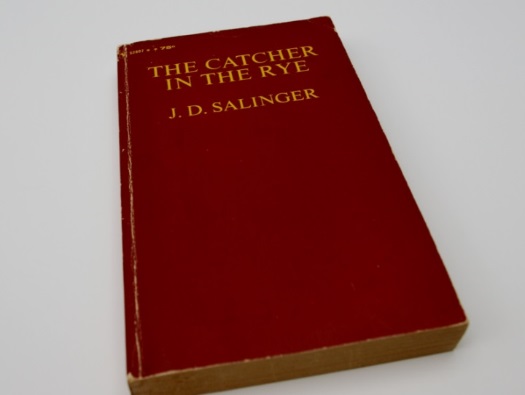
Photo by Thursday Review
Why Does
The Catcher in the Rye
Remain Such a Sturdy American Classic?
| published February 9, 2026 |
By R. Alan Clanton
Thursday Review editor
My first and only copy of The Catcher in the Rye is in very rough condition. The lousy state of this paperback edition has little to do with bad treatment on my part, but everything to do with its extreme old age: it was printed in 1968, and according to the copyright and data page, it was the twentieth printing of the Bantam paperback edition. The book had already sold millions of copies by the time mine came rolling of the presses, and to date it has sold into the many millions worldwide.
Intriguingly, someone wrote the name “Phoebe” in the front, where people traditionally write down their own names. Who knows how many folks had read my copy by the time I bought it in 1975. Was a “Phoebe” among those readers? I’ll never know. In 1975, I plowed through the book in less than three days, which is about how long it took me to re-read it as an English major at Florida State University in roughly 1987. Nowadays—older, slower, and prone to adult distractions—it took me a whopping four days to complete it last week, cover to cover.
The Catcher in the Rye moves fast because it must; this is a condition crafted by author J.D. Salinger, a very purposeful storytelling style meant to propel the book forward and offering very little respite. For many readers, this swiftness of consumption is a joy. For others, it’s a relief, as in: thank God that’s over with. Depending on which critic is discussing the book, Salinger’s classic is either the work of a genius, or, one of the worst books ever written. The novel is one of the most frequently assigned books in schools and colleges, but it is also one of the most frequently banned books in school systems and libraries nationwide.
This extreme yin yang of sharply divided opinions and extremely varied literary criticism—now more than half century old—fuels the novel’s own self-enduring hype, and its own longstanding weathering of censorship: the more it gets banned, the more people want to read it, especially successive generations of young people.
First published by Little, Brown in 1951, the novel’s origins can be traced to a few of the book’s chapters published in short story form in the mid-1940s in The New Yorker and in Colliers. Though these magazine pieces were slightly different from what ended up in the novel, they became the backbone upon which author J.D. Salinger fleshed out his famous coming-of-age story—the tightly-woven first person narrative of prep school ne’er-do-well Holden Caulfield, and his roughly 48 hours of rambling listlessness in New York City after he is booted out of his expensive school. Holden has failed all classes, except English.
One only has to read about two chapters into the book before it becomes crystal clear why the novel can still spark such polarizing opinions. Holden’s storytelling is at times acidly caustic, at times digressive, and at nearly all times gratingly cynical. He spends almost as much time explaining to readers his own disgust at the things he sees as he does making himself disgusting in the process. Holden’s self-professed disenchantment and disenfranchisement is relentless throughout the story, even as he admits to readers (and to almost anyone who will listen) that his downward spiral is entirely of his own making; he blames no one but himself for his bad grades. Though he apparently comes from modest wealth—his parents live in an upper middle class apartment in Manhattan, and they can afford to send young Holden to an elite Pennsylvania prep school named “Pencey Academy,” one of several prep schools he has attended—some of his most frequent targets of contempt are others who come from wealth. Holden continually derides phonies, charlatans, big shots, and pretenders of all kinds—which, as we move through the chapters, turns out to be almost everyone.
He reserves genuine affection only for his kid sister Phoebe, for his older brother D.B.—who we learn is a writer living in Hollywood—and a departed brother, Allie, who died of leukemia a few years earlier. Even those for whom he offers a faint nod of connection—Mr. Spencer, a teacher and mentor at Pencey; Sally, an old girlfriend; Carl Luce, a classmate from a previous school—are held at arm’s distance from his emotional self, and he seems to regard them with significant ambivalence, considering them as mentors or touchstones only as far as he can take them, then, just easily shunted aside when they begin to grate on his nerves and clash with his mercurial sensibilities.
As readers of his tale—or more to the point, listeners—it is understood that we are expected to accommodate his moodiness and his displacement. However, for most who read The Catcher in the Rye, it is Holden’s unyielding and unrepentant cynicism that infuses the novel with its most enduring mood and tone. Indeed, the young Holden Caulfield may be one of the most unlikable voices in all of modern American fiction.
Which raises the obvious question—why do we still laud this novel as an American classic and a sturdy standard of great twentieth century literature? And more to the point: why does the book continue to draw a new crop of readers from each generation and each new wave of young readers?
Much can be attributed to a very circular process at work. The Catcher in the Rye is framed—obliquely at its start, and more illuminatingly in its final paragraph—as a story being told by someone recounting events for therapy or psychoanalysis. If you miss the fleeting hint on the first page, the novel brings it back to this clinical venue at the very end, when Holden makes an overt reference to his—presumably temporary—medical condition. Even in this penultimate moment, Holden is unimpressed, grousing that “this one psychoanalyst guy they have here” asks if Holden intends to apply himself when he returns to school. Holden says such questions are “stupid.”
Written at it was at mid-century and at arguably one of many golden age apexes of clinical psychology, the novel’s inward and listless texture suggests Holden has been asked—probably for the second or third or fourth time—to recount the very recent events of his life. Holden is suffering from depression, and after having told his story more than once, he is bored, morose, and unenthusiastic even about the colorful bits from his tale.
More tellingly, he acknowledges as early as the first chapter that he is an incorrigible liar, and in nearly each of his encounters with people he offers some balderdash about his life—and not merely the fibs about his age in bars and nightclubs where he tries to order adult drinks. He tells a woman on a train he is suffering from brain cancer; he lies to his professors, his dorm mates, doormen and elevator operators, even to the younger sister he adores. In this sense, his cynical tale can be seen as self-deconstructive within the first chapter. Can we trust the story he his telling us? Salinger likely assumes that as readers we will place ourselves within Holden’s framework, and that we will accept his retelling as reasonably reliable. But by the time we get to the fourth and fifth chapters, we see little chance that he will redeem himself by our lights, though we are given flashes of hope each time he speaks fondly of either his kid sister or his older brother.
Even Holden’s grand quest—an intention to leave everything behind except what he can carry, and then travel somewhere “out west” to begin his life anew—goes askew; his plan involves impersonating a deaf-mute in order to avoid any significant interaction with other people, a way to shun hypocrisy and phoniness. He abandons this scheme only when his adoring sister shows up with her suitcase and demands that Holden take her with him on his escape, which he knows cannot happen. Instead, he takes her to a Central Park carousel, where he watches her in her childhood innocence—sparking a moment or two of fondness not only for Phoebe, but a vague nostalgia even for those he has told us he dislikes.
In the 1960s and 70s, The Catcher in the Rye became a book read widely and intensely by people in separate but parallel worlds, giving it multiple engines for sales. For one, it was being widely assigned by teachers as young adult reading—deemed edgy in places, perhaps, but a classic coming-of-age novel. In fact the book was never intended as anything but mature adult fiction. This is not high school reading: Holden employs a prostitute, engages in underage drinking, smokes cigarettes continuously, spies on people in sexual situations through hotel windows, and makes clumsy attempts to pick up older women. Holden’s lowball language is constant, even offending the women he attempts to woo in nightclubs.
Indeed, despite the book’s popularity with English teachers coast-to-coast, the novel was paradoxically banned or excluded from some school systems and some libraries, lest it be mistaken for a morality tale with a fleeting upbeat final paragraph. Predictably, this half century of banning the novel fostered a cottage industry in a thousand communities and towns as young people bought copies from new or used bookstores, then read The Catcher in the Rye anyway. Ownership of the book became a symbol of literary chops, overt rebellion, or simply secreted decadence. The more the book got banned, the more thousands of young adults each year read it, whether in secret or in plain view.
Then there was the prep school aspect. The Catcher in the Rye quickly found its place amongst the other great coming-of-age novels set in real or fictional elite preparatory academies, and therefore became required reading across this dappled, always revolving set of young readers—as much as requirement in the backpack or on the book shelf as John Knowles’ classic A Separate Peace, and Nancy Horowitz Kleinbaum’s Dead Poets Society, and occupying a more resonant place in the student’s life than, say, all the paperback copies of J.R.R. Tolkien or C.S. Lewis. Therefore, despite the chain smoking and the bumming of matches and the lies Holden tells to nuns and random people, the novel fixed itself on the world of Prepdom, those schools where Oxford shirts, blue blazers, penny loafers abound, and where a tennis racquet arrives with every kid's luggage on day one. As a nod to the book’s importance to this subculture, Lisa Birnbaum, editor and one of the authors of the satirical book The Official Preppy Handbook (first published in 1980), rates The Catcher in the Rye as the essential paperback book.
And of course there was—and remains—the strange circular relationship between the fictional Holden Caulfield and the realities of twentieth century psychology. The Catcher in the Rye became in its day (and gaining momentum over the decades) a literary touchstone for the alienated youth and the misunderstood rebels. We understand that Holden tells his largely hangdog story from a seat inside a place of psychiatric care, and he recites it with such a lack of enthusiasm as to seem like a kid already toppled over into clinical depression. Indeed, he not only openly uses the word “depression” on several occasions, he seems to relish in this clinical terminology, using his depression as an explanation for some of his behavior. Is he using this as a badge of honor? Or is Holden a genuine sufferer of a mood disorder?
That the novel became frequently suggested reading material for young people suffering from various disorders seems both counter-intuitive and yet strangely inevitable. And of all the paradoxes surrounding Salinger’s classic, this one remains the most intransigent, especially since the novel’s tiny flicker of hope at the end seems so fragile and fleeting. Why recommend to a young person suffering from depression that they read this book, unless it is to spur creative output as its own therapy (presumably both more both upbeat and instructive) to bring about some breakthrough?
Then there is the youthfulness of the voice. In popular culture—and in the grim world of reality—The Catcher in the Rye translates all-too-easily into the zeitgeist and parlance of each new “lost generation,” whether it is greaser, or punk, or metal, or grunge, or goth, bad boys or lost boys or deathrockers, notwithstanding the absurd clash when placing the young prep school Holden alongside the members of rock bands like Guns N’ Roses or Green Day (bands famous for their multiple references to The Catcher in the Rye). Still, each new wave of kids come back to this book each year, each generation, solidifying the novel’s chops as a key rite-of-passage for young readers.
Perhaps this is why the novel endures as subversive literature. It had an especially potent heyday in the 1960s and 1970s when the book occupied a niche just short of a mystical mountaintop for millions of young readers, despite the grating cynicism and the leaden spirit.
Still, because the book ends with a fragmentary, fleeting nod toward a hopeful future—and largely because among Holden’s few touchstones is his obvious admiration for his siblings—the novel has often been interpreted as having a positive resolution. It is interesting to note that both older brother D.B. and kid sister Phoebe are writers—an apparent family skill—and it is this singular talent which Holden himself reluctantly embraces, for example when his roommate Stradlater badgers Holden into writing an essay which Stradlater can take credit himself. Holden grudgingly composes the essay while his roommate is on a date (for which Holden is intensely jealous), but when Stradlater returns and reads the essay, Stradlater is disappointed. This triggers a brief altercation, and effectively sets Holden on a faster flight from his prep school at the start of the novel, and cements in Holden’s mind the folly and phoniness of most of those he encounters through the rest of the tale.
Which brings us to the question of literary style: The Catcher in the Rye was Salinger’s only according-to-Hoyle novel; his other well-known works were short stories or collections of short fiction, most notable among them Franny and Zooey (1961), For Esme—With Love and Squalor (1950), and Raise High the Roof Beam, Carpenters [and] Seymour: An Introduction. All these short story collections share a remarkable amount of their narrative DNA with The Catcher in the Rye, particularly the issues of depression or clinical factors (the unnamed Sergeant who tells the story in For Esme—With Love and Squalor is suffering from PTSD, or battle-fatigue; likewise, the subject of Raise High the Roof Beam includes bipolar behavior and obsessive disorders). Another of Salinger’s short stories was A Perfect Day For Bananafish, published in the New Yorker in 1948, which tells the story of a deeply troubled, clinically depressed WWII veteran who commits suicide.
All of Salinger’s short pieces are rightly considered masterpieces of their forms, especially for their evocative narratives and their skillful prose.
But, The Catcher in the Rye reads differently. In fact, it may be the most poorly-written novel among the “Top 100 American Novels” lists prepared by so many esteemed magazines and journals. And therein resides another of the book’s paradoxes: Holden’s narrative is coarse, clumsy, digressive, and often highly tangential—hardly an example of exemplary prose for students of any age. But, here too, Salinger must have sensed he had hit his mark despite the hackneyed speaking style, for after all we are experiencing this story through the eyes and the voice of Holden Caulfield—and only Holden Caulfield—an alienated teenager at the cusp of adulthood, disconnected from his parents, ill-at-ease in his prep schools, awkward and clumsy around strangers, occasionally more awkward around even those he presumably cares for (in another telling scene, his insensitive talk causes an ex-girlfriend to cry). Holden is simply that sensitive but clumsy kid trying to make sense of his world—a middle child (in this instance, literally) and a kid too young to have fought in World War II like his older peers. In fact, a few critics have suggested that The Catcher in the Rye is a war novel without the war, complete with Holden’s own form of battle fatigue and emotional exhaustion.
The novel was rejected outright by several publishers who did not appreciate what was perceived as Salinger’s writing shortcomings—more to the point, the crass narrative stylings and the trash talk—and at least one potential publisher was flummoxed by what was interpreted at Holden’s mental instability. Another publisher rejected the novel for what was deemed a target audience ambiguity: was this a young adult novel with an overload of grown-up cursing? Or was it adult fiction with an affected view of how teenagers talk and think?
But at the time, Salinger’s work was also revolutionary and—in retrospect—a breakthrough in style and form. Few American writers had attempted such a significant foray into a linguistic experiment in rule-breaking and non-conformity. William Faulkner had surely succeeded with The Sound and the Fury (1929), as would Harper Lee in 1960 with To Kill a Mockingbird. In this sense, Salinger could be said to have summoned a subversive form, making him a co-conspirator in the revolution for which each wave of post-WWII young readers seems to have embraced from the 1950s onward. The Catcher in the Rye became an essential Baby Boomer book, threading its way deftly into the cultural quilt of each successive generation.
And perhaps, too, there is the approachability and swiftness of the read. This makes the book agreeable to each new class of readers despite the book’s occasional anchorages in mid-century New York culture, and even then, nearly every scene can be easily translated for each new set of readers: the jazz clubs can just as easily be discos or nightclubs; the cigarette smoking just as easily vaping. And so on. Aside from the cynicism, the rest of the story converts with astonishing comfort and ease into our sensibilities, and in that sense it is perhaps predictable that the novel remains a popular and relevant book for each generation.
As of 2025, some 66 million copies had been sold.
The glaring success of The Catcher in the Rye had the unfortunate effect of pushing Salinger—in life an understated introvert—into the shadows and eventually into a famously reclusive life. Though he was a prolific letter-writer, he rarely gave interviews, and over the decades fought several high stakes legal battles over articles and a planned biography. He was also a prolific writer for the sake of writing, telling the New York Times in 1974 that he found peace in completing short stories and novels without the pressure to worry about publication. A few of those who knew him well through the 1960s and 1970s said he reportedly had completed as many as a dozen entire novels—though none had been, or ever would be, submitted for publication. In this way, Salinger established a sharply different place for himself in our consciousness than fellow recluse Thomas Pynchon; Pynchon’s output has increased in recent decades, though many critics still regard his earliest works—Gravity’s Rainbow, The Crying of Lot 49, and V—as his best.
Clearly, Salinger’s towering achievement is his The Catcher in the Rye, a novel that still manages—for better or worse—to capture the voice and eyes of a struggling, disillusioned teenager whose cynical take on the hypocrisies of his world leave him looking for innocence, and finding it only in the words and motions of his kid sister Phoebe, the idealist he knows he can never be.
Related Thursday Review articles:
Alas, Babylon, Revisited; Alan Clanton; Thursday Review; December 1, 2025.
Go Set a Watchman; Harper Lee; Book review by Karen Franklin; Thursday Review; August 30, 2015.