
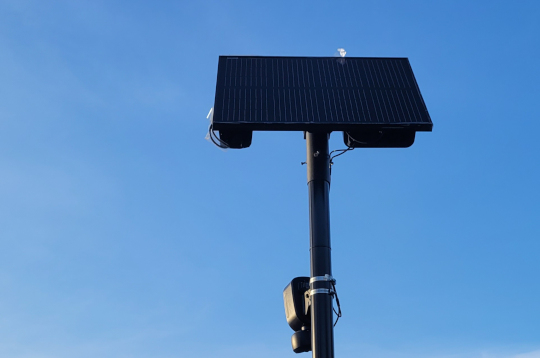
Photo by Alan Clanton for Thursday Review
Small Arizona Community
Bans Flock Cameras
| published November 19, 2026 |
By R. Alan Clanton, Thursday Review editor
The town of Fountain Hills, Arizona—about 30 miles northeast of Phoenix—voted this week to ban Flock cameras and similar automated license plate/vehicle tracking systems from its roads and avenues, and from all city property. The Fountain Hills Town Council voted 5-2 to “permanently” ban such tracking systems from its community.
The Fountain Hills Town Council took the action—like many counties and cities—in the wide wake of citizen concern that Flock systems represent a clear invasion of privacy, and because of the controversy surrounding numerous instances of unauthorized uses of the tracking systems to stalk individuals, track individual movements, and engage in warrantless surveillance.
In September, Florida governor Ron DeSantis and the Florida Department of Transportation ordered all Flock camera systems removed from state roads and highways, and asked that the permits and licenses to place those cameras in those locations be revoked. The Florida order did not apply to Flock cameras or similar camera systems placed on city, community, or county roads, and did not require that homeowner associations or developers remove the Flock cameras from their properties.
Many other cities and towns around the country have adopted similar laws, though in most cases there are exceptions for private properties, developers and large retail centers, private roads, streets and roads not under local jurisdictions, and HOAs.
The Fountain Hills vote clearly seeks to go further. Drafted by council member Allen Skillicorn and several others, including an Arizona legislator, the wording of the measure is meant to be comprehensive, and “bans the town from acquiring, leasing, funding, installing, operating, or hosting any automatic license plate readers (commonly known as Flock cameras) or equivalent AI-powered vehicle-tracking systems, and prohibits outside agencies or vendors from placing them on town property or rights-of-way.”
In short, Fountain Hills elected representatives want nothing to do with Flock camera systems in their community. The Fountain Hills move has been described as “the gold standard” when it comes to local legislation to ban the camera systems.
“These AI-based spy cams are nothing more than a warrantless digital panopticon designed to track every law-abiding citizen’s movements and feed the data to government and Big Tech,” said Councilman Allen Skillicorn, who led the effort. “Fountain Hills just told the surveillance state to take a hike. While other towns play games with temporary pauses or weak guardrails that get ignored, we drew a hard line.”
Flock Systems, which is based in Atlanta, Georgia, has been manufacturing and selling the packages for some years. Because of the relatively low cost and simplicity of installation, many counties and cities installed the systems without public debate, and in some cases with little or no discussion even of budget matters. Flock systems are largely autonomous: using state-of-the-art cameras, they automatically track vehicles which pass along the road on which the camera is placed, feeding data in real time back to a central database.
Flock cameras are so effective that they can track some vehicles based solely on model, make, color, and even distinguishing characteristics, such as bumper stickers, wheel covers, or dents (In August, Thursday Review spoke to at least two law enforcement officials in Florida who said that the reliability of Flock’s tracking is very close to 100%, even tracking vehicles without tags).
Indeed, where data sharing is the norm between neighboring jurisdictions, vehicles can be tracked with accuracy from town-to-town, county-to-county. The AI nature of Flock cameras mean there is little need to collate or sort the data—the system is designed, if needed, to immediately organize the data it receives and identify those vehicles which pass through its fields of vision, and the systems will be just as obviously able to build a "dossier" on any vehicle it sees frequently.
But in some states, Flock cameras are placed by large retail landlords in and around shopping center parking areas and large retail developments. In Florida, Georgia, and Colorado, many HOAs routinely place Flock cameras near neighborhood entrances. And many towns and cities install Flock cameras near traffic chokepoints or near key intersections and along bridges.
This, of course, can be interpreted as a windfall for most law enforcement, since it means straightforward, real-time results: tracking vehicles belonging to criminals, locating kidnap victims, locating missing persons, identifying criminal perpetrators, finding missing children, and rapidly tracking stolen vehicles.
In fact, Flock’s own website touts its system’s technological advancement as operating hand-in-hand with law enforcement and police, and cites the rather astounding point that “20% of all U.S. crime is solved with Flock” (a data point I was unable to verify using any information found publicly, including data found through the FBI).
But Flock systems—which have proven to be easy to hack and even easier to access through unauthorized methods—have been notoriously used by bad cops to stalk wives and lovers, to violate restraining orders, and to stalk other individuals not suspected of crimes. Flock camera systems are also inherently efficient at tracking a driver’s patterns, including doctor visits, shopping habits, retail preferences, and routine destinations as mundane as day care centers, schools, cell phone stores, drug stores, and fast food choices.
As some critics of Flock cameras have pointed out, does the owner of a nearby shopping center need to know that you prefer Dairy Queen to McDonalds? Does the city or county need to know which pharmacy you most frequent? Does the landlord of a large shopping center need to know how many times you visit Target, as opposed to Home Depot? Or, for that matter, which access roads you might use to enter those retail locations? Does local government need to know which church, or synagogue, or mosque you attend?
The ubiquitous nature of Flock cameras worry some civil libertarians who believe that such a comprehensive system—able to build what amounts to a digital portrait—is a clear violation of the right to privacy which goes far beyond simple traffic management and roadway safety.
The pushback against Flock cameras has begun in recent months to merge almost seamlessly into the worries about Artificial Intelligence and data centers. Flock cameras systems are in fact a very clear—and approachable—example of how some forms of AI work, since a Flock camera system by its design requires very little human intervention or management, and can make autonomous decisions about how it collects the data it receives.
DeSantis’ September decree in Florida was seen as one of the most striking official moratoriums against Flock to date, though many say the measure did not go far enough since the order came by way of the Florida Department of Transportation, which has little if any authority over camera systems not part of the state-managed roads and highways, and which had no records of permits issued for some locations.
After DeSantis’ edict, some Florida counties went further by banning all cameras placed by local government (even on non-state roads), but, troublingly, many Flock cameras remained even after city and community officials removed the “licensed and sanctioned” cameras. In Palm Beach County and Broward County, some cameras remained in place—installed by parties unknown, irking some citizens and worrying others who have had enough of the surveillance.
Clearly, in Fountain Hills, local officials have voted strongly in favor of a more comprehensive ban. The Fountain Hills’ decision leaves little room for misunderstanding the community mood, and—according to Skillicorn—should set an example for other cities and towns if their citizens are concerned about the invasive convergence of AI and surveillance.
Related Thursday Review articles:
Florida Bans Flock Cameras on State Roads & Highways; By R. Alan Clanton, Thursday Review editor; September 1, 2026.
Safety or Surveilance? How Flock Cameras Are Dividing Towns; By R. Alan Clanton, Thursday Review editor; May 28, 2026.