
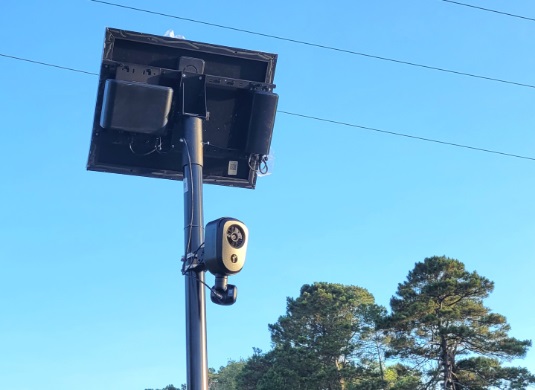
A Flock camera located at the boundary of Duval and Clay Counties in Florida; Photo by Alan Clanton for Thursday Review
Safety or Surveillance?
How Flock Cameras
Are Dividing Towns
| published May 28, 2026 |
By R. Alan Clanton,
Thursday Review editor
About two years ago I decided I was going to Beat the Rap, as it were.
I had received a letter in the mail from a small agency charged with collecting fines for minor traffic infractions—in this instance, the allegation that I had run a traffic light in Green Cove Springs, Florida.
Indeed, I had been in Green Cove Springs on or about the date mentioned in the letter. I had been driving from St. Augustine, Florida to Jacksonville, Florida with my wife Lisa and frequent Thursday Review writers and contributors Michael and Jeanne Sigler (Michael is the author of two books; Jeanne is a radio personality in southeast Alabama). We had decided to avoid the traffic hubbub and gridlock of I-95 and I-295 that afternoon by seeking the “scenic route” back to our house by crossing the St. John’s River and choosing back roads. In truth, we found ourselves in more gridlock and more traffic hubbub, prompting me toward irritable driving and harsh language.
But, run a traffic light? Place myself brazenly afoul of the law? No way, I said to myself. The letter was breezy and friendly, and suggested I could view the incident by logging-in to the company’s website, watching the video myself, at which time I was entitled to challenge the assumptions of the incident.
I was shocked. Not only was there a very clear and unambiguous video of my car running the light (I was more-or-less tailgating the helpful driver of a large white Chevy pick-up truck), my car tag was so clearly visible that I could read every letter and number, the name of my county, and even the yellow and black sticker with the expiration date. More striking, I could make out the Ford logo on the gate of my SUV, the word “Escape” under the back window, and even the hair color of Michael and Jeanne side-by-side in the back seat. From the angle of the video clip, the camera had to have been at least 75 feet away. The lighting was impeccable, the clarity was chilling, and the traffic light had decisively turned from “stale yellow” to ice cold red as my car rolled through the quiet intersection.
Instantly crestfallen, I gave up all hope of challenging what I expected to be a grainy, blurry, murky video of an SUV of indeterminate color and style. I was busted. If I was ever going to fight for justice and freedom by battling The Man in the Supreme Court, it was not going to hang on this case. Rather than give Clay County the satisfaction of a fast electronic delivery, I wrote a check and dropped it in the mail the next day.
This was for me a moment of clarity, both figuratively and literally. What I saw in that traffic camera video was as startling in its high definition as it was impervious to challenge. And even as I wrote that check, I began thinking about the power found in such high resolution data, if collected more-or-less continuously.
At that time, I had heard nothing of “Flock Cameras” or their various permutations, though I was acutely and reasonably aware of the general notion that we are being watched and tracked more or less continually in our lives. Traffic cameras are not a new thing; they’ve been around for decades and have undergone continuous improvement over the years. Introduced in the U.K. and Europe earlier than in the U.S., they are ubiquitous in London, Berlin, Paris, Amsterdam, and Vienna. When coupled with the extensive network of smaller, private camera systems and security systems in banks, coffee shops, restaurants, and touristy areas, along with an even more extensive security systems in place for most businesses and industrial locations, few Europeans are able to move about through a typical day without some form of tracking.
In the United States, home security systems and especially doorbell camera systems have proven their reliability. These simple camera systems can discourage theft of packages (no one wants their box from Amazon stolen off their doormat), identify car thieves and vandals, track the movement of unwanted nuisance animals, and if nothing else let a homeowner know who is standing at the door—friend, stranger, neighbor, lawn care dude, or pizza delivery.
To solve serious crimes, police and law enforcement often use a combination of all these tools and devices, sometimes asking that residents and businesses review their security footage for anything that might be helpful. And one needs merely to watch the news each day to understand how pervasive the use of security systems and surveillance cameras are in quickly identifying suspects.
Even the staunchest of civil libertarians have a hard time railing against these technologies when these systems can be so readily and reliably used to deliver justice.
But what happens when the “surveillance” is being installed by communities, cities, counties, states—and even businesses—with the central and unambiguous purpose of simply tracking you, or your car, continuously? Just ask the people living in Troy, New York. Or in Golden, Colorado. Or in Mountain View, California. Or the hundred or so other communities where “Flock” cameras and their kindred systems have been installed and then triggered controversy.
So-called Flock cameras (the most popular brand is made by Flock Safety, based in Atlanta, GA) and the databases they serve can be an instantly divisive theme at any backyard BBQ, birthday party, conference room discussion, or even in line at the grocery store. The cameras are also a flashpoint for local officials in the hundreds of U.S. cities and towns where these cameras have been installed, and have triggered heated debates in the meetings of city councils and county commissions, and even with homeowner associations where residents and neighbors were once in agreement on security.
For many American communities the sudden appearance of these devices becomes the first part of the strange story: what is that thing along the side of my road or near my child’s school? And when did it first appear?
Flock cameras are designed primarily as license plate readers and vehicle trackers. The cameras use high resolution lenses, are generally aimed and calibrated to effectively track movements on roads, and can read tags, permanent or temporary. They can also identify almost all vehicles with nearly 100% accuracy—including make, model, year, design elements, and, as some police and law enforcement have learned, even by stickers, dents, dings, and missing wheel covers.
The data collected can be fed almost continuously into a county or city’s database, meaning law enforcement and local officials have a highly effective and easy-to-access tool to track criminals on the move, or to locate those being sought for arrest or simply questioning. Proponents of the cameras say that these systems are needed—indeed, can be highly effective—for discouraging sidewalk and neighborhood crime, keeping tabs on suspicious vehicles late at night, tracking congenital speeders and loud-muffler race cars, and reducing break-ins of cars, SUVs, trucks and garage doors.
Inexpensive when compared to other big security systems—Flock cameras can cost as little as $1200 apiece with multiple camera platforms priced to encourage more elaborate setups—the systems will track in real time the comings-and-goings of all vehicles. Some HOAs notably place the cameras at main entrances to neighborhoods, ideally watching vehicles arrive and depart, 24 hours a day. Some cities and towns will place them near key traffic flow choke points of certain areas or regions, enabling police and law enforcement to track criminal movements, or so that traffic managers and city engineers can better understand traffic conditions and congestion.
The cameras are also becoming common on roads which traverse a jurisdiction, for example from one county or township to the next (see the caption in the photo above!), which has already facilitated interagency cooperation when it comes to sharing that data. In mega-cities like Atlanta, Miami, Denver or Los Angeles, where there can be dozens of jurisdictions shoulder-to-shoulder, Flock cameras serve an invaluable role when placed next to roads at these strategic boundaries.
Flock’s website makes it clear that their marketing approach appeals directly to some of these themes. “Clear evidence. Safer Communities. Privacy First,” the main headline reads. Then, “Flock connects communities, businesses, and public safety so incidents can be understood clearly and decisions can be made on facts.” A smaller display ad on the main page says “20% of U.S. crime is solved with Flock.” (I could find no direct corollary or mention of this in any U.S. government website, including data available with the FBI). The website’s main page uses a background image showing a flock of birds moving in harmony across the screen, a nod to both the ancient theory of the flock, and our new understanding of how artificial intelligence works, including drones.
Indeed, most law enforcement agencies and police departments suggest that the growing presence of Flock cameras (and similar systems) in communities and towns will become a driving factor in the speed and effectiveness of solving crimes, and reducing overall crime rates. Images and videos harvested by Flock are difficult to contest.
In reality, and in all instances, Flock cameras track everything—recording the vehicle license tags of every vehicle which passes the camera, and even tracking those cars and trucks without a tag. To civil libertarians and those wary of artificial intelligence, this means that at their core, Flock cameras can (and will) also track your movements to the grocery store, to work, to school, and back again, allowing AI to very quickly and effortlessly build a profile of your daily routines and spending habits.
Because Flock systems can be purchased by private individuals, private companies, small HOAs and condo associations, the use of the cameras has become controversial. Because of the high quality of the images, Flock cameras not only know your car and its daily movements, but your interests and hobbies and political preferences based on stickers, your penchant for fender benders based on dents and scratches, your fetish for privacy based on the density of your window tinting, and even your passions for certain sports teams based on flags or decals. How does the county or the city know you’re a Trump-loving, MAGA, soccer mom with three kids, an annual pass to Six Flags, and a love of the Carolina Panthers? Because it’s all right there on your SUV or family van.
Privacy advocates regard this sweeping data collection as nothing less than invasive, and a violation of several basic freedoms. Some progressive groups have pointed out that Flock cameras have been used in ICE round-ups of immigrants, and used in some cities to track and identify people in attendance at political events and rallies. The immigration issue alone triggered backlash in a few California towns (Santa Cruz, East Palo Alto, to name two examples), where local officials eventually had the Flock systems dismantled and removed.
Furthermore, and on a less political scale, Flock cameras can be used to track any individual’s movements through the retail world—whether that movement is for grocery shopping, trips to the bank or credit union, and stops at pharmacies or gas stations. Meaning: just as your every keystroke and search engine request on your phone or computer builds a profile of your interests and searches, so will your vehicular visits to Target, Home Depot, Walgreen’s, or Burger King. Likewise, Flock can track your visits to your physician, or to a walk-in clinic, or to your therapist.
Is it a matter of public safety which church or synagogue or mosque you visit? Do the police need to know that you frequent McDonald’s more often than the Wendy’s across the street? Is your neighborhood safer because the Flock system knows you never took the Nikki Haley bumper-sticker off the dented bumper of your Jeep Cherokee and you have a Chicago Bears decal in the side window?
Advocates for "responsible" AI, many police, and lots of law enforcement officials would answer that question with a definitive yes. The fact that such exacting data can be collected and collated so easily is precisely the point, and—in fact—may speed-up the arrest of perpetrators and offer solutions to crimes without ambiguity, and, as Flock indicates, “decisions can be made on [the] facts.”
But in a politically-charged environment, even the most mundane of intentions can spark friction and anger, and draw standing-room-only crowds to local council and commission meetings, placing elected officials in the path of citizen anger, and forcing law enforcement chiefs to explain how they intend to use the cameras.
In Troy, New York, the Republican mayor came under intense fire when she attempted to defend the Flock cameras, as Democrats—who control city council—pressed to have the Flock cameras removed from the city. Mayor Carmella Mantello made it very clear that she felt the cameras were not only in the public interest and cost-effective, but an essential no-brainer when it comes to the community’s safety. Political pressure brought questions about the cameras into city council meetings, where there were shouting matches and accusations of official lies. After the council voted to defund the cameras, the mayor invoked a state-of-emergency to keep the cameras operating using emergency monies. Like those suburbs around Golden, Colorado, Troy, New York became sharply divided about the Flock system.
Rolled out in the late teen years, Flock Safety has seen its footprint grow from a dozen or so communities in 2019 to camera systems now operational in more than 9,000 cities and towns and counties. Because of the low cost and ease-of-set-up, and even their use of solar panels to keep the cameras functional at all times (meaning they do not use any electricity), Flock cameras are often seen as a straightforward tool to help reduce all forms of crime, even non-violent nuisance issues such as perpetual speeders, risk-taking sports car drivers, and bored teens on the prowl for petty crimes of opportunity. Flock’s website touts that its system helped located some 10,000 missing persons in 2025 alone.
Flock’s data is generally fed directly into a national database maintained by the company. And since the data is collected in real-time, the information harvested by Flock can assist law enforcement with a wide range of tracking: stolen cars, missing persons, fleeing felons, kidnapped children, the movements of rival gang members, hijacked delivery trucks, elderly drivers with dementia. But it can also invite unwarranted use of the system, such in in some of those California towns where local officials complain that ICE illegally hacked into the Flock systems in an effort to track the movements of illegal workers and immigrants sought for arrest.
The low cost of Flock’s systems are also an inducement for many cities and towns to install Flock cameras as something akin to a petty cash outlay, requiring little or no approval from elected officials, and therefore no public discussion or debate. Indeed, in some of the communities where the cameras have caused the most contentious fights, the cameras were installed very quickly, sometimes late at night, leaving locals to simply discover them almost by accident in the days that followed.
Flock cameras near schools and playgrounds and day care centers have also stoked their own form of controversy, since the systems—which some in the media have said can be easily hacked—could provide just the sort of information sought by an angry ex-spouse, a potential kidnapper, a stalker, or pedophiles. If it is true that Flock systems can be hacked, then it is also true that the data can just as easily be misused for dozens of reasons ranging from fraud to theft to stalking to harassment.
A central argument in opposition to Flock is that such cameras violates—among other aspects of the Bill of Rights—the Fourth Amendment, which states that people have a right to “be secure in their persons, houses, papers, and effects, against unreasonable searches and seizures,” without probably cause and without a warrant. Fourth Amendment defenders insist that Flock cameras invade and puncture both the letter and the spirit of this intention by brazenly harvesting our data without our specific permission, and without a warrant or probable cause.
Law enforcement hawks disagree. And Flock’s own marketing materials remind readers that this fight has been fought before many times, and resolved by the courts: U.S. citizens should expect no reasonable blanket protection for “privacy” if they are driving their vehicle on a public road, paved and maintained with public money. Likewise, there is no “privacy” if you are in the parking lot of Target or Walmart, or driving along an avenue on you way to work, to school, or to your pharmacy.
But what if you are on your way to your attorney’s office? What if you are on your way to seek a restraining order against an abusive ex-spouse? What if you are driving to your psychiatrist office? Do local officials need this data? And why?
Again, many people will take the tack that very little of this matters now. After all, in the post-9/11 era, we’ve long ago ceded much of our privacy to the intrusions now continuous in a digital age. The initial shock came during the Obama years when it was revealed how much of our digital footprint had been collected by companies like Verizon, AT&T, Apple, Microsoft, Yahoo, and AOL, and how almost all of that data had been flowing out the side-doors into the data centers of the NSA. And few people should offer any shock or outrage any longer that companies like Google, Facebook, and Amazon have been collecting and analyzing our cookie crumbs and our clicks with ever-increasing granularity.
For better or for worse, Flock cameras will continue to feed their stream of data into the larger “system.” There are few moderates on the topic in those communities where the cameras have stoked ire and controversy, but where the middle-of-the-road exists, those citizens simply argue reasonably that officials in these cities and town should let voters decide, or at least allow for a full vetting and vigorous debate in town halls and public forums.
Related Thursday Review articles:
The NSA's Quiet Acknowledgement; Thursday Review editors; January 7, 2015.
Thwarting Terror: How Much of Your Personal Data is Enough?; By R. Alan Clanton, Thursday Review editor; December 27, 2013.
Your Best Secrets Worth Tracking, and Keeping; By R. Alan Clanton, Thursday Review editor; June 8, 2013.