
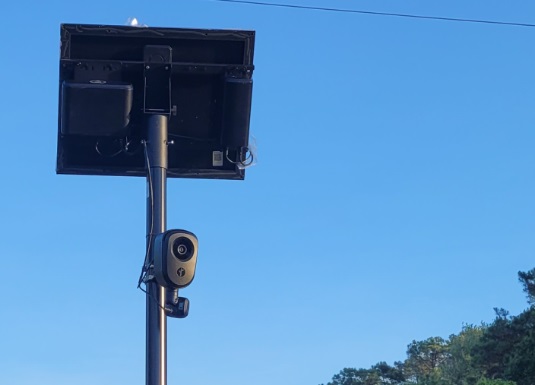
Photo by Thursday Review
Florida Bans
Flock Cameras on
State Roads & Highways
| published September 1, 2026 |
By R. Alan Clanton, Thursday Review editor
The Florida Department of Transportation this week issued a statewide edict banning the use of Flock Safety camera systems on state roads and highways. The order, which was approved by Governor Ron DeSantis, will also require that Flock cameras be removed in a timely fashion from wherever they have been already installed by local or county law enforcement.
The ban does not apply to camera systems installed on roads which are not part of the official state highway and road system, and—for now at least—those cameras may remain in place, though some local sheriffs and police departments began issuing their own statements on social media explaining that they will remove or disable all cameras within certain jurisdictions.
FDOT also said that the ban, which begins immediately, applies to other similar tracking camera systems not manufactured by Flock, which is based in Atlanta, GA. Flock Safety is the largest and most ubiquitous of these surveillance systems, though other companies sell products that work the same way.
Flock Safety cameras and similar systems have been installed by the hundreds of thousands across the country, in almost every state except Alaska. The systems are designed to automatically track vehicles based on license plate, vehicle make and model, color, and other distinguishing factors, such as dents, stickers, or add-ons. Flock Safety markets the systems as a reliable and effective way to locate stolen vehicles, track missing persons, manage traffic complexities, assist with infrastructure planning, and solve crimes. The systems are also commonly sold to communities and homeowners’ associations under the pretense that such systems will help greatly reduce car thefts, car break-ins, vandalism, garage-door entries, and sidewalk crimes.
The high resolution cameras, the real-time data, and the sophisticated algorithms used to identify vehicles are considered nearly 100% effective. The data collected can sometimes lead to rapid resolutions to certain crimes, meaning the cameras are tools often favored by law enforcement.
But in some cities and communities there has been organized opposition to the camera systems since the data collected can also be easily used to simply track the movements and behaviors of residents or visitors. There has also been an escalating concern over misuses and abuses of the systems, including a number of instances of police, law enforcement personnel, and public employees accessing the videos and the data to stalk spouses and significant others, to violate restraining orders, to track children, and even to collaborate with car thieves seeking to track the whereabouts of certain vehicles.
The systems are also reportedly easy to hack, raising concerns that unauthorized individuals, groups, and companies—foreign or domestic—can access the data collected to create profiles of individuals and families based on the driving habits. When combined between varying jurisdictions, the data collected can be easily collated—one of the selling points offered by Flock Safety.
Public outcry about Flock cameras had been a source of concern for DeSantis, who recently encouraged the Department of Transportation—the agency which had been tasked with issuing permits to counties, cities and communities—to consider a ban along state roads and highways.
The statewide ban will have no effect on camera systems installed for traffic flow and traffic management. Such systems can be found in nearly all of Florida’s 67 counties and in hundreds of Florida cities and towns. The current edict applies only to those Flock cameras installed on state roads and highways.
Florida’s may be the first statewide ban of the systems on state roads, though other states are considering similar moratoriums. Just last week, Texas terminated funding the cameras.
Flock Safety camera systems and those made by Flock’s closest competitors are inexpensive, easy-to-install, and relatively maintenance free. Many of the camera systems are powered by solar panels atop the device, and most systems can be installed alongside a road or near an intersection very quickly. Because the cost is so low, many counties and cities have installed the systems without any public discussion or public debate. But in communities and towns like Troy, New York, Golden, Colorado, and Mountain View, California, deep divides and bitter debates have erupted about installation of such systems.
Some civil libertarians have also raised fears that the data collected by such camera systems—when paired with some of the newest tools of artificial intelligence—can all-too-easily form an entire government dossier on private citizens based on the movements of the vehicle day or night. Indeed, similar surveillance systems already in place in shopping centers, malls, and other retail developments have been used to collate data about shoppers and frequent visitors.
Only a week earlier, Texas Governor Greg Abbott issued an executive order ending further state funding for Flock cameras or similar systems. Though the Texas edict did not go as far as that of Florida’s, some legislators in Texas are already urging a more comprehensive ban similar to the one just established in Florida.
Within hours of the memo and announcement of the statewide ban, numerous counties and cities in Florida issued their own press releases. Some county sheriffs and some police chiefs in the Sunshine State simply followed suit with their own moratoriums or bans, though in many of these instances the announcement made no mention of cameras already in place.
In most of Florida’s 67 counties, there is no local guidance preventing or discouraging homeowners’ associations, private developers and private neighborhoods, or even individuals, from installing Flock cameras.
Related Thursday Review articles:
Safety or Surveillance? How Flock Cameras Are Dividing Towns; By R. Alan Clanton, Thursday Review editor; May 28, 2026.
Jason Arday's Borrowings; By Bob Armstrong, Thursday Review contributor; August 28, 2026.