
Photo by Thursday Review
The Essential E.L. Doctorow
| published March 27, 2026 |
By R. Alan Clanton
Thursday Review editor
The folks at Thursday Review love E.L. Doctorow. In 1985—coincidentally our last issue printed on newsprint—we published a glowing review of World’s Fair, Doctorow’s clearly auto-biographical coming-of-age novel set in the Depression-era Bronx of the late 1930s, and with the 1939 World’s Fair as its penultimate cultural event. Though told mostly through the voice and eyes of its protagonist, Edgar (he bears a close resemblance to author Doctorow, whose first name is Edgar), the narrative also shifts into the words and deeds of other family members. Our reviewer, Beverly Keener, said World’s Fair was the best book she had read that year.
Then, back in 2006, Thursday Review published a short retrospective article reviewing Doctorow’s 1994 novel The March, a complex and multifaceted semi-fictional retelling of General William Tecumseh Sherman’s massive military campaign through the Carolinas and through Georgia in the waning stages of the U.S. Civil War. Our review was brief, glowing, and included a look back at the long cultural and historical resurgence in media and Hollywood interest in the Civil War..
But after some brief discussions on social media after Alan Clanton’s retrospective review of Quinn’s Book, by author William Kennedy, several TR readers began urging us to look at Doctorow as a great source of American fiction seen through the prism of time. Do these novels stand the test of time? Basically, that was the central question. In the case of Kennedy’s books: yes—most especially his celebrated “Albany Cycle,” of which Ironweed and Billy Phelan’s Greatest Game were arguably his most notable work.
Doctorow—who died in July of 2015—can be said to especially stand this same test of time. Born in The Bronx in 1931, Doctorow came to prominence as a new force in American fiction with his inventive style: the comfortable intertwining of his fictional characters—usually the narrator or protagonist—into the threads of real life people and into the histories of the era and place. This injection by average street survivors into the stories of the rich, famous, infamous or dangerous became for Doctorow his signature form of storytelling, and his novels made history and place a very compelling theme at a time when most best-selling authors found it easier to write into the here-and-now of their contemporary world. But Doctorow was a master at making the past particularly relevant to our own lives—our time and place and families—by making the past come alive in such vivid and tactile ways. Writer Jay Parini says that Doctorow “showed us again and again that our past is our present, and that those not willing to grapple with ‘what happened’ will be condemned to repeat its worst errors.”
Doctorow studied at Kenyon College in Ohio, and after a stint in the Army during the Korean War, Doctorow began his career as an editor—first for a publishing company, then for a New York firm which read and edited film treatments and stories submitted for the motion picture industry or TV. Among the screenplays and scripts he read were hundreds of westerns, churned out no doubt at high speed by struggling young writers and writing wannabes hungry for access to Hollywood or to television. Most of the screenplays were formulaic, hackneyed, dependent upon cliches. He hated the westerns he read so much that he finally decided to write his own version, and what began as a parody of the very form soon evolved into a real novel, as he found himself unable to sustain the sarcasm and sardonic downplaying of the western form. Instead, he wrote his own taut reboot of the genre, and in so doing found his love of writing period piece work. That book became Welcome to Hard Times (1960), a somewhat revisionist western (this, years before the film and writing form called “revisionist western” was understood to be a movement or subgenre). Doctorow was somewhat ahead of his time in the approach, but it paid off with a few positive reviews and some early recognition of his writing talent.
Doctorow became well-known when he hit his stride at the start of the 1970s with his novel The Book of Daniel, a fictional account very loosely shadowing the lives and trials—and eventual executions—of Julius and Ethel Rosenberg. Doctorow tells his story through the shifting lens of 1960s radicalism and leftism, and instead of the real-life Rosenbergs, the narrative rides upon his semi-fictional characters, Paul and Rochelle Isaacson as the retelling unfolds in the hands of their son, Daniel. The novel is a complex tale, with its narrator looking backwards (mostly) trying to make sense of his life within the context of past events, and parallel to this are references and allusions to the Old Testament, predominantly to the biblical "Book of Daniel." The novel can easily be regarded as somewhat experimental in style, since despite its smoothness and its remarkable ease-of-read (for me, at least), it shifts perspective while also viewing past events as clear prelude to what may happen in the future—both against the ongoing context of the “now.” This would be a recurring process for Doctorow over the long arc of his career as a writer.
As a fan of Doctorow’s works, his golden age seems to be the “center years,” that period from the mid-1970s through and mid-1990s when he hit his stride in terms of both atmosphere—few writers of the Twentieth Century were able to so deftly take readers into the fabric and tactile reality of history—and storytelling craftsmanship. Doctorow was able to take incalculable months of research about a given decade or place, and make it immensely fertile soil for his narrative genius without triggering even the briefest threat of boredom for the reader.
In order of publication date, Doctorow’s richest period of output includes Ragtime (1975), Loon Lake (1980), World’s Fair (1985), Billy Bathgate (1989), and The Waterworks (1994).
Ragtime was a huge success for Doctorow. The book became a best-seller, and set a new standard for its effective fusion of real life historical figures with the fictional characters, and for its interweaving of real events with the fictional narrative. The book also grew quickly in stature over the next year, with robust hardcover sales followed quickly by Bantam Books’ acquisition of the paperback rights for an eye-popping $1.8 million (This was a good move for Bantam, which quickly saw at least 5 million copies sell in paperback). By the end of 1975, Hollywood wanted in on the success of Doctorow’s novel, though it would take five years for the film to arrive in theaters. The film version of Ragtime, directed by Milos Forman, premiered in theaters in November 1981, but struggled at the box office despite good reviews from some critics; its budget ballooned in part due to complications of an actors’ strike in 1980.
Ragtime was, for many readers, very much a new kind of storytelling. The novel fuses and interweaves dozens of real-life people into the fictional tableau of the era, alongside and amongst fictional characters. Though Doctorow did not invent this form of narrative, with Ragtime he clearly perfected and shaped it into a largely acceptable form of fiction for the wider reading audience, and almost entirely without literary pretense or the sort of complexity that pervades books we delicately describe as “dense” or slow reading. Ragtime was neither of these, and its remarkable smoothness and steady pacing is one of the most endearing factors in the novel’s success. It would also become a Doctorow trademark—a careful, studied infusion of history and period atmosphere shorn of pretense and one-upmanship.
Among the characters we meet and spend time with in Ragtime: Emma Goldman, Harry Houdini. Sigmund Freud, Henry Ford, Theodore Dreiser, and—notably—Evelyn Nesbit, through whom (or around whom) a significant part of the story is told. Other parts of the story are told through the unnamed members of a wealthy family, characters known simply as “Mother” and “Father” and other extended family members referred to with monikers such as “Mother’s Younger Brother,” and so forth. Members of this family—whose fortune has been made in the manufacture of fireworks, flags, and patriotic decorations for picnics and parades—interact throughout the novel with both the fictional and the real world of the era. Other parts of the tale are told through the actions and eyes and words of Coalhouse Walker, a black man whose startling confrontation with white firemen and policemen who vandalize his expensive automobile sets in motion numerous developments within the story, and overlaps deeply with some of the other characters.
The novel presents a jangling, startling, boisterous tableau of both the shocking inequities and the rich diversity of the United States at the turn-of-the-century, with little off limits: labor disputes, child workers, racism and prejudice, opulent wealth and gritty poverty, police heavy-handedness, cruelty and kindness, and the dazzling sexual intrigues of the men who became obsessed with Evelyn Nesbit.
In 1980, Doctorow followed Ragtime with his highly experimental Loon Lake. And it was here where Doctorow stumbled and nearly fell. Loon Lake tells the story—more-or-less—of a Depression era ex-carnival worker and drifter named Joseph Korzeniowski, or “Joe,” who—after wandering and being chased by dogs—stumbles, literally, onto the idyllic Adirondack Mountains estate of a wealthy industrialist, F.W. Bennet. Most critics—and many readers—found the novel unapproachable; Doctorow had written the novel as if by pulling out all the stops on a Moog Synthesizer: non-linear, overlapping and shifting time frames; wildly shifting perspectives; alternating pronouns; differing narrative and textual styles with each chapter change; interminable sentences and paragraphs; and a glib disregard for so many grammatical canons that the story begins to rapidly buckle and fold. Still, a few critics praised Loon Lake for its penetrations into psychology, and its coming-of-age story of the young drifter and the characters he meets around the property at Loon Lake.
World’s Fair, which was published in 1985, restored Doctorow’s reputation with those critics underwhelmed by the experimental excesses of Loon Lake. Doctorow’s sixth novel, World’s Fair is Doctorow’s most autobiographical novel; its protagonist, Edgar, is a child of the Bronx of the 1930s and early 1940s. In World’s Fair, Readers are immersed in Doctorow’s lavish and eloquent style of atmospherics, though told mostly (not entirely) through the eyes of the young Edgar as he interprets the movies he sees, emulates his heroes, reads about war in Europe, and faces his Jewishness each day. Edgar speaks often as an adult with what we as readers (usually) require as a grown-up voice, while also retaining what is clearly needed to make Edgar understandable as this storyteller: the eyes of a kid in New York, alight with innocence and wonder but also already jade by the realities of his young life in the Bronx. The story swirls compellingly toward its title subject: the 1939 World’s Fair, which was located in Flushing Meadow, New York. The fair itself, described with Doctorow’s remark gift for color and detail and texture, give us also a look at how Americans perceived their world in the 1930s—the sci-fi and the fantastical mixing so hopefully with the backdrop of increasingly dangerous world events.
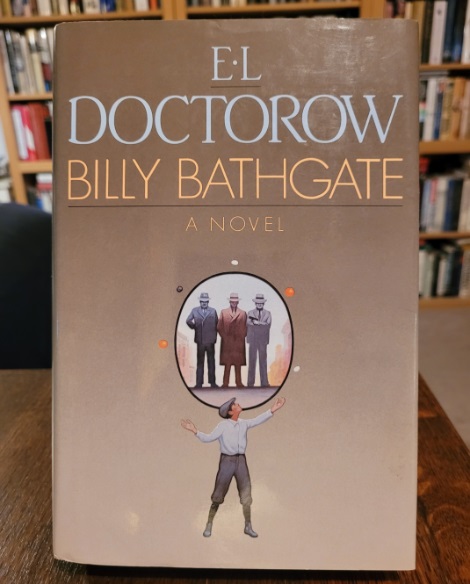
Of all of Doctorow’s best works, my favorite is Billy Bathgate. Published in 1989, the novel tells the Depression-era story of a precocious teenage kid from the East Bronx tenements who, by a chance encounter, is able to ingratiate himself into the inner circle of the Dutch Schultz criminal organization. Here, amongst accountant and financial strategist Otto Berman, mob lawyer Dixie Davis, fearsome gang henchmen Lulu and Irving, the young Billy Behan is able to sate his ambitions to rise above poverty and hardship. Billy also falls into a relationship with Drew Preston, Schultz’s ersatz girlfriend by way of the murder of Bo Weinberg. Billy’s romance with Miss Preston (she is in fact married to a wealthy New York stock analyst named Harvey), if discovered by any member of Schultz’s gang, would end in the deaths of both Billy and Drew.
The novel is largely framed around the central event of Bo Weinberg’s death. The narrative circles back to this incident—which Billy witnesses, his first close-up encounter with how Schultz metes out his form of mob justice—several times through a series of flashbacks, including Billy’s own retelling to Drew when she insists Billy recount how her beloved Bo had died. Accused of betraying Schultz, Weinberg is killed by having his feet encased in a large bucket of cement, then, he is pushed overboard from a tugboat late at night.
That our storyteller Billy has so easily insinuated himself into Schultz’s inner circle and into the rotating trust of Berman (who explains how he has rigged the numbers games), to Irving (a high-functioning recovering alcoholic, fastidious, patient, and precise), Lulu Rosenkrantz (brutal and lethal), and the chatty Schultz himself, obviously gives us, as readers, Doctorow’s own spin on how life was lived inside the criminal world of New York’s mafia of the 1930s. Still, Billy has his own moral compass, such that it is, and his affection for Miss Drew means he must walk a very narrow tightrope at times, balancing his own lies against his own life, and that of Miss Preston (who he vows to protect from what he fears will be her ultimate punishment for also being on that tugboat on the river the night Weinberg was killed).
One essential narrative component of the novel is its long segment told not in New York City, but in the country—in upstate New York, where Schultz’s lawyers have managed, after much negotiation and legal wrangling, to have Schultz’s trial for income tax evasion conducted. Doctorow spends much quality time in this contrast between the city and the small town, and in the sometimes jarring contrasts as seen through the eyes of Billy, the street smart city kid. This is Doctorow at his best: just as the atmospherics of 1930s New York City are so much fun to read, so too are the richly textural segments set in upstate. It is in this venue where Billy comes of age, both within the eyes and comradery of the gang, but also as Billy begins to develop his affection for Drew. Billy is almost as equally smitten by the idyllic beauty of a part of the world he could have only previously imagined—this city kid now surrounded by rolling hills, thick woods, lush farmland, babbling brooks and streams, and a town filled with polite people living their everyday country lives, boring though those lives seem when contrasted to the big city.
The character Billy speaks to us more-or-less from his adult perspective, and we are left to understand that he is retelling this story, not narrating it in real time as a teenager, but recounting these events from later in his life. In the end, the novel takes us rapidly into the complex intrigues which require that other gangsters, notably top boss Lucky Luciano, conclude that Schultz must be eliminated before he makes good on his bold plan to assassinate prosecutor Thomas Dewey.
Doctorow’s novel—though it uses Billy as our Trojan Horse to enter the interior world of The Mob—takes only minimal liberties with the known facts (in real life, Bo Weinberg went missing upon leaving a restaurant; he was never seen again and was presumed killed) while threading our fictional protagonist through some of the most intimate conversations between Schultz and his top gangsters. It helps us immensely that the gang members are as talkative to Billy as we need them to be. Likewise, the one plot device used near the end of the novel—whereupon Billy gains possession of Schultz’s horde of cash (in real life, presumed buried in the ground in a safe somewhere in remote upstate New York) and lives more-or-less happily ever after—was regarded by some critics as a cheap and lazy conclusion, though one could argue it too is in keeping with the way Billy has insinuated his way into the gang in the first place.
Then, there is The Waterworks—Doctorow’s tale of New York City in the years shortly after the U.S. Civil War. Another of Doctorow’s atmospheric period stories, the novel is also steeped in a dense brew of history and gothic intrigue, with lifelong newspaper editor—whose name we only know as McIlvaine—serving as narrator of a story apparently being retold decades after the events.
McIlvaine’s best freelance reporter, Martin Pemberton, has gone missing, not long after Pemberton—a Civil War veteran—asserts to McIlvaine and several others that his long dead father Augustus Pemberton is actually still alive. McIlvaine and the others assume that Pemberton’s outrageous claim is metaphorical: that the spirit and force and embodiment of Augustus Pemberton—who we learn made his money from the slave trade, then later, ironically, from lucrative military contracts for the Union Army—lives on within the corrupt machinations of New York City. It is the time of William “Boss” Tweed, an Industrial Age northeast dependent on child labor, and a staggering flow of immigrants from around the world. The older Pemberton became wealthy despite the shoddiness of the items he manufactured for the Army (boots and shoes that fell apart, uniform jackets and pants that bled their blue dye in the slightest rain).
But the younger Pemberton means what he has said: he believes his father is, in fact, very much alive and well, for he claims to have seen him in a horse-drawn carriage with other aging men, all well-dressed, all presumably healthy save for extreme old age. For the younger Martin Pemberton, the shock of this is complicated, for he has disavowed his father and estranged himself from his father’s business as a direct rejection of his father’s ruthless and craven business practices.
This leads our editor-storyteller on a multi-pronged investigation: what has happened to his best reporter? And can it be true that Pemberton’s father is still alive? McIlvaine takes a hiatus from his stwewardship of The Telegram to try to locate the missing Pemberton. The mystery deepens into plot twists that echo the darkest tales of Mary Shelley and Edgar Allen Poe. Augustus Pemberton, and numerous other elderly captains of industry—are in fact among the living, being kept unnaturally alive by a brilliant but possibly insane Dr. Wrede Sartorius, who uses highly exotic and experimental treatments at secret sanitariums, one of which is located inside the old city waterworks just outside of New York City.
Some critics noted that here, Doctorow himself presses his metaphors so intensely that they edge into more brazen symbolism, such as Dr. Sartorius’ use of the tissue, blood, and organs extracted or removed from sick or weak N.Y. child laborers to supply what he needs to sustain the lives of the aging wealthy and the elderly industrialists. Furthermore, it is the political machine of Boss Tweed that has empowered Sartorius to operate within the city, and it is the wealth—residual or otherwise—of these aging captains of industry which in turn fuels the corrupt cycle.
And though McIlvaine is jaded and cynical about his New York City, and uncertain of the success of his quest to locate the missing younger Pemberton, McIlvaine encounters an honest cop within the corrupt New York City police force—Captain Edmund Donne. Donne collaborates with McIlvaine to seek out the truth.
The Waterworks is filled with a persuasive combination of ghost story and political thriller, as well as its share of contemporaneous science fiction: among Sartorius’ treatments are blood transfusions and bone marrow transplants, procedures that had not yet been invented. The novel also ends murkily and uneasily for our narrator McIlvaine: as an editor and writer, he had stumbled upon what would have been the story of the century, but he is so disturbed by this tale that he cannot see fit to write about it in any context or in any venue. This is ironic to him, since he readily acknowledges at the beginning of the novel that as a newspaper editor, he is both curmudgeonly and hard-to-please, rarely offering praise even to his best writers, and always on the lookout for what he cynically hopes will be the next shocking, lurid headline for the readers of New York City.
That the subject of McIlvaine’s quest is his best writer Pemberton—a frequent book critic known for digesting entire books in two days and then offering scathing or blistering reviews—gives Doctorow ample room to have fun with the literary modes of the previous century, and to poke a little macabre fun at book criticism in general.
But the novel’s setting in New York City also helps establish many things we come to understand about this greatest of all American metropolises in another time: New York City’s evolutions have never ceased, but the town always owes something critical to its checkered and complicated past. Indeed, The Waterworks many subplots set the stage for what we understand about the city described by Doctorow so colorfully in Ragtime, Billy Bathgate, and World’s Fair. Again, Doctorow’s immersive style commits him to a passion for New York City much in the same way that we breathe the air of Albany in the works of William Kennedy, or in the way we taste the brackish tides of South Carolina in the works of Pat Conroy, or in the way we marvel at the chaos and cacophony of Florida described by Carl Hiaasen.
Doctorow died at age 84 in July 2015. The New York Times described him as a “literary time traveler.”
Related Thursday Review articles:
The Albany N.Y. of William Kennedy: A Look Back at Quinn's Book; By R. Alan Clanton; Thursday Review; February 24, 2026.
Why Does The Catcher in the Rye Remain Such a Sturdy American Classic?; By R. Alan Clanton, Thursday Review editor; February 9, 2026.