
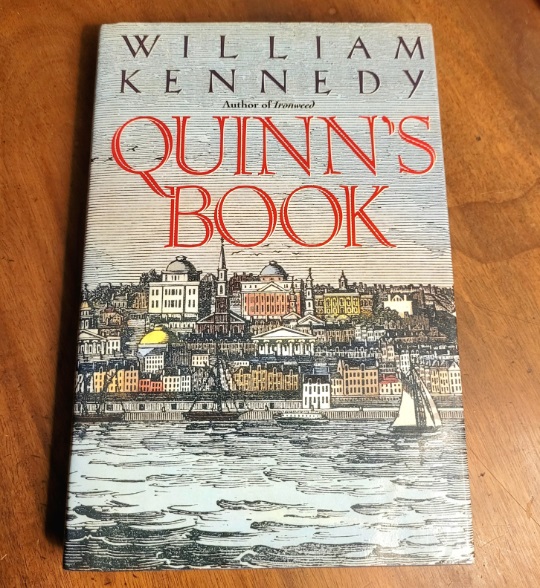
Photo by Thursday Review
The Albany N.Y.
of William Kennedy:
A Look Back at
Quinn's Book
| published February 24, 2026 |
By R. Alan Clanton
Thursday Review editor
Author and historian William Kennedy faced tough times in the 1970s. Despite his skill as a writer and his years in journalism, his only novels written to that period had languished in a backwater of sales. The Ink Truck was published in 1969, Legs in 1975, and Billy Phelan’s Greatest Game in 1978; to avid readers and to Kennedy fans in later decades, these brilliant works of fiction occupy an more-or-less obvious place in the American literary Pantheon, but this was not the case in the early 1980s. Though he taught journalism and writing at the University of Albany for many years, it was beginning to look like his fiction would slip into obscurity.
Even when he completed writing Ironweed—a book that was to become one of his masterpieces—his struggles for recognition were still substantial: legend holds that the book was rejected at least a dozen times by publishers before his mentor, Saul Bellow, intervened and threw some leverage behind Kennedy’s work. Bellow leaned on his contacts at Viking, and Ironweed hit the presses. This time, the book gained traction not only with the literary critics but the wider reading public as well, and Ironweed went on to become a smash success. Predictably, this spurred a rapid reconsideration of his earlier books, and Legs and Billy Phelan’s Greatest Game both gained fresh recognition, which in turn triggered sales (think of Bruce Springsteen’s first two albums, and their rediscovery only after Born to Run became a huge success).
As anyone who has ever read William Kennedy knows and understands, the author’s true love is his hometown of Albany, New York. Born in Albany in 1928, Kennedy went on to college in Loudonville at Siena College. His early career was in journalism, working for newspapers in Glens Falls, then back in Albany for the Albany Times Union. Drafted into the Army in 1950, he took his journalism skills with him, writing for an Army newspaper while stationed in Europe. Then, at the end of the 1950s, Kennedy travelled to Puerto Rico to work and study, the work part of the equation being journalism—he was a founding editor of the San Juan Star. The study part of the deal was to learn from his new mentor, Saul Bellow, who was teaching a course in writing. That friendship would place the seed for Bellow’s intervention years later.
Kennedy’s works include plays, short stories, children’s books, screenplays (he shares credit with Francis Ford Coppola for the script for The Cotton Club), lots of non-fiction, and even poetry.
But Kennedy’s main body of work is what is known as the Albany Cycle—a series of novels, somewhat loosely interconnected by time and history and varying lineage, centered in his beloved Albany, a city which only Kennedy seems able to paint so dazzlingly in both the vivid colors of each time and place, and in the subtle hues, sepias, newsprint black-and-white, and golden hour luminance his novels and characters seem to inspire. These novels include the aforementioned Legs (his semi fictional account of gangster “Legs” Diamond, who was killed execution style in a rooming house in Albany in 1931), Billy Phelan’s Greatest Game (the story of a bookie, poker player and pool shark with a penchant for small-time trouble who finds himself suddenly caught-up in a much more sinister crime), and Ironweed, the Depression-era novel that went on to win a Pulitzer Prize and a screen adaptation starring Jack Nicholson and Meryl Streep.
Quinn’s Book, published in 1988 after Kennedy had received a grant to allow him the freedom to write full time for at least three years, fits neatly into the Albany Cycle. Told in Kennedy’s lavish and atmospheric style, the book takes readers back into the mid-1800s and onto the streets and into the homes of the rich, the poor, and the inescapably eccentric of the Albany of the nineteenth century. Told more-or-less entirely from the standpoint of—and in the voice of—its protagonist, Daniel Quinn, the novel is lush with journalistic detail and gritty realism, and steeped deeply in the language of the day. Indeed, some readers may be taken aback at times by the colorful and sometimes baroque interplay of linguistic textures and dictions, a not unreasonable approach to a story in which its principal characters—Dutch, Scots, Irish, English, escaped slaves, Spaniards, American Indians, French—are simmering in the melting pots that were the cities and towns like Albany.
Quinn is an orphan who has survived his hardscrabble life through luck and cunning (in this sense, the novel is a traditional orphan’s tale), but who is smitten from the outset of the story by a young girl named Maud Fallon, whose life he has saved from drowning, and whose aunt and guardian is an infamous Spanish dancer and actress and stage provocateur named Magdalena Colon. Aside from his attraction to the enigmatic Maud, Quinn is drawn to the newspaper business—for he hopes one day to become a decent writer and storyteller. Quinn also finds himself in possession of a long-buried birdcage—deliberately hidden by his family—which, after he digs it up rusted and rotting, seems of little value until he discovers a small disk-like “plate” hidden in the bottom of the cage.
Tracking back at times four and five and six generations—to Holland, to England, to Scotland, through generations of Indian tribes—Quinn’s books also, at times, feels genealogical in its threads, though Kennedy is sufficiently skilled as a gifted craftsman of the great American historical novel to sense the right moment to swerve from this multi-generational Americana in the nick of time, sparing us tedium. His great-great-grandfatherly-great-grandmotherly set-ups serve to set each family stage for the oddities and the eccentricities of Albany before and during the U.S. Civil War, and further enrich the flavor of the melting pot. Such is life along the Hudson River.
The book can be messy—literally—and Kennedy is effective enough as a writer to make these grotesqueries work: open wounds festering and then being treated; firsthand accounts of the effects of cholera and other nineteenth century plagues; sexual encounters for which explicitness is replaced with Quinn’s firsthand accounting in decorous but precise language. Again, Kennedy takes care to veer us back into the intrigue of the story before these moments become tiresome.
Quinn’s Book can be a challenge at times to read, but this effort is well-rewarded for anyone who sticks to the story and finds the treasures throughout. Kennedy is such a gifted storyteller that by the point of about the third chapter, you will not want to set the book aside. Quinn’s Book is also a good starting point for someone delving into Kennedy’s body of work for the first time (it is not necessary to read the Albany Cycle in any particular order, though arguably Ironweed is the most tragic and emotionally gripping of the series).
Kennedy’s passion for writing about Albany has been deep, and the city—the site of several sixteenth century Mohican and Algonquin enclaves, settled later by Dutch colonists as early as the 1620s, and chartered officially by the English in 1686—has been a source of Kennedy’s most fruitful output of atmospheric, evocative writing.
Related Thursday Review articles:
Why Does The Catcher in the Rye Remain Such a Sturdy Classic?; Alan Clanton; Thursday Review; February 9, 2025.
Wolf in White Van; Book Review by Kristy Webster, Thursday Review contributor; February 5, 2016.