
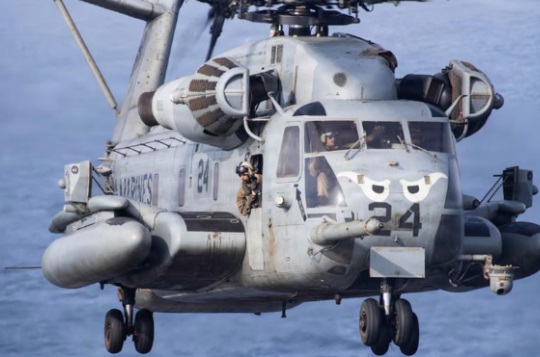
Photo courtesy U.S. Navy
Pentagon Requests
Weapons Production
Increase
| published September 2, 2026 |
By Thursday Review staff
September began with escalating violence between the United States and Iran, and by the end of Tuesday both sides were again trading rockets and missiles, with Iran retaliating by firing missiles at Jordan, Kuwait, and Qatar. The intense flare-ups have shattered hopes that the war had moved into a purely economic battle of wills between President Donald Trump and the Iranian regime.
Instead, the U.S. Central Command announced that “U.S. forces began striking Islamic Revolutionary Guard Corps (IRGC) targets in Iran” in direct retaliation for Iranian attacks on both commercial shipping in the Persian Gulf and on U.S. forces in the region. And though the rapid escalation has been substantial over the last 48 hours, President Trump took to social media to imply that the heaviest attacks against Iran were “waiting in the wings.”
With the cost of the war between the U.S. and Iran increasing with each passing month, and little end in sight for the Trump administration or the Pentagon, talk of shortages of ordnance and weapons—most notably the missiles, rockets, and drones being used most heavily by American forces in the region—have wrought genuine worries that the U.S. military has depleted its stockpile to dangerously low levels.
Also critical, at least according to some reports that have appeared in the Washington Post and other media outlets, is that overall large-scale operations in the Middle East are posing a clear risk in other regions of the world—especially in those areas where U.S. forces are already spread thin, or where local or regional tensions are a constant issue. Experts have cited especially a need for constant vigilance in the Pacific, where China and North Korea pose existential threats to their neighbors, and to the Ukraine, which is deep into a four-year war which began when Russia invaded eastern Ukraine.
At least $30 billion in approved and planned assistance to Taiwan has not been delivered, despite enormous military exercises directed by Beijing in the waters around Taiwan and in the air—drills meant to simulate a full scale invasion.
Though exact numbers are classified, according to Reuters and other news sources, the U.S. has used some 65% of all its stockpile of ship-launched rockets and missiles—almost all of that in the Middle East. This number may include some 80% of all THAAD missiles and around 50% of all U.S. Patriot interceptor missiles.
As a result, the shortfall has triggered delays in providing weapons to Ukraine, and has caused delays in the delivery of weapons and ordnance—already agreed upon—to Taiwan and The Philippines. The shortage has also required moving many chess pieces around on the board—redeploying some rockets and missiles from Europe, for example, to quickly resupply forces in the Middle East. Officials in Japan are also on edge since they have been told to expect similar delays on defensive systems; Japan hopes to acquire several key defensive tools, including Patriots as well as Tomahawk cruise missiles.
News of the possible weapons shortages echoed through Washington more than a month ago, and the reports came in tandem with concerns about personnel fatigue and conditions aboard U.S. ships, and of critical weapons being pulled from other theaters to be sent immediately to the Middle East.
President Trump and Secretary of War Pete Hegseth have generally dismissed such concerns, and have said there is no risk of American forces running out of essential weapons or ordnance. Some military think tanks are even in general agreement on the basic facts: the real shortage is not with guns, bullets, tanks, boats or boots, but with very specific high tech weapons systems such as the defensive Patriot missiles and the offensive rockets like the THAADs.
Despite assurances by Trump and Hegseth, Department of War officials have asked that several major military contractors quickly ramp up production of those weapons systems at greatest risk of depletion.
Just this week, the DoD announced it had signed-off on two major seven-year “framework agreements” with General Dynamics and with Lockheed Martin to speed up production of certain weapons. The DoD announcement said the agreement would fast-track the manufacture of both the Patriot (full name: Patriot Advanced Capability-3 Missile Segment Enhancement interceptors programs), and the THAAD (Terminal High Altitude Area Defense).
“Today’s announcement represents an example of the evolution of how we partner with industry to expand the Arsenal of Freedom [to] outpace emerging threats,” said Under Secretary of War Michael P. Duffey.
Duffey’s statement made it clear that the Pentagon wants to move quickly by “cutting red tape, shortening timelines, and rapidly scaling our domestic manufacturing capacity…”
The statement said that, among other objectives, the Pentagon needs General Dynamics to triple its production of the PAC-3 MSE interceptors (Patriots), and quadruple production of THAAD interceptors. In the DoD press release, Duffy also said that the same pressure will apply to those contractors and subcontractors who supply General Dynamics with their specialized components and parts.
Some military analysts suggest that these requested numbers are in alignment with the estimates that indicate that the U.S. may have already fired some 65% of these missiles and rockets in its combat operations in the Middle East. Meaning, the weapons shortages, while limited to very specific areas, are in fact real.
U.S. forces included or positioned in NATO countries have felt the pinch, and this sense of urgency has been heightened by the increased number of incidents in NATO nations involving Russian (or Russian-directed) aerial and drone incursions. There have been flyovers or missile and drone incursions by Russia in Romania, Poland, Germany and Hungary, and though some of these have been “accidental,” others have been viewed as attempts by Moscow and by Vladimir Putin to test both the effectiveness of NATO’s defensive systems, as well as NATO resolve.
Likewise, China has been flexing its muscle around Taiwan, which Beijing has never acknowledged as a separate or independent entity. And in the Korean peninsula, annual joint exercises with the combined forces of U.S. and South Korean troops were cancelled or largely scaled back over concerns that the Pentagon needed to prioritize its Middle East operations.
Though their sources have remained anonymous, the Washington Post published an article this week revealing that some Pentagon top level assessments have raised the alarm bells regarding U.S weapons stockpiles. One of those routine reports—the Secretary of Defense Orders Book, or SDOB—has specifically described the weapons issue as critical to all theaters of operation for U.S forces. The report is classified, but those who have had access to the information have apparently leaked the gist of the mid-August report to some news sources.
At the start of the U.S. war with Iran, President Trump indicated that it was his view the war would last only a matter of weeks. But the war quickly escalated, and became more complex. Despite repeated attempts (and reports of attempts) to negotiate a settlement, hostilities continue to erupt between Iranian forces and U.S. forces in the region, and each time the fighting flares up, more rockets and missiles are expended. Now six months into the war, and the Pentagon is busy shifting priorities elsewhere in the world in an effort to keep the option of continued military action available to President Trump.
In the meantime, Iran has remained defiant despite the punishing strikes by the U.S. On Tuesday, a spokesman for the Iranian Foreign Ministry adopted a much more bitter and dire tone in his comments, suggesting that if Iranian oil and commerce is to be restricted, then no other nation’s commerce will be allowed to pass through the Strait of Hormuz either.
Related Thursday Review articles:
Saving Lives in War; By Bob Armstong, Thursday Review contributor; May 18, 2026.
A Political Autopsy With Few Surprises; By R. Alan Clanton, Thursday Review editor; May 24, 2026.