
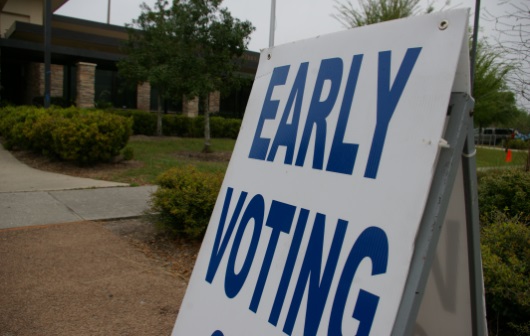
Photo by Thursday Review
A Political Autopsy
With Few Surpises
| published May 24, 2026 |
By R. Alan Clanton,
Thursday Review editor
The so-called Democratic Autopsy has finally been “declassified” by the Democratic Party and has been released to the media and the public, if anyone is interested. CNN first published some leaked portions of the report earlier in May, but now the entire document can be accessed online, in a PDF version, or, for that matter, on dozens of news websites across the land.
This blunt forensic analysis (it can be found at democraticautopsy.org) offers no surprises. The report simply puts some serious pounds-per-square inch chomp-down on the already biting facts.
First, that by early 2024, then-President Joe Biden was becoming unraveled by age and addled by mental deterioration, and by the time he arrived on stage to debate challenger Donald Trump, it was too late. Biden’s shocking debate performance caused his campaign to implode, and because of the perilously late date, made any campaign by Kamala Harris untenable.
Secondly, that Biden, his spokespersons, and his proxies in the media were tone deaf to the economic hardships through which most Americans felt their daily and weekly pain. President Biden and his White House team were not merely late-arrivers to this particular dance, they were no shows entirely. And even after Biden had handed the baton to Harris, she too failed to address the obvious. In the fever pitch of the election, when asked by CBS News if she would have done anything differently, giving her a chance to differentiate herself from Biden, Harris said “nothing comes to mind.”
Thirdly, the Harris campaign wasted incalculable millions of dollars and unfathomable resources on all the wrong things, a component of which included missed opportunities in several key states. On Election Day this enabled Trump to take not only critical swing states, but gave him decisive leverage in states that should have been easy wins for Harris, such as Michigan, Pennsylvania, and Wisconsin.
And, fourth, the Harris campaign and the Democratic Party failed at that most essential of time-honored and time-tested political canons: get out the vote. By the time the votes were all counted, Harris had managed—improbably and inexcusably—to shed nearly 6.8 million voters who had voted for Biden only four years earlier. Harris also allowed some three million Democrats to stay home on Election Day.
On these four major points, the report offers little that should come as a surprise to anyone who was awake during the 18 month run-up to Election Day 2024. Indeed, entire books have been written on the subject (see our review of 2024: How Trump Retook the White House and the Democrats Lost America, by journalists Josh Dawsey, Tyler Pager, and Isaac Arnsdorf).
What makes this report crucial for the Democratic Party is that it offers an unfiltered, no-holds-barred, gut-wrenching assessment of how these failures cost the party dearly on Election Day, and may have even contributed mightily to the disaffection and disillusionment of many voters who might have otherwise been predisposed to lean leftward or toward the Democratic ticket. Many Democrats felt then—as they do now—that some aspects of the disaster were avoidable, most especially those owned by Biden himself.
Central to all of this, as the report makes clear, was Biden’s personal decision to reject his pledge to serve as a “bridge” president—that is, serve out one term while simultaneously encouraging the next generation of Democratic Party leaders to have sufficient time and space on the national stage to run in 2024. As many Democrats have told me over the last year and a half, had Biden stuck to that original pledge, the primary and caucus season for Democrats would have looked much different, and surely would have included a dozen candidates of Harris’ generation.
This in turn would have given Democratic voters an investment in the process and in the choice at the top of the ticket in November 2024. As it turned out, Biden’s ultimate decision to not run came so late that few Democrats even knew anything about Kamala Harris, much less had some form of enfranchisement in her candidacy. Instead, Harris had a scant 107 days to organize her campaign, establish a message, and present it to a largely skeptical electorate—none of whom had voted for her in a single primary or caucus in 2024.
For the Democratic Party, this was a historically unprecedented situation—a conundrum of sorts which could not be avoided once the die was cast. Only one U.S. President had served without having been elected either as President or Vice-President, and that was Gerald Ford. After then Vice-President Spiro Agnew resigned, Richard Nixon had selected Ford to be his Vice-President. But after Nixon himself resigned in August 1974, Ford served the remainder of Nixon’s unfinished term. Ford had two years in which to prove his mettle to the American public, and Ford ran a full-court press in the primaries and caucuses in 1976 (he was challenged by Ronald Reagan), which meant Ford had earned his place at the top of the ticket in his own right by the time he addressed Republicans at the convention in Kansas City that summer. But even with his formidable popularity, Ford lost in November to Jimmy Carter; Ford could not shake off the legacy of Watergate, and was rejected by a majority of voters.
Hubris certainly played a role in Biden's thinking, though one can argue that ego plays a large role in any presidential campaign. But Biden’s decision to reject his own pledge to not run for a second term set the stage for a primary and caucus season with no challengers, no serious considerations of a Plan B, and a progressively-tightening window of opportunity to unravel what some within the party must have known might become a Gordian Knot. Again, the reporting was out there, but during the Biden years most within the White House—along with the surrogates within the chattering media—regarded the narrative of Biden as a stumbling, bumbling, elderly man on the edges of dementia as a tempest stirred up only by the most rabid of the right-wing media. Neither Biden’s age nor his mental capacities were a genuine issue, or so the thinking went.
When Joe Biden faced off against Donald Trump on the same stage in June, the reality was much different. By that time there had been dozens—indeed, scores—of stories, albeit anecdotal, among those who had come into close contact with Biden over the previous year, including lawmakers, donors, political allies, media people, and advisors. Taken together as a whole, these seemingly small encounters clearly showed that the President’s mental faculties were suffering. Within the first twenty minutes of the debate, the spectacle was a disaster for Biden. By the time the debate was over, few analysts on either side of the political divide seriously thought Biden could recover the public’s trust easily. To paraphrase the book by Dawsey, Pager and Arnsdorf, the drumbeat began in the distance, but in earnest. Donations dried up within days, celebrities and fundraisers canceled or postponed events, and a slow but steady erosion began among Democrats in the House and Senate.
Reasonable people can disagree, but it is not an overstatement to suggest that the election was won by Trump and lost by the Democrats in the chaotic weeks that followed.
Still, the autopsy offers a significant deeper look at some of the events that preceded the infamous debate, and the multitude of miscalculations (and a few boneheaded moves) that followed.
The long-awaited “Democratic Autopsy Report” spent time in its own form of lockdown long enough to spawn controversy. For reasons that remain unclear and muddled, DNC chairman Ken Martin, among other party officials, kept the report secret for many months. This sequestration of the document fueled speculation—some mild, some wild—that the report was either too brash or too toxic for media exposure. Rumors swirled, including one which suggested that only a redacted version would ever been released. Even the mainstream media loves a dark conspiracy theory, and the longer the report remained shrouded, the more the narrative began to drift into the political equivalent of Big Foot sightings and grainy photos of the Loch Ness Monster.
To avert being tainted by the accusation that the party was hiding its own dirty laundry, the DNC finally agreed to release the report in an act of “full transparency,” but only after effectively disavowing the conclusions, scoffing at the writing style, and even adding the strange caveat that the DNC “cannot independently verify the claims presented.” Meaning, there were photos of Big Foot and the Loch Ness Monster sitting in on Democratic Party strategy sessions.
Current DNC leaders also gave the report a less-than-stellar grade for style and composition, stating that the paper “does not meet our standards.” This is in itself is revealing, since it suggests that the DNC is more concerned with split infinitives and dangling participles than doing the sort of soul-searching needed to fix the problem—in fact, a recurring problem. Some Democrats are still stinging from Hillary Clinton’s seemingly improbable loss to Trump in 2016. And I know more than a few Democrats who are still sore that they lost to George W. Bush in 2004. In all three instances there was shock and dismay, followed by the usual “how is it that we screwed that one up?”.
I read the full report very carefully in almost one sitting, and some of the least surprising elements seem to be the ones that provoked the most outrage and most askance looks by the DNC.
One crucial section of the report focuses on how the Democratic Party lost the trust and loyalty of working-class voters and the vaguely defined blue collar segments, many of whom (especially those aligned tightly with labor unions) were exceedingly loyal to Democrats in the early and middle twentieth century. But, this of course is old news, and one which has troubled the Democratic Party for decades. The steady migration of some segments of the working class began with Richard Nixon, then, reached significant levels with Ronald Reagan in 1980. Reagan’s landslide win in 1980 was largely seen as the start of an electoral realignment, one which would not have been possible without a massive shift in the allegiance of millions of working class Americans. In the intervening decades this tide has shifted somewhat back and forth, but only on occasion in favor of the Democrat at the top of the ticket—as it did to a degree for Bill Clinton in 1992, and again for Barack Obama in 2008.
But the report is shockingly thin on root causes. Even most Democrats agree that the pivotal campaign issue was inflation, and a failure by Biden-Harris to take ownership of the hard street facts of the economy. Clearly this spurred a decisive migration of working class and middle class voters to move rightward, drawn—uneasily perhaps, but inexorably—toward Trump’s populist rhetoric. Worse, neither Biden nor his White House team offered much acknowledgment of the economic hardships that were steadily defining the Biden era. Inflation, coupled with the witch’s brew of supply chain issues, shortages, job insecurity, and wage instability, produced an unsettling reality from which Biden appeared detached, and one which his surrogates downplayed or dismissed.
Arguments about what could have been done to improve or fix the economy became meaningless by the time it was too late, just as they would be pointless now. As one Democratic friend told me, “what’s the point of arguing solutions to the problem if the President doesn’t even acknowledge that there is a problem?”
This alone was potentially fatal, as Americans rarely tolerate extreme economic hardship for very long. But even after Biden agreed to step aside in July, Harris seemed strikingly unwilling to accept any ownership of a failing economy, preferring the feint of “well, it’s not really that bad.” Steadfastly Harris shunned any strategy that would require a full embrace of an issue deemed central to the reality of most Americans.
Even Biden’s “successes” on the economic front missed the mark or sailed into oblivion. The report cites the Inflation Reduction Act, which in the end produced little easing of the pain, and was so abstracted from Main Street realities that most people had never heard of it. The report fails to directly talk about Biden’s inability to understand the optics of the moment (a key point I wrote about in previous articles). Cancellation, for example, of oil lease options on Federal land in Wyoming and the Dakotas, and a reduction in new leases in the Gulf, during the same exact week that fighting between Russia and Ukraine triggered a measurable increase in worldwide oil prices. Whether his decision regarding the leases was sound or not, why choose that moment to throw salt directly on an open wound? Why not wait even two weeks? These are the sorts of day-to-day decisions which Presidents must make with judicious care, and with a full understanding of the potential for collateral damage.
Biden’s penchant for similar blunders—some merely the result of foolish timing—kept the drip-drip-drip nearly continuous, and included an inability to understand the horrific optics along the U.S.-Mexico border, and the stunning visuals of desperation as the last U.S. military cargo planes left Kabul. Each became made-to-order talking points for conservatives, and the border problems—which reached crisis levels for more than a year—all-too-easily fed into the feedback loops of crime, health care, and economic struggles.
These optical disconnects pushed millions Americans away who might otherwise have been predisposed to vote Democratic in November 2024, and many of those same voters either stayed home or voted for Donald Trump. It remains unclear how much leverage Kamala Harris could have exerted, and to what effect, considering the short amount of time she faced between Biden’s withdrawal and Election Day.
The report, authored by a decidedly left-of-center (at times brazenly socialist) organization is unfriendly toward the Democratic Party’s overall strategic uncertainty, but it is obviously hostile in places toward the GOP, to which it frequently points with the usual punch-down list of canards, assumptions and gripes (corporate greed, a desire for low wages, reduced health care, and a not-so-veiled agenda of race and cultural bigotry). The MAGA movement and Trump’s frequent rhetoric make some of this a valid punching bag, but many of these talking points are the same straw man absurdities made by the hard core left since the 1960s and 70s.
A few of these assertions are made more with an accusatory tone toward the Democratic Party for not offering substantial retorts to the GOP, but this circles back inevitably toward longstanding fractures with the Democratic Party. The multigenerational battle between “progressives” and “liberals” is a family feud with very deep roots, and can traced back to the bitter fights between—for example—Lyndon Johnson and Bobby Kennedy (1968), or to latter struggles between Walter Mondale and Gary Hart (1984), or between Hillary Clinton and Barack Obama in 2008. This power struggle between the traditional “moderate” component of the Democratic Party and its more left-leaning elements has erupted noisily every few election cycles. And it can pit advocates of centrism and moderation against vocal left-leaning gadflies like Bernie Sanders. It can also have devastating results when it causes the fragile coalition to become unglued, as it did in 2000, when Ralph Nader may have sheared away enough votes to deny Al Gore the Presidency. (What really mattered more in all those Florida recounts?—the 525 votes which separated Bush from Gore?—or the 97,470 votes Floridians cast for Ralph Nader?)
It is on this very chalkboard where the report grated most noisily and irritatingly on the DNC. This longstanding struggle remains unresolved, and there have been misjudgments over whether to co-opt GOP language and develop centrist bridges (as President Clinton did after the so-called Republican Revolution in 1994), versus an unapologetic, full body embrace of leftist causes and progressive themes, something the party has been reluctant to do in decades.
Again, this was a topic which fueled Nadar’s campaign rhetoric and rallied his followers, and later gave energy to Bernie Sanders: of what use is the Democratic Party to progressives if the party, every four years, simply rechristens itself “GOP Lite” in an effort to appease moderates and centrists? The autopsy hits this theme pretty hard. Harris famously courted some disaffected Republicans (such as maverick Liz Cheney), openly touted the ambivalence of Republicans wary of Trump (Nikki Haley and Mitt Romney, to name two examples), and expended great strategic energies in creating a safe passageway for Republicans to abandon Trump and vote outside their comfort zone on Election Day. But the report, authored as it was by progressives, felt (maybe rightly) that this was not only wasted time and energy, but even counter-productive to the critical goal of getting out the vote and making certain that the traditional Democratic constituencies had a reason to believe in Harris.
Here too is the conundrum for Democrats: Trump loyalists are famously unwilling to turn their backs on Trump for any reason, and Republicans have for decades shown a propensity for voting reliably Republican (and turning out consistently on Election Day). This is true even when those voters are compelled to hold their noses while casting that vote, and even when they have remained “undecided” right up until the night before. Conversely, the Democratic Party has lost several Presidential elections because many Democratic and independent voters simply stayed home, as was the case in 1988 when George H.W. Bush trounced Michael Dukakis, and again in 2004 when George W. Bush defeated John Kerry.
In short, if Harris and her team had learned any lessons from the elections of 2016 and 2020, it was surely pointless to waste any resources or money in an attempt to lure large chunks of the traditional GOP map, especially in the era of Trump. Biden’s win in 2020 came not through outreach to Republicans, but by way of the most time-honored of all election strategies: voter turnout.
The report also drills down deeply on some of the details. For example, Harris and her advisors were told that most polling data showed that “measured breaks” from Biden’s positions might easily and gently separate her from a few of Biden’s biggest blunders, but the inner circle around Harris basically ignored this advice. Harris was inexplicably obtuse when asked to explain any policy differences with Biden, or for that matter anything that she might do differently herself as President.
There were other details badly handled. Even when pollsters presented that campaign with clear statistical proof that some of Trump’s negative ads were shown to be effective with voters, the Harris team did nothing. Harris also ignored vast chunks of rural and heartland America, and constantly argued that the college-educated areas and the upper-middle-class suburbs would effectively close the gap (this strategic misfire was almost identical to the one triggered by Hillary Clinton in 2016 when neither the suburbs nor the college-educated women rescued her from Trump’s Election Day onslaught).
Arguably the most sensitive and contentious segment of the report discusses Biden’s handling of Israel and Gaza, and the war that Israel waged in Gaza after Hamas kidnapped and killed more than 100 Israeli citizens. The report’s author makes it clear that the Israel-backed political action groups in the United States wield far too much power within the policy-making rooms and within the places where large donations to Democrats originate. The report suggests that Michigan was winnable for Harris, but that her failure to call out Israel for genocide, forcefully admonish Benjamin Netanyahu, and distance herself from Biden’s position, not only allowed Michigan top slip away, but even tilted many of those same cities and towns into Trump’s column, effectively turning Michigan in Trump country. Trump won in Michigan by 80,000 votes.
But the report’s handling—notably its sequestration, reluctant rollout, and the ensuing caveats and disclaimers tacked upon it by the DNC—produced its own weird weather system, a political squall which displeased many Democrats who feel that openness and candor is the correct path forward after a crushing defeat. This risk-aversion to even understanding what went wrong is an obvious sign that the party’s health is not on the mend, despite the optimistic prognostications about the much-anticipated midterm elections, now only months away.
Related Thursday Review articles:
A book review of 2024: How Trump Retook the White House and the Democrats Lost America; R. Alan Clanton; Thursday Review; February 25, 2026.
Trump's Huge 2016 Win: How the Pundits & Pollsets Got it Wrong; By R. Alan Clanton, Thursday Review editor; November 11, 2016.