
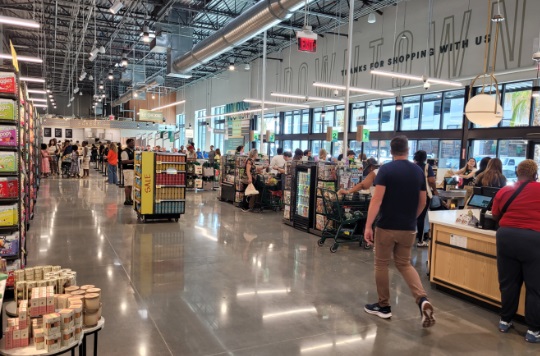
Checkout area inside a Whole Foods Store in Florida;
Photo by Thursday Review
U.S. Inflation Hits 3.7%
In September
| published October 14, 2026 |
By R. Alan Clanton, Thursday Review editor
Inflation in the U.S. rose to 3.7% in the month of September, a slight uptick over the adjusted August figure of 3.4%, according to data released this week by the Bureau of Labor Statistics. Most analysts say that the biggest factors in the jump are linked directly to gas and energy prices, both of which continued to spike in reaction to the war between the U.S. and Iran, and food, much of which is likewise tied closely to fuel costs, transportation expense, and the cost to operate farm equipment.
The increase in inflation is unwelcome news for Republicans across the country, especially those facing stiff challenges from Democratic candidates in House and Senate races. Numerous races at the congressional level are extremely close, and Democrats hope to leverage dissatisfaction with President Trump’s handling of the economy into enough wins to regain control of the Senate, and possibly the House of Representatives.
The September spike in inflation is the highest since the biggest surge of the year, which came in May—a springtime spike of 4.2% which was spawned almost entirely as a result of higher gas prices.
All told, gas prices have risen about 34% in the last year, and the fuel oils most commonly used for home heating have increased a staggering 70%. Those costs are being passed on to consumers across the country, and as cooler weather arrives, many homes will face sharp increases in heating costs. Some analysts suggest that many Americans could pay as much as $1000 more this year in gas and energy costs over the previous year.
The inflation figures for 2026 show that Americans are suffering with higher costs across the board. However, the 2026 numbers are still dramatically better than their highs from the 2021-2023 all-time peaks under then-President Joe Biden. 2026 started in good shape, when in both January and February the inflation figure hovered at 2.4%.
The rise in inflation will again put significant pressure on the Federal Reserve to again raise interest rates in a traditional effort to slow inflation; the Fed raised interest rates just last month despite Trump’s objections.
Food and gas prices tend to hit middle class and poor families the hardest, and often forces families to make very difficult decisions in their monthly and weekly budgets. Polls show that many Americans blame Trump for poor handling of the economy and for not delivering on his promises to bring price down and halt inflation—factors which were central to Biden’s defeat in 2024.
Trump has hoped to quell some of the pressures on energy markets and transportation sectors by entering into a deal with Russian President Vladimir Putin to allow Russia to sell millions of barrels of diesel fuel—a product largely sanctioned since Moscow’s war with Ukraine began more than four years ago. Diesel fuel—which is an essential part of the larger supply chain, and includes everything from the cost of trucking to the cost of farming—has a wide multiplier effect when its price rises. Trump sees lower diesel costs as a rapid fix.
However, Trump is facing significant backlash in congress over the deal, and many of Trump’s Republican allies say they oppose any deal with Russia. Seven key members of the Senate Foreign Relations Committee—four Republicans and three Democrats—have released scathing statements opposing any arrangement with Russia which would allow Putin to sell his fuel on the global markets, since such a move would no doubt help Moscow to pay for its costly war with Ukraine.
The new inflation numbers will again pose a challenge to Republican candidates who have tied their candidacies closely to Trump; indeed, Trump’s most powerful leverage in the 2024 election was calling out Biden’s middling and ineffective responses to the pressures Americans felt from inflation—most especially those core costs of gas, home energy, and food.
The good news for Republicans is still the labor market, which is largely stable and sturdy even as most households face challenges to make ends meet. Even with relatively full employment, pressures to increase wages could again spur more rounds of inflation.
Worrisome is the data that shows that many Americans are still spending at pre-inflation rates, meaning they are likely drawing from whatever savings they have, or, worse, racking up debt by using credit cards to sustain their household demands. Several grocery retailers have tracked an uptick in the use of credit cards—as opposed to cash or debit cards—to pay for groceries, a sign that some American households are running-up debt to pay for food.
Related Thursday Review articles:
U.S. Economy Added 162,000 New Jobs in August; By Thursday Review staff; September 4, 2026.
Bank of America to Inject $250 Billion Into U.S. Infrastructure; By Thursday Review staff writers; August 15, 2026.