
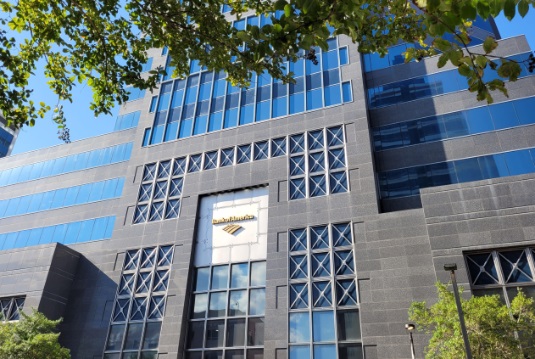
Photo by Alan Clanton for Thursday Review
Bank of America
to Inject $250 Billion
Into U.S. Infrastructure
| published August 15, 2026 |
By Thursday Review staff
Bank of America announced days ago that it will create a $250 billion initiative to help pay for the cost of American infrastructure improvements over the next two years, with a particularly heavy focus on semiconductor research and manufacturing, data center construction, computer technologies, energy and power sectors, and transportation projects.
The banking colossus said it intends to offer loans and financing across a broad range of infrastructure projects almost immediately, and that it expects that the majority of that cash infusion will be deployed within the next 18 months, with most of the financing completed by July 4, 2027.
Linking the bank’s initiative to the 250th birthday of the United States, Bank of America is betting that its lending and financing leverage in these critical sectors will help to shore up the overall economy, while also addressing the growing pressures and demands on everything from technological development to computer manufacturing to physical infrastructure.
BofA says it also seeks to offer sufficient capital to propel the U.S. and its power grid through what may become a critical and complex battle over data centers, which are at the heart of many local and regional political fights.
BofA Co-President Jim DeMare said that he is proud of the the bank’s long history of investing in the U.S. economy. “The infrastructure that powers our economy, strengthens our energy security, and secures ur technological leadership will drive growth, create jobs, and define America’s next chapter.” The bank says it estimates the initiative will create 90,000 jobs.
In its official statement—found on the Bank of America website—BofA outlined its priorities for the lending and the investments, citing manufacturing capacity, data centers, telecommunications and connectivity, energy and power infrastructure and water facilities, and computer hardware and chips. The infusion will also apply to traditional transportation projects as well.
The announcement comes as all these factors have shown a propensity for negative news in recent months, notably the vulnerability of electric systems and water systems in many communities, and antiquated technologies upon which many American homes and businesses depend for telephony, internet, streaming services, and television.
In recent weeks some cities and towns have seen their water and electric grids come under attack by hackers possibly linked to Iran. The data breaches have exposed how vulnerable some of these systems are to outside attacks, and the risks of operating essential public services using antiquated technologies.
Data centers, which are at the heart of many contentious political fights in thousands of communities, are largely seen as heavy consumers of both energy and water, and there are widespread fears that these centers will overtask public services already straining to keep up with household demands, and also trigger sharp spikes in the cost of home energy and water.
Essential to all of this: roads, highways, bridges, overpasses, and all manner of on-the-ground traffic management. Few American communities or cities are free of the headaches and hassles of a crumbling and overwhelmed infrastructure. And for many new businesses to be built, and for many existing businesses to expand, the physical infrastructure projects must be completed first.
Bank of America’s huge initiative comes only a year after JPMorgan Chase rolled out a similar initiative in which it sought to offer lending and capital to energy development, technology and advanced manufacturing, and supply chain improvements.
Related Thursday Review articles:
Comcast to Spin-Off NBC Universal & Sky Into Separate Entitie; By R. Alan Clanton, Thursday Review staff writers; June 29, 2026.
Fox to Pay $22 Billion in Roku Purchase; By Thursday Review staff; June 15, 2026.