
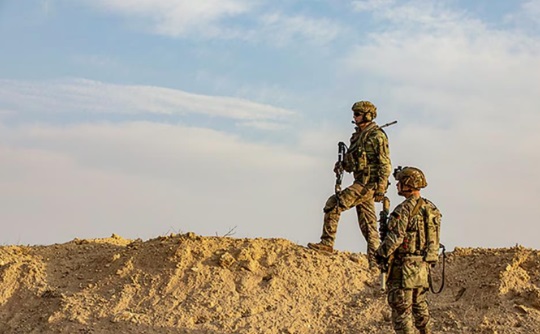
Photo courtesy Dept. of Defense
photo by Army Sgt. Julio Hernandez
Ending Decades of Intervention,
U.S. Forces Withdraw
From Iraq
| published October 2, 2026 |
By R. Alan Clanton, Thursday Review editor
On the last day of September, 2026, U.S. military involvement in Iraq was declared officially ended. The Pentagon announced it had withdrawn the last American forces across the border into Jordan, where U.S. and coalition forces will continue to fight the last remnants of the Islamic State and other militant groups.
Late into Tuesday and through the night into Wednesday morning, U.S. personnel climbed aboard transport planes in Baghdad and at Irbil Air Base, equipment and hardware in tow. By noon there no American military personnel left. Thus ends the second major military intervention by American troops in Iraq; the first began in the immediate post-9/11 age, when President George W. Bush ordered the U.S. military to go full force into Iraq in 2003 with the goal of toppling the regime of Saddam Hussein and ousting remnants of al Qaeda. The second U.S. entry came when the Islamic State, aka ISIS, threatened to destabilize the region.
Pentagon press spokesman Sean Parnell said that American withdrawal marks the “transition from a wartime coalition mission to an Iraqi-led security effort.”
Though ISIS and other violent groups are far from completely neutralized in the Middle East, the Pentagon concedes, the United States has completed its main mission within Iraq.
“The primary reason for addressing Iraq’s remaining security challenges, including ISIS remnants and Iran-aligned militias that undermine Iraqi sovereignty and regional stability,” Parnell said in the statement, “now rests with the government of Iraq.
In early 2014 ISIS surged onto the world stage in the rapid collapse of Iraq after previous U.S. forces left Iraq during the Presidency of Barack Obama. ISIS, also known as the Islamic State in Iraq and the Levant (ISIL), or simply the Islamic State, rapidly took control of a vast area of the Middle East, including large contiguous parts of Syria and Iraq, along with significant chunks of Egypt, Chad, Nigeria, Mali, Burkina Faso, and pockets within a half dozen other countries.
ISIS rose quickly during 2014, evolving from what the Obama administration characterized as “mostly misfits” and the “junior varsity team” into a lethal fighting force. It exploited the chaos of Syria’s long civil war, and it quickly gained momentum within the vacuum of disunity inside Iraq. In its path, ISIS spread terror and fear, enforcing its brutal control through beheadings, crucifixions, immolations, and shootings.
ISIS murdered Kurds, Shiite, and Yazidi minorities, destroyed archeological sites and smashed antiquities, burned museums and schools, looted banks, battled Kurdish rivals across northern Iraq to within a few hundred yards of the borders of Turkey and Syria. Along the way ISIS collected every weapon it found, including those left behind by the rapid flight of Iraqi security forces and Iraqi police—some $1.5 billion in military hardware and swag which had been brought to the region by U.S. forces. ISIS took effective control of several key cities, among them Mosul, and further south, ISIS took control of oil refineries and oil pipelines.
It was that last act, of course, which became the tipping point which brought U.S. troops back into Iraq, and required more U.S. military buildup in the adjacent areas of Jordan and Saudi Arabia. ISIS was funding itself generously from the control of that oil, and then-President Obama was forced to send U.S. troops back into the breach. Over the next decade, American and coalition forces chipped away at the vast Islamic State footprint, with Iraqi troops eventually gaining the upper hand, though it remained tenuous in some areas for years.
Through its stunning gains, ISIS also managed for a period of two years to overshadow even al Qaeda, and began to take the lead in gaining recruits from all over the world—including a small number of Americans—and in channeling those who had converted to radical militancy, a process which included ISIS-inspired terror attacks across much of Europe, and several infamous terror incidents in the United States.
ISIS militants kidnapped several American and British journalists, using them for publicity before brutally beheading them for the cameras.
At first, at least, Iran had little use for ISIS and little reason to collaborate with the mostly Sunni radical group. Iranian troops even helped to drive ISIS back in several areas of Iraq.
President Donald Trump had made it one of his primary military objectives to get the last U.S. forces out of Iraq in his second term, a commitment made in part to align to agreements made during the Biden years to reduce U.S. troop numbers inside Iraq to zero by mid-2026.
The President on Wednesday characterized the last 12 years of U.S. involvement in Iraq as “a very expensive excursion into Hell.”
Trump has faced pressure in the many months since the war with Iran began, with Trump vowing it would be a short fight. But in fact, the war has escalated and then began to drag on despite numerous attempts at cease fires or negotiated settlements. Some at the Pentagon hope that the extraction of all U.S. personnel from Iraq will give the military more leeway in the ongoing fight with Iran.
Iran has its own ax to grind inside Iraq, and has spent considerable effort attempting to destabilize Iraq and to sway Iraq into Iran’s orbit, even though Iran was included in the original coalition of forces mobilized to fight ISIS in the first place. Though U.S. and all original coalition forces have withdrawn from Iraq, it is not clear that the Iranian militias have any intention of leaving soon. This leaves Iraq with an uncertain immediate future, and little clarity as to its own identity as Iran defies much of the world, and as Iranian leaders continue to challenge President Trump’s military efforts in the Persian Gulf.
Iran supports—in some cases openly—numerous militant and extremist groups within the region, including non-ISIS militants who still operate in parts of Iraq. Baghdad has been largely unable to defang all these groups in a uniform or consistent manner, even with U.S. help. Some radical groups have been destroyed or have fallen apart, but Iran quickly offers backing and support to the next group which forms in Iraq, creating what some see as a continuing and problematic challenge for Iraq. Iran may also give direct support to militant groups willing to move aggressively into the mostly Kurdish areas in northern Iraq, where the vacuum left by the American withdrawal may be offer the greatest temptation. Irbil Air Base, which was once home to more than a thousand U.S. troops, is located in a semi-autonomous area well within the Kurdish region of influence.
Prime Minister Ali al-Zaidi praised the “orderly transition” from U.S. support to an Iraq able to manage the fight going forward. Al-Zaidi termed the American departure as a “new phase, one defined by Iraq’s sovereignty, the strength of its institutions, the readiness of its forces, and a balanced partnership with its friends.”
From bases and positions in Jordan, Kuwait, and Saudi Arabia, the U.S. will continue to provide intelligence, and, if needed, military help.
At the height of the first U.S. incursion into Iraq, there were some 170,000 U.S. troops alongside a smattering of forces from other countries. The first drawn-down—which had been a major pledge by then-President Obama—began in late 2010 and concluded in 2011, and included a significant handover of U.S. hardware and weaponry to Iraqi troops and Iraqi security forces. But the rapid spread of the Islamic State shattered the fragile hope that Iraq could remain stable, and triggered panic in Baghdad. Eventually, Americans had to return.
During the first phase of U.S. involvement, from 2003 to 2011, 4,599 American service members (across all branches) died in combat operations in Iraq, adding to the losses which were still adding up in Afghanistan.
Related Thursday Review articles:
War Endings: Reflections of the U.S. Exit From Iraq; By Bob Armstring; Thursday Review contributor; October 2, 2026.
Pentagon Requests Weapons Production Increase; By Thursday Review staff; September 2, 2026.