
Image courtesy of Focus Features-StudioCanal
Pressure Does Not Disappoint
| published June 10, 2026 |
By R. Alan Clanton
Thursday Review editor
Most of the larger-than-life figures from the World War II era had strong opinions about the things that were pivotal for the eventual Allied victory: advances in radar systems, the development of the Higgins Boat, the cracking of the German Enigma code, the steady ramping-up of American industrial production, ultimately, even, the use of atomic weapons. Churchill, Eisenhower, George Marshall, Omar Bradley, Bernard Montgomery—all were asked that question by journalists over the decades, and all gave varying answers.
Clearly, the success or failure of D-Day weighed heavily on the minds of all concerned, even the realists among the German commanders. Field Marshal Irwin Rommel felt that when the critical day arrived, and if the Allied forces could be repelled—thrown back into the sea, as it were—Germany might secure its victory, at least on the western front, within a 24 hour period. Likewise, General Eisenhower too understood that the fate of the war depended on whether Allied forces could gain a foothold on the beaches of Normandy. And for that to happen, much depended on the weather—a frightfully fickle handmaiden to what was no doubt the pivotal turn of World War II.
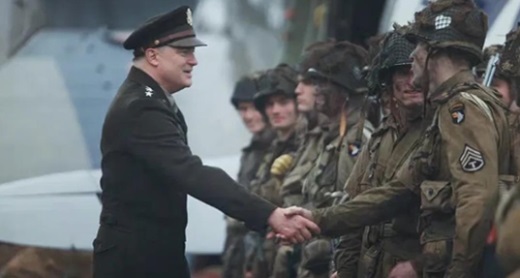
The fact-based film Pressure, directed by Anthony Maras with a screenplay by Maris and David Haig, explores the intricacies and the pitched battles fought in those conference rooms and offices within Southwick Mansion, where Eisenhower (played to perfection by Brendan Fraser) has set up headquarters and where the final decisions regarding D-Day are to be made. Eisenhower must balance the egos and the temperaments of dozens of generals and admirals under his immediate command, and he must make sweeping yes-or-no decisions based on the best judgment of scores of experts in a variety of fields.
All agree the landings must take place within a very narrow window of two-to-three days in early June 1944, when currents, tides and moon offer the right set of battlefield conditions, and before the Germans see through the ruses and the distractions and obfuscations meant to confuse them. Indeed, the German high command knows the allies are coming, it is simply a matter of when (and they, too, expect the Americans and the British to arrive under optimum weather conditions).
But when it comes to a straight-forward, binary choice based on the weather, Eisenhower faces his toughest decision, and two staff members are at odds: British officer Group Captain James Stagg and his American counterpart, Colonel Irving Krick. Stagg is Churchill’s favorite, and the Prime Minister has insisted Stagg be given seniority among the meteorological team at Southwick House; Krick has been with Eisenhower since North Africa.
Stagg is taciturn, curmudgeonly, and embodies a Scotsman’s skepticism of anything easy or sloppy; Krick is outgoing, charismatic, and an incurable “team player” always looking to please the boss. Krick is also (literally) the founder of meteorological studies at no less than Cal Tech, and his preferred tool is meteorological history, specifically historical weather patterns; Stagg feels he is duty-bound to point out that history is no match for the sometimes shocking turns humans have experienced at the hands of natural forces, most especially in the North Atlantic.
This sets the two top meteorologists on a collision course from the start—essentially a power struggle to gain the ear and the approval of Eisenhower and the other brass. Almost all depends on a manageably favorable forecast, which Krick is willing to endorse, but for which Stagg has serious doubts. If Stagg is correct, the invasion would face a postponement of at least two weeks, a huge gamble considering the risks that the Germans would discover the plans. Worse, asking the vast combined forces of the armada and all the air support to stand-down presented separate but still massive problems.
Despite Ike’s clear attraction to Krick’s optimism and his historical view of the weather, the top general eventually comes to the conclusion that the data-based, hard numbers presented by Stagg are to be trusted more.
As a film, director Maras works this angle well, but begins to overplay this hand quickly. Both Stagg and Krick—played by Andrew Scott and Chris Messina, respectively—tumble into character clichés a little too easily, and Messina’s portrayal turns Krick into a glib, strutting, name-dropping ass. However, the tension between the competing forecasts was real, and Maras captures the agonizing uncertainty that this wrought in those high-level meetings with Eisenhower.
Brendan Fraser is unstoppable and astounding as General Dwight Eisenhower. It is clear from the start of the film that Fraser worked hard to capture not merely Eisenhower’s bearing and charm, but also his sometime towering insistence on clarity and digestible answers. Fraser also deftly portrays Eisenhower’s brooding over these monumental decisions, the weight of which literally hangs upon him at all hours.
The film’s narrative climax comes not with the horrifically bad weather that arrives—just as Stagg had predicted with such gloom—but when Stagg and Krick together realize that a very small window of opportunity to launch the invasion will arrive despite the width and the breadth of the storm. This narrow opportunity allows Eisenhower to make that famous final call, launching the largest armada of ships ever assembled, sending hundreds of planes and bombers across the English Channel, and setting in motion (and irreversibly) the largest amphibious landing of soldiers in human history.
Multiple films have been made which provide a granular, gritty look at the foot-by-foot, yard-by-yard struggles of allied troops to wade ashore and secure the beaches, so this film understandably spends only a minimal amount of time on the shores of Normandy. Though at the very end the film strangely glosses over what would have been the most logical and human thing to understand—that there were huge numbers of casualties in that heroic effort. General Montgomery announces to the others in the room that all beaches have been secured, with no mention of the human cost.
The film is obviously large-scale and epic, meaning I would offer my usual advice to see it on the large screen, but do not mistake this for a war film in the traditional sense. Its primary battle sequences are reserved (logically) only for the last minutes of the film as D-Day unfolds with all the familiar withering gunfire, clawing along the beaches, and brutal fighting. Pressure puts us deep inside Allied headquarters where ultimately the lonely decision to launch Operation Overlord rests with one person, General Eisenhower, who simply wants to make an objective and clearheaded decision—one which he knows could cost the lives of thousands of men, but one which will surely alter human history.
Related Thursday Review articles:
Remembering Robert Duvall: A Look Back at a Great American Actor; By R. Alan Clanton; Thursday Review; February 16, 2026.
"Crack the Sky, Shake the Earth" A Look Back at Tet; By Kevin Robbie, Thursday Review contributor; February 14, 2015.