
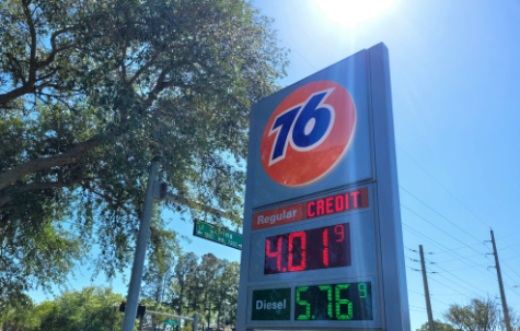
Photo by Thursday Review staff
Pain at the Pump=
Pain at the Grocery Store
| published April 12, 2026 |
By Thursday Review staff
The wider war in the Middle East has wrought the one thing that U.S. presidents dread (or ought to dread) even more than a protracted war: economic uncertainty.
President Donald Trump has insisted—on and off since the start of the war with Iran—that the battle has been decisively won in the early stages and that this fight may last only days, or weeks. Investors and average Americans, however, seem unmoved by these proclamations, and an already teetering economy in which some Biden-era prices were finally brought under control, while other prices have been rising steadily, has increased the angst of American families and consumers.
Predictably, gas prices have risen steadily since the start of the war. But White House attempts to compartmentalize this increase as a short-term issue began to fail as soon as Iran effectively declared war on all U.S. allies and financial partners, and within days of the de facto closure of the Strait of Hormuz. For most Americans, gas prices now hover above $4 per gallon—prices not seen in decades.
Worse, by last week, that rapid spike in the rise of gas at the pump broke all records: March saw the single-highest one-month percentage increase since the data has been standardized in 1967 (Gas prices have been higher, but they have not risen this fast). Coupled with the weekly pain felt when families and individuals shop for groceries, this puts the Trump administration’s flagship policy package—that of bringing inflation under control and making things affordable again—into serious jeopardy.
Trump’s team pushed back last week, with White House economic advisor Kevin Hassett urging caution when looking at the numbers. Hassett stressed that gas prices will inevitably drop as soon as the Strait of Hormuz reopens and oil begins to flow, and he also pointed to those products which have—in fact—seen price decreases almost as dramatic as their infamous increases only two-to-three years ago (eggs and pork products, to name the two most recent examples).
On the question of reopening the Gulf, Hassett and other White House surrogates are surely correct; even a marginal bargain with Iran in which all hostilities steer clear of the Persian Gulf might help. Once oil begins to flow, not only will gas prices begin their organic and inevitable slide downward, which in itself might ease consumer unease, but other prices may cool as well.
Furthermore, the gloomy lining surrounds a silver center: what some economist call “core-inflation”—all products and services minus the dozen or so most volatile items—is actually stable. And many of those “unstable” products saw their own spikes as a result of an unusually long and costly winter.
But the cost of gasoline at the pump—when combined with the challenges most Americans face when entering the grocery store—now means that many families are being forced to make very precarious decisions. And many market analysts say that the extra cost of oil is already inevitably impacting the daily lives of farmers, growers, dairies, and those hundreds of firms tasked with transporting food to grocery stores. Rising oil prices also have the oft-overlooked effect of driving up the cost of most fertilizers, and forcing price increases into the wide and diverse petro-chemical and plastics areas—and this too has an immediate impact on grocery stores and retailers.
As a result, scores of staple items will see price increases within weeks, or days, meaning that the “core-inflation” factor will soon see stress.
Over the weekend, and within the context of the United States imposing its own blockade on all Iranian shipping and coastal transit, Trump backed off his earlier predictions about oil prices, telling some reporters that energy prices may remain aloft for months, maybe even for the remainder of the year. This too will likely impact crude oil prices as soon as the markets open this week.
A long, grueling weekend of talks between the United States and Iran—held in Islamabad and mediated by Pakistan—failed to produce any substantial breakthrough, and it remains unclear if the extremely fragile ceasefire will remain intact this week. Vice-President JD Vance left the negotiations without any assurance on the central sticking point: that Iran clearly agrees to never develop a nuclear weapon, something Tehran has refused to concede for years.
The blockade is timed to go into effect on Monday morning. Though intended to limit any ocean-borne trade or military movement by Iran, the proximity of U.S. warships so close to Iran’s shore could, some fear, lead to a quick renewal of hostilities, something which will surely continue to impact the flow of oil through the Persian Gulf.
With the price-at-the-pump hovering around $4 a gallon nationally—with some states like California much higher—consumers will continue to make very difficult decisions about how to spend their limited money--at least until peace breaks out and the critical oil again begins to flow.
Related Thursday Review articles:
Aldi's Ambitious Expansions; R. Alan Clanton; Thursday Review; February 13, 2026.
Kroger Ending Grocery Deliveries in Florida; By R. Alan Clanton, Thursday Review editor; November 27, 2025.