
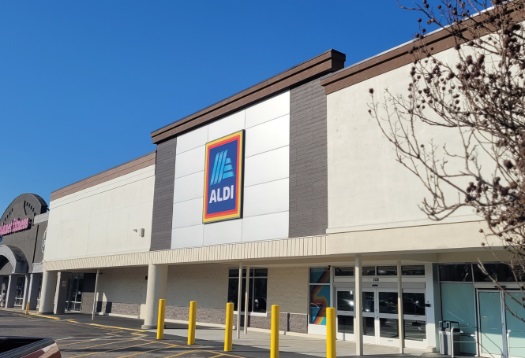
Photo by Thursday Review
Aldi's Ambitious Expansions
| published February 13, 2026 |
By R. Alan Clanton
Thursday Review editor
The rising cost of groceries—deeply problematic since the start of the Covid-19 pandemic—was one of the decisive factors in the 2024 election, and it has remained a sore point for most American families. Though some food prices have stabilized, other post-pandemic factors have fueled continuing cost increases, including the buffeting and whiplash from various trade wars, continuing supply chain issues, and, most recently, record-breaking winter conditions which will likely have inflationary impacts well into the next year.
Depending on the source of data—numbers provided by federal agencies, numbers offered by the major retail associations and business groups—food prices have risen a staggering 30-to-33 percent since 2020. The key factor when measuring overall inflation, grocery prices have increased even faster than other angst-inducing sectors—including technology, building materials and lumber, and home energy.
In short, Americans generally feel the most pain when checking out at their grocery store.
This has in turn made the always challenging issues faced by grocery stores even more fraught with turmoil for the next few quarters. Some of the major chains such as Kroger plan back off plans to expand as aggressively, and still other grocery retailers like Winn-Dixie continue to strategically close underperforming stores. Many Americans are being forced to make tougher, more painful decisions about what to keep on their weekly grocery list, and what to cross off.
This day-to-day strife and business instability appears to have had little impact on Aldi, which is now the largest grocery retailer in the United States, with some 2,625 locations. Aldi is also making no secret of its plans to expand in 2026, telling the business press that it intends to open another 180 stores in the next ten months, bringing its grand total to more than 2800 retail stores by the end of the year. Aldi also hopes to be operating in at least 3,200 locations by the end of 2028.
To put that into perspective, if its expansion plans remains on track, Aldi will be opening a new retail grocery store every two days for the next 24 months.
Kroger is technically the larger chain, for now, but only because Kroger (like competitor Albertson’s) operates using a variety of retail store names, depending on the city or state or region. But Aldi uses no such Trojan horse when it comes to branding, and, besides, within this year Aldi will surpass Kroger—by any of Kroger’s various names.
Aldi’s astonishing success seems in large part driven by its ability to leverage the American consumer’s anxiety about food prices to its advantage. Given the length of time that U.S. grocery buyers have faced pain at the checkout line, traditional brand loyalty has eroded, and those consumers who have tended to stick with Winn-Dixie, or Publix, or Albertsons, or Harris-Teeter, have found themselves forced to find ways to stretch their food dollar much further.
Aldi says it plans to spend at least $9 billion on its planned expansions, which will include not only more retail locations, but also several massive distribution centers designed to compete very closely with Kroger’s distribution and delivery models, and even with Amazon, which has been making its own forays into the grocery business. Aldi is also aggressively taking over real estate once occupied by underperforming competitors.
In Jacksonville, Florida, for example, Aldi recently converted several Winn-Dixie locations—which had been a part of Winn-Dixie’s drawn-downs—into Aldi stores, hoping to quickly capture the same local and regional shoppers before they changed their driving/shopping patterns, and by offering striking price advantages over what the next-nearest competitors could offer (in the case of northeast Florida, this closest competition comes mainly from Publix, the largest retailer in the Sunshine State). Aldi is also converting scores of Harvey’s grocery stores in other parts of the south. (Aldi purchased most of the Winn-Dixie footprint last year, but decided to keep some of the Winn-Dixie stores branded as Winn-Dixie, for now).
But Aldi’s national expansion also includes building from the ground-up in many locations, often as a way to capitalize quickly on neighborhood growth or new suburban expansion. Retail and business real estate firm JLL (Jones, Lang, LaSalle)—which also manages major properties for companies like Amazon and Grady Health Systems, and helps manage financing for large office and retail centers—says that Aldi is building new store locations faster than any of its grocery competitors. JLL’s website also includes a number of articles highlighting how Aldi stores—positioned as an anchor in a strip center or shopping center—can induce other retailers to quickly move in, an indication of how much traffic an Aldi store can generate.
Several detailed JLL articles highlight the immediate multiplier effect an Aldi’s can have on a shopping cluster, citing examples in Los Angeles, Atlanta, and St. Louis.
According to ScrapeHero, a business data firm, Aldi is already the largest grocery retailer in Missouri and Illinois (Albertson’s dominates five West Coast states; Kroger and Food Lion divide up much of the Midwest and the east coast; Publix is the biggest in the Southeast). If Aldi follows through with its ambitious expansion plans, it may surpass the others in all these regions, including in Florida where Publix has more retail locations than any other chain.
Aldi’s share of the grocery shopping market has been increasing much faster than expected in recent years, and according to retail data available for 2024, at least one third of all U.S. shoppers spent money in an Aldi location—a substantial bite of the overall pie when one considers the perceived dominance of the other mega-chains. Only Trader Joe’s saw a measurable increase in customer traffic greater than that of Aldi’s during the previous two years.
Trader Joe’s, according to ScrapeHero, is ranked ninth nationally in terms of retail grocery store locations.
Aldi’s aggressive plans to keep building new stores (or converting the under-performing locations of other grocery chains) mean that by the end of 2030, few Americans will be able to say they’ve never seen an Aldi. And the planners at Aldi want the uninitiated shopper to understand the formula that has been driving this success with consumers. Even as the Trump administration touts stability among the prices of some core items—gasoline at the pump, building costs—food prices continue to eek upwards, and some economists point out that a recent, brutal three-week winter may have so deeply imperiled some North American crops that more price increases in grocery prices will be inevitable.
Aldi says it wins when customers begin looking elsewhere for ways to cut costs and get more for their (often fixed) food budget. In part, Aldi accomplishes this through somewhat smaller retail stores—less square footage, but with dramatically fewer brand options. Where a typical Public or Harris-Teeter store might use much shelf space to display as many as ten brand options for the same item, Aldi will offer only three, or two—with at least one of these being Aldi’s house label.
But Aldi had no intention of having its store mistaken for The Dollar Tree or Dollar General in terms of quality. So Aldi also forces the issue of the look and feel of the store, avoiding a lowball appearance among the aisles, and ensuring that all products are of high quality and that shelves are neat and clean. The strategy is to balance the low cost with a high end cache, which Aldi execs say is in large part what drives the chain’s customer loyalty.
Aldi’s generally limited floor space can be dramatically off-putting to first time shoppers: a typical Aldi store may be only half the square footage of a nearby Publix or Albertsons. This means that a few first-timers may be nonplussed by what seems a spare selection and not return, or return only in convenience fashion for one or two items. But Aldi is also wagering on the very market factors that have driven those new customers into their store in the first place: a need to shave substantial dollars off the food expenditures in a world of rising grocery prices. The bet is that a percentage of those newcomers will decide to buy fewer items altogether, in scenario which will prove a win for Aldi, and a win for the customer who just figured out how to spend $43 less each month for groceries.
In that sense, Aldi’s biggest challenge during its robust expansion will be to not only entice new customers—grocery buying patterns can be tenaciously loyal in many major U.S. markets—but keeping them once they’ve browsed the store once or twice. Like Trader Joe’s, customers either come in once for the experience and then rarely return, or they become fantastically loyal to the retailer. Publix, for example, succeeds in large part because of the loyalty of its customers, and in both Florida and Georgia (where Publix is the largest grocer), Aldi is not averse to placing one of its stores within a block of a Publix. In Newington, New Hampshire, an Aldi store and a Trader Joe’s occupy bookend locations in the same retail center.
Considering the relatively limited floor space, some first-timers to an Aldi may also be surprised to find at least two full aisles of decidedly non-grocery items. My visit this week to a brand new Aldi location yielded looks at patio furniture, pet carriers and pet blankets, step stools and ladders, shower heads, pillows, door mats, board games and outdoor kid's toys, and art supplies. To some grocery purests, this makes an Aldi location seem a bit too much like a micro-WalMart. But Aldi is again betting on the obvious: that some consumers will shift enough of their limited buying power from Target or WalMart to change their overall pattern, and stick with Aldi for some additional items.
An Aldi store also makes no pretense toward slick presentation and wastes no capital on expensive display furniture: most of the produce and almost all of the bread is displayed modestly in cardboard boxes or coardboard trays. This cost-saving measure surely reduces the heavy capital investment needed to open a Publix or a Harris-Teeter, and gives Aldi an edge in overhead. This may offer a visual jolt to those shoppers accustomed to the steel-composite-laminate look of the traditional chains, but Aldi's strategists are betting that for many younger families on a tight budget, this box-and-crate informality will offer ample evidence that their food dollar is going further.
According to the most recent data shown on ScrapeHero, Aldi has 2,626 retail stores; Albertsons has 2,281; Publix is in fourth place with 1,467 stores; Kroger has 1,249 stores; and Food Lion operates 1,110 locations.
Related Thursday Review articles:
Kroger Ending Grocery Deliveries in Florida; Alan Clanton; Thursday Review; November 27, 2025.
Immigration, ICE, and a Hotel Rebranded; By R. Alan ClantonThursday Review; January 8, 2026.