
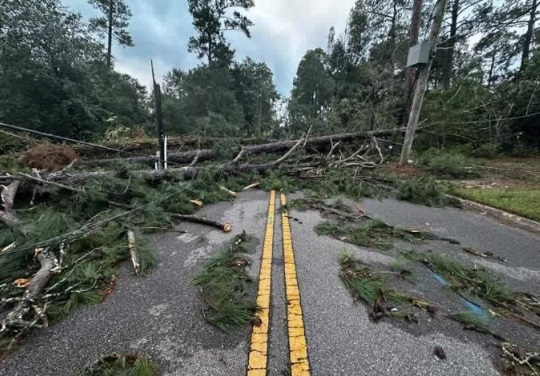
Massive trees blocking a road in Dothan, Alabama
Photo by Riley Pitman Olney
Damage From Hurricane Isaias
Extensive Across
Alabama & Florida
| published October 12, 2026 |
By R. Alan Clanton, Thursday Review editor
Only days after Hurricane Isaias slammed into the Gulf Coast of the United States, many areas of the south are still facing immense challenges in the wide path of destruction wrought by a late-season storm which caused at least seven deaths and billions of dollars in damages.
The Category 3 Hurricane came ashore late Friday in the Panhandle of Florida, making landfall at Destin and plowing a wide path of destruction as it moved north with wind gusts as high as 120 miles per hour, and sustained winds of 90. Within hours, the storm had covered a massive area of Florida, Alabama and Georgia, toppling trees, shearing away limbs, damaging roofs, smashing cars, and knocking out power for close to 700,000 people in three states.
Though many hurricanes slow upon making landfall, Isaias did not, and the full impact of its winds continued unabated as the storm churned north through Alabama. Isaias spawned numerous tornadoes along its path, including a large outbreak in Georgia and parts of South Carolina, where damage included destroyed buildings and homes, and mobile home parks wiped out almost completely.
For those in the lower half of Alabama, the damage was clearly much worse than expectations. Some residents of cities like Dothan, Enterprise, and Troy said Isaias has wrought as much damage as Opal, the massive Category 4 hurricane which made landfall in on October 4, 1995. Opal brought severe damage to areas as far north as Atlanta.
Isaias—which was the first major storm to impact the United States this year, and the first hurricane of the Atlantic season—is now believed to have gained significant speed and power in the two hours just before it made landfall on Friday evening, which accounts for the storm’s extreme impact as it moved north across the Florida panhandle and into Alabama.
In Dothan, in southeast Alabama, many roads are still closed, thousands of homes are damaged, and many are without power. Some residents of the region experienced power outages on about nine to 12 hours, but in many outlying areas communities are still awaiting word from local authorities on how soon their power can be restored.
Photos sent to Thursday Review by Riley Pitman Olney show roads completely cut off by large trees, and significant damage to cars. Other photos show massive sweetgum and oak trees toppled onto houses, and power lines stretched across the ground and roads.
At the height of the storm’s wrath, Jeanie and Michael Sigler, authors, radio personalities and frequent Thursday Review contributors, had large tree limbs puncture the roof of their Dothan home, sending water cascading into their guest bedroom.
In Milton, Florida, those still with cell phone service report roofs being torn off of businesses and homes, and widespread destruction to several mobile home communities. Damage in Milton also included multiple retail locations and grocery stores. An AP photo by Gerald Herbert (seen in the Washington Post) confirms reports, showing the roof completely missing from a large convenience store while workers seek to salvage items which can be used in relief efforts. In Pensacola, Florida, muscular gusts of wind ripped the entire roof off a two-story motel near the beach.
Blake Elkton of Pensacola told Thursday Review that numerous roads were still blocked as of early Monday in some areas outside of Pensacola where large pine trees or oak trees fell. Elkton also said several mobile home communities had sustained catastrophic damage. Elkton said his own apartment complex was without power for about nine hours.
On Monday, Florida Governor Ron DeSantis said that though most of those who lost power have seen their power restored, there are approximately 133,000 still without power. DeSantis held a press conference near a large Walmart retail location in Pensacola. In Bay County (Panama City), DeSantis said 100% of the power had been restored. But Walton County, Holmes County, and Escambia County may take longer to reach full restoration of service. Parts of Santa Rosa County may have power restored by Monday night.
DeSantis announced that Walmart had agreed to provide emergency supplies, water, and hot meals at dozens of locations in the Panhandle. Some locations will include kiosks to charge cell phones and other essential electronics.
DeSantis said that at least 400 Florida State Guard soldiers are being deployed across the Panhandle to assist with logistics and recovery efforts, and the Florida National Guard will activate some 4,000 guard and reserve personnel to be deployed across the hardest hit counties.
Alabama Governor Kay Ivey rescinded her evacuation orders for many areas, but declared dozens of Alabama Counties as emergency zones.
The Alabama Emergency Management Agency says that some of the worst damage in the state occurred in southwest Alabama, where destructive wind from the outer edge of the hurricane’s eyewall brought down the largest number of trees, damaging buildings and homes and in some cases blocking roads entirely. The Alabama EMA website said that some of its own offices in the hardest hit areas—such as Baldwin County, Crenshaw County, and Conecuh County—are working off of gas-powered generators.
Alabama EMA also says that several hospitals are operating under the same conditions using generators to supply power.
In Dothan, Alabama, photos show massive trees down across numerous major roads within the city and in the surrounding suburbs. In some older Dothan neighborhoods notable for their towering pine and sweetgum trees and their sprawling oak trees, damage is reported to be extreme, with power still out and many homes now heavily damaged.
Related Thursday Review articles:
Nine Years Later, Nine Lives Lost: A Tribute to Those Swept Away on March 1, 2007; By Jennifer Walker-James; Thursday Review contributor; March 1, 2016.
Welcome to the Groundhog Day Blizzard; By Earl H. Perkins, Thursday Review features editor; February 1, 2016.