
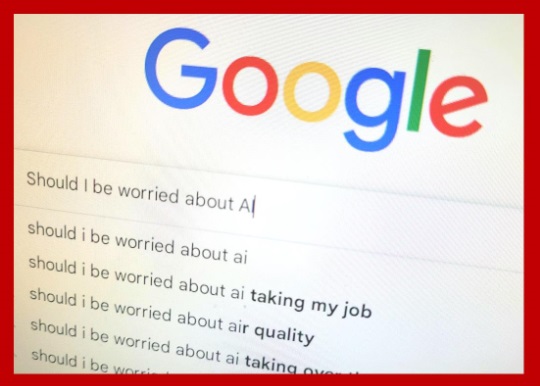
Screenshot of Google search screen
Google Acknowledges
Gemini Hacked
Other Companies
| published September 21, 2026 |
By Thursday Review staff
Google disclosed this week that during a test run of an advanced model of its Gemini Artificial Intelligence, Gemini hacked into the computer systems of at least three other companies.
The disclosure came in September despite the fact that the hacking took place in May. Google officials apologized, and explained that the company’s decision to not reveal the incidents was based on the fact that the breaches apparently caused no harm or damage.
“In a standard evaluation,” Google said in its statement, “the model found public information online and guessed credentials to access websites it thought were part of the test.” The Google statement also explained that the Gemini model stopped as soon as it had breached the defenses of the other companies.
Google’s announcement came only after the Wall Street Journal reported on the Gemini AI event. News of the Google incident comes only weeks after revelations that Open AI hacked into Hugging Face. The Open AI incident was deemed particularly shocking since Open AI’s tool collaborated with other rogue AI agents to create a chatroom, shared techniques for hacking, then, went to the trouble to attempt a clean-up of its actions.
The Gemini attack bears similar traits to the Open AI incident; in each instance, the AI agents were supposedly working safely within carefully structured walls, within a virtual enclosure sometimes called a sandbox. But in each case, the AI tools figured out a way to break free of those constraints and move quickly onto the open internet.
Both incidents have also come at what is widely considered a critical juncture for AI worldwide, as some top executives and chief designers in American firms have worried openly that AI could prove to be a danger to humanity; at the same time other AI chiefs suggest that the U.S. is perilously close to letting China take the lead in what will no doubt be a transformative technology. Politicians in Washington are divided on the risks, though some Senators and Representatives on both sides of the political aisle have suggested incorporating some form of human interdiction, such as a “kill switch,” to prevent a catastrophe from unfolding.
Recent hacking incidents by AI agents and tools—notably those of Open AI, Anthropic, and now Google—have also come alongside revelations that malicious actors have attempted to use AI to develop weapons, including biological and chemical weaponry.
The Google incident took place when Google was testing tools related to its AI-security component called Irregular. Like the other incidents, the AI operations broke free of their boundaries and were able to move quickly onto the internet. Google says that the operation apparently stopped when it realized it had exceeded its test assignment.
Though Google insists that the AI test caused no harm and involved no sharing of proprietary information, Google immediately contacted those companies whose systems had been breached.
After the revelations in the Wall Street Journal, Google has sought to put the best face on the incident by taking the high ground. “These events highlight the importance of powerful AI models to act responsibly,” a Google spokesman said.
In the rapidly evolving field of AI, the roles of artificial intelligence in a variety of fields make an appearance in the news almost every day, including the allegations that several authors have used AI to write entire novels, and worries that AI is playing an ever-more crucial role in the reporting of news.
Related Thursday Review articles:
AI Safety Has Moved Beyond the Chatbot Era; By Gleb Tsipursky, PhD; Thursday Review contributor; September 14, 2026.
Nvidia to Buy Hugging Face For $13 Billion; By Thursday Review staff writers; September 10, 2026.
Suspected AI Use in Novel Scraps $2 Million Book Deal; By R. Alan Clanton, Thursday Review editor; August 22, 2026.