
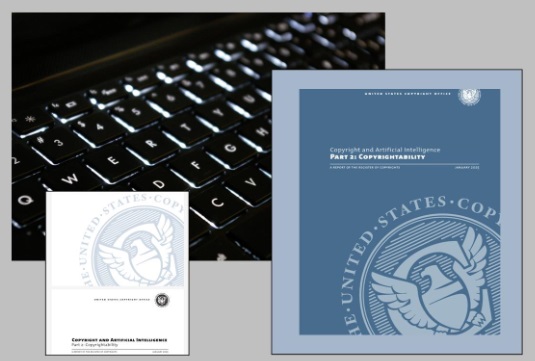
Photo-composition by Thursday Review
Suspected AI Use in Novel
Scraps $2 Million
Book Deal
| published August 22, 2026 |
By R. Alan Clanton
Thursday Review editor
It has only been months since novelist Mia Ballard has had to deny allegations she used Artificial Intelligence to write her horror story Shy Girl, which was originally self-published, but after gaining substantial traction in sales was picked up by Hachette Publishers. Ballard says she has done nothing wrong, but many experts suggest her novel was almost entirely the work of AI.
Now, an even larger financial mess has erupted after a $2.3 million book deal and a 14-way bidding contest brought the announcement that Jerry Falade’s much-promoted and much-anticipated new novel, Call Me, I’ll Hide the Body, may also be the work of AI, and not that of author Falade.
Falade had won approval from Minotaur Publishing, owned in the United States by Macmillan, to publish the novel next year, after lavish critical fanfare triggered plans to have multiple companies engage in competitive bidding for the rights to sell the new novel. It had quickly escalated into one of the richest book deals in history.
But the deal collapsed rapidly after concerns were raised, even by Falade’s own agents and managers, about “how the manuscript evolved from origin to completion.” An editor who was proofing the book in May and June apparently raised concerns that some passages and some aspects of the novel showed significant signs of AI authorship and other forms of artificial intervention. Soon afterwards, other editors began looking more closely.
Then, after a long meeting between Falade and his agents and editors in late July—a meeting in which several persons said that Falade’s explanations of his writing processes shifted and changed, and his explanations of his narrative decisions no longer aligned to what he had told them previously—agents and editors decided to make a clean break. That’s when the multimillion dollar deal was yanked.
Falade, like Ballard, denies the use of generative AI in the writing of the novel, and has suggested in a few interviews that the deal was canceled because of race. Falade, who is Nigerian, studies and teaches at Southern Methodist University in Dallas, Texas. According to an article in Publisher’s Weekly, Falade specializes in the study of black masculinity in contemporary African American and African diaspora literature.
The cases of Ballard and Falade are no longer aberrant instances of authors using AI to do their writing. In the last 12 months at least three other scandals have erupted over the suspected (in some cases proven) uses of artificial intelligence to write entire books, including reports that author H.M.Wolfe used an AI tool known as Pangram to write the novel Daggermouth. Though Wolfe denied the accusations, publisher Tor Bramble eventually remained committed to the book despite significant skepticism of authorship by editors who read the novel.
Adding to concerns about AI for use in the generation of intellectual materials: a substantial reorganization of how colleges and universities are evaluating students after hundreds of instances of students using AI to complete papers, essays, written evaluations, and even testing.
A recent New York Times article reveals just how pervasive the use of generative AI has become in colleges, and how many departments and individual instructors are requiring students to be tested using oral evaluations and handwritten tests inside a physical classroom, free of any electronic devices. The problem has grown uncontrollably for schools and colleges which offer entirely online classes—coursework in which the student and the professor may never even meet in person, and in which there are few resources available for the school to verify whether the content is truly the work of the student.
But the challenge now facing publishers has become formidable and—already—potentially costly. Not long after the high stakes and expensive fracas over Falade’s much-anticipated book, HarperCollins CEO Brian Murray has offered comments to the media regarding his company’s response to the issue.
Calling the current situation “very murky” and demanding new rigorous standards as to how authors, editors, and publishers collaborate, Murray says that in this new environment, editors and writers must have, at times, “difficult conversations.” Indeed, Wolfe, Ballard and Falade have pushed back very hard, going so far as to suggest the door swings both ways; could it not be “interpretive AI” which may blowing the whistle in error on the entirely original work of authors and writers accused of “generative” AI?
“This is an industry built on trust and relationships,” Murray told Publishers Weekly, adding “we need to rely on those qualities” to sort out what is the true work of authors and what has been written using generative AI.
Falade also insists his suggestion that race plays a factor is a valid issue for publishers to consider. “Three black authors received major publishing deals this year,” Falade said, “and all three later had deals cancelled or disrupted following suspicions about AI,” Falade told The Guardian. He has told several reporters he plans to eventually prove that his book was written using only his own imagination and his own skills as an author.
Falade has also told Publishers Weekly that he is also angry that the “detection” of his alleged AI used was itself determined by the aforementioned Pangram, which is one of the commonly used fact-checking and AI-checking tools. Falade said he gave no one permission to use Pangram—or any other large language model (LLM) device or algorithm, to review or check his book.
The back-and-forth leads many publishers to the conclusion that the tempest will grow worse before the industry is able to resolve the problem.
But the complexities have already advanced and morphed far beyond the range of classroom testing and the author-publisher relationship. Two years ago, apparently fictitious bylines began appearing on USA Today websites and on some Gannett newspaper mastheads. The names of the writers seemed uniformly unknown to the writers within the brick-and-mortar environments, and much of the content of the “new” writers seemed to be quickly revealed to be the work of AI. Executives at USA Today and at Gannett denied anything was amiss, but the fracas bore an odd resemblance to similar scandals which impacted Sports Illustrated, and recent developments by other newspapers and magazines now using AI-generated content in both print and online.
Earlier this year the revered Cleveland Plain Dealer rolled out a pilot program in which an AI tool will write short news pieces, many of the items based on regional or local events or activities. Despite uproar among journalists nationally and unease among his own staffers, newly hired Cleveland Plain Dealer editor Chris Quinn defended the move, saying “artificial intelligence is not bad for newsrooms. It’s the future of them.”
Some have suggested that it is inevitable that a variety of forms of generative AI will become ubiquitous in the near future. Indeed, the use of the already immensely popular tools ChatGPT, Gemini, Claude, and Meta AI are not likely to go away, and will probably only increase in popularity as these apps are added to millions of phones and computers, and as similar tools designed for research and productivity become standard in workplaces, research facilities, labs and hospitals. From the perspective of research, medicine and scientific advancement, these forms of AI can be easily understood to have hugely beneficial outcomes.
But the central question of intellectual property rights and the all-important connection between authorship and ownership becomes blurred when the content has been generated using AI—and that means money is ultimately at stake. Generative AI material cannot be copyrighted, nor is it subject to copyright laws in the way that human-generated original work is traditionally subject to copyright.
A visit to the website of the U.S. Copyright Office's website, Copyright.gov, indicates just how complex and formidable this issue has already become. A Copyright Office initiative which began only three years ago has yielded a Part One (published July 31, 2024) covering the concept of “digital replicas,” and a Part Two (published January 29, 2025) examining the issue of generative AI content and material. Part Three is not quite complete, but last year the office released a preliminary summary which will cover “Generative AI Training.”
The “Part Two” document is some 42 pages long in a PDF or Word version, meaning, predictably, two things: there is not yet a “short” answer, and your government tax dollars are at work in the preparation of 42 pages of explanation when TWO pages might easily sum it all up.
The report begins with some broad explanations, including the 2023 Notice of Inquiry in which the Copyright Office solicited opinions and ultimately received more than 10,000 comments, letters, and concerns. Page iii of the Executive Summary offers some bullet points, among them:
--The use of AI tools to assist rather than stand in for human creativity does not affect the availability of copyright protection.
--Copyright protects the original expression in a work created by a human author, even if the work also includes AI-generated material.
--Copyright does not extend to purely AI-generated material, or material where there is insufficient human control over the expressive elements.
--Whether human contributions to AI-generated outputs are sufficient to constiture authorship must be analyzed on a case-by-case basis.
And in effect the Copyright Office declares that the existence of new AI-generated content requires no new laws, nor any major modifications to the existing law, regarding copyright. “Questions of copyrightability and AI can be resolved pursuant to existing law, without the need for legislative change,” the report says up front.
These points by the Copyright Office effectively keep the discussion more-of-less solidly in the domain of publishers, editors, agents, and authors to work out the day-to-day skirmishes. Since material generated solely by AI cannot by copyrighted, publishers have little incentive to invest in, promote, or curate the work of authors whose newest book appears to be entirely the work of a robot, and agents and editors have little reason to cultivate an ongoing relationship with that writer or author. No enforceable copyright means no money.
Since no one has developed a business model in which non-copyrightable work can be made profitable, publishers—who are understandably interested to some degree in their bottom line—see no future, even if a book is acknowledged to be AI-generated and even if that same book is fabulous. In fact, the Copyright Office report seeks to get ahead even of a theoretical future in which somehow we are able to monetize generative-AI; the report quotes the Copyright Alliance (a non-profit organization which pulls together the interests of creators and writers), “If policy-makers give incentives to generate AI content, the sheer volume and speed with which AI material is generated could obliterate the markets for much human creation.”
So in this sense most authors and almost all publishers should be in agreement, especially about what is at stake.
For colleges and universities, the near future may require much more time for “must-be-present” classroom evaluations and testing, since there is little professors or instructors can do to stanch the flow of students using AI to generate responses or to quickly write an essay. Newspaper publishers may already be slowly but steadily introducing AI into their news-gathering and newswriting processes, a move that owners and publishers may find increasingly necessary to a business model which has been in steady decline for decades.
With so much uncertainty within the publishing industry, some theories can slip easily into conspiracy and off-the-grid extravagance, such as the rumor (unfounded, but interesting) that Shadow Ticket—the latest work of the famously reclusive author Thomas Pynchon—is entirely the creation of someone who hotwired an AI tool to produce a novel eerily similar to Pynchon’s previous novels. There is no hard evidence whatsoever to this fanciful rumor, but in the instance of an elusive and rarely-seen writer like Pynchon, many bloggers (and at least two face-to-face real-life human friends) have suggested that A) Pynchon is dead, and B) AI will write his future novels.
Again, that door swings both ways: it would be tragic to learn of Pynchon’s death. But would diehard Pynchon fans still rightfully swoon at his next novel, offering posthumous praise to the robot which so remarkably captured his narrative genius and his gift for odd characters with funny names?
Related Thursday Review articles:
Safety or Surveillance? How Flock Cameras Are Dividing Towns; By R. Alan Clanton, Thursday Review staff writers; May 28, 2026.
Cleveland Plain Dealer Introduces AI-Generated News Items; By Thursday Review editors; March 2, 2026.