
Photo Thursday Review
Chevron, Exxon-Mobil
Each Post
Lower-Than-Expected Earnings
| published May 7, 2026 |
By Thursday Review staff
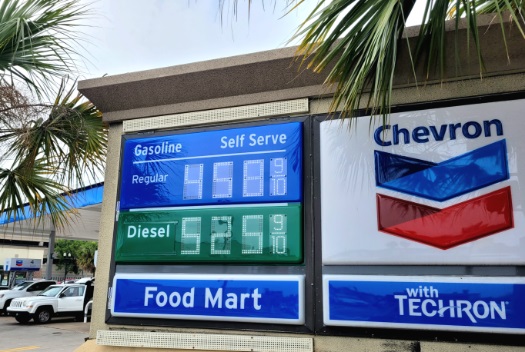
With the war in Iran dragging on into its third month, worldwide energy prices have become volatile and unstable, with prices in the United States rising dramatically. Last week, with the fragile ceasefire on the brink of shattering, oil prices rose yet again, with the average price-at-the-pump for Americans reaching nearly $4.50 per gallon.
Despite these price increases, two of the largest oil and energy giants, Exxon-Mobil and Chevron, have reported significant drops in profits for the first quarter of 2026. Both companies blame the instability of world markets, supply complexities, and the realities of so much oil being effectively trapped northwest of the Strait of Hormuz.
Chevron announced that its profits have fallen about 37% against the same quarter in 2025; Exxon-Mobil said its profits fell by 46% when compared to last year. Though both companies—the two largest of the American oil conglomerates—produce a significant share of their oil in the U.S. or in the Gulf of Mexico, both also rely heavily on oil from overseas markets.
The rise in oil prices has sparked concerns about re-heated inflation in the United States, including another spike in the cost of items in grocery stores as famers contend with extra fuel and fertilizer costs, and as logistics vendors and firms contend with sharp increases in gas and diesel costs. Some economists are pointing to a slowdown in growth alongside fewer jobs, conditions similar to the 1970s.
The White House insists that oil prices will quickly stabilize and prices edge downward as soon as the Strait of Hormuz reopens and the seas become safe again for the transit of tankers. But Iran has shown few signs it is willing to back down despite the military pummeling which the United States and Israel have unleashed since the start of the conflict.
Chevron’s CEO and chairman Mike Wirth has suggested that as the war drags on, U.S. customers will begin to see shortages in the supply chain. However, Wirth struck a somewhat upbeat note in his letter to shareholders. “Despite heightened geopolitical and related supply disruptions,” Wirth told investors, “Chevron delivered solid first quarter performance, underscoring the resilience of our portfolio and the value of disciplined execution.” Wirth also pointed to Chevron’s recent acquisition of Hess, as well as growth in U.S. areas.
But Wirth also warned investors of the immediate challenges if the war continues and if violence continues in the Persian Gulf. “We continue to closely monitor developments in the Middle East with a focus on the safety of our workforce and the integrity of our assets and operations.”
Exxon-Mobil’s CEO Darren Woods also tried to put the best spin on what was surely a difficult period. “The conflict in the Middle East contributed to a highly volatile operating environment,” Woods said. “Supply tightened. Logistics became more complex. Markets moved quickly.” Woods also pointed to Exxon-Mobil’s ability to accommodate some of these disruptions by shirting supplies from other areas of the world. Exxon-Mobil’s report frequently referenced the obvious upticks if—and when—the Strait of Hormuz reopens for tanker movements. The report goes on to speculate outcomes in the event that the Strait of Hormuz remains closed for part or all of the 2nd Quarter.
Both companies—Dallas-based Exxon-Mobil and Houston-based Chevron—assured their investors and market analysts that plans are in place to avoid a catastrophic 2nd quarter even if oil supplies remain tight because of the Iran war.
In recent days Iranian military forces have struck at U.S. ships in the Persian Gulf, and those U.S. ships have returned fire in what Secretary of State Marco Rubio has called “defensive engagement,” though the White House has insisted the cease fire is in place. Both President Trump and Rubio have said that the first phase of this engagement is essentially over, declaring the war ended when the fighting reached its 60th day.
But with hundreds of ships and hundreds of oil tankers effectively trapped by the hostilities—especially in the narrow Strait of Hormuz—worldwide energy supplies remain tight, and the risk remains that Americans may still see high gasoline prices for the foreseeable future. Some oil and gas analysts have pointed out that some of the last tankers to safely leave the Persian Gulf waters are now arriving in U.S. ports, meaning a much more painful period of shortages may be on the immediate horizon.
On Wednesday U.S. ships fired on Iranian-flagged ships, including one tanker. President Trump, whose position sometimes shifts from day to day, said on Wednesday that if Iran does not accept the current deal to end the war, he may intensify military actions, including more bombing. Trump’s announcement came just one day after a “pause” in Pentagon plans to escalate airstrikes and naval actions.
Then, on Thursday, the U.S. military struck two Iranian sites near the Strait of Hormuz after the Pentagon reported that Iran had launched a variety of missiles, rockets, drone and other ordnance at American forces. Those attacks were described by the Pentagon as “defensive” and not to be construed as violations of the fragile cease-fire.
In the meantime, with the last of those tankers already in transit when the war broke just now arriving in U.S. ports, some economists worry that the impending shortfall in supply will nudge gas prices even higher, possibly triggering a round of inflation. Rising jet fuel prices have already had a widespread impact on Americans, with at least one struggling airline—Spirit Airlines—shutting down its operations abruptly last week. Other airlines have indicated they may be forced to raise ticket prices in order to remain profitable.
Related Thursday Review articles:
Pain at the Pump Equals Pain at the Grocery Store; Thursday Review staff; Thursday Review; April 12, 2026.
Who is to Blame for the Spirit Airline Debacle?; By Thursday Review staff, Thursday Review; May 2, 2026.