
Photo by Thursday Review
Staying the Course Vs.
The Drumbeat:
A review of 2024: How Trump
Retook the White House
and the Democrats Lost America
| published February 25, 2026 |
By R. Alan Clanton
Thursday Review editor
The dramatic presidential election of 2024 turned largely on the economy, and any analysis which does not start from that central premise is flawed. The economy was the bane of then-President Joe Biden almost from the start of his term, and Biden himself—along with plenty of his advisors and closest allies—felt rightly that much of the problem had been inherited from Donald Trump’s first term.
Still, sitting presidents own their economy, whether fairly or unfairly, whether they like this condition or not. It was the key factor in almost all “economic” elections in the twentieth century, from Herbert Hoover’s loss to Franklin Roosevelt, to Jimmy Carter’s shellacking by Ronald Reagan, to George H.W. Bush’s defeat to Bill Clinton. From Day One, Biden’s woes—rising oil and gasoline prices, imbalances in the supply chains, increased home costs, and most especially a tsunami-like rise in grocery prices unlike anything seen since the 1970s—were a challenge that should have dominated his attention more than any other issue.
Though there were other factors, the Biden administration’s inability to stabilize the events of that era of economic pain probably doomed his reelection even before he withdrew from the race. As his vice-president, Kamala Harris too owned this problematic legacy.
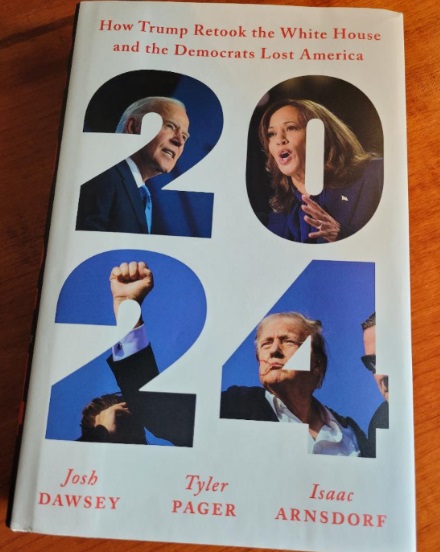
One of the central themes of the fast-reading book by journalists Josh Dawsey, Tyler Pager, and Isaac Arnsdorf—2024: How Trump Retook the White House and the Democrats Lost America—Biden’s weak response to the economy tracks closely with a dozen other factors, including the president’s faltering physical and mental condition, a background current largely unseen by most Americans until the night of Biden’s disastrous debate performance on stage.
At 364 pages, this book moves with astonishing speed and page-turning drama. Dawsey, Pager, and Arnsdorf rapidly set us up for the great rematch, taking us quickly through the challenges by a half dozen Republicans to win over GOP voters early in the primaries and caucuses: Florida Governor Ron DeSantis, former South Carolina Governor Nikki Haley, and former New Jersey Governor Chris Christie among the leading contenders. In fact, it was never much of a contest: DeSantis was an early favorite of GOP voters, though his candidacy was largely deemed Trump-Lite, a kinder gentler take on more-or-less the same agenda. Christie and Haley were the heart-and-soul challengers, seeking to create a safe exit ramp for what they believed were the millions of Republican voters squeamish about another four years of Trump in the White House. Haley, in particular, believed that Trump would lose to Biden in November 2024, and all three of these contenders made a point of suggesting it was time to move on generationally.
The authors pose the obvious question: why didn’t Republicans strategically coalesce around a single anti-Trump candidate, rather than effectively create another numerical conundrum very much like the one the party faced in the run-up to 2016. As is often the case in crowded fields, ego plays a substantial role in decision-making, for other than businessman Vivek Ramaswamy, who was deemed a place-holder for Trump, the principal combatants—Haley, DeSantis, Christie, and Arkansas Governor Asa Hutchinson—all seemed to see themselves as singularly able to not only outflank Trump for the nomination, but effectively take on Biden in November.
None of the candidates could foresee the drama ahead, though a few within GOP circles suspected that Biden himself might implode, thereby radically altering the race. In rapid order, DeSantis, Christie, and Haley folded, since by the end of the day on Super Tuesday there was no path forward for any challengers to Trump. The 2024 race quickly solidified as a rematch of 2020.
From Biden’s perspective, this seemed a no-brainer; he had beaten Trump in 2020 and it was his belief—and that of most of his closest advisors—that there was no reason to expect a different outcome, especially as Trump’s various court cases and criminal cases were still actively winding their ways through the legal systems in multiple jurisdictions.
But as the book points out, Trump wasted little time worrying, and instead turned these legal processes to his advantage, effectively converting them energetically into proof that the Blue half of America was out to hector him from the political system using whatever tools left-leaning prosecutors could use. Trump’s instincts were correct: his followers were loyal and tenacious, and would stick with him even as a dozen court cases moved forward. As the authors point out, Democrats placed entirely too much faith that the legal proceedings would neutralize Trump, and had few solid playbooks for facing a Trump shorn of prosecutorial baggage in November 2024.
But Dawsey, Pager, and Arnsdor also point to the fatal hubris within Biden’s White House and within his inner circle: a persistent, almost at time delusional belief that all would be well despite the growing evidence that Biden’s physical and mental acuity had deteriorated sharply since his election in 2020. The anecdotal stories had been circulating for more than a year: those who had met privately or within small groups with Biden noted his frequent bouts of confusion, his stammering, his weak voice, and his growing inability to complete thoughts. He was also lapsing into frequent malapropos, and had developed a troubling habit of shifting subjects or places as if he had lost the thread. Biden loyalists dismissed much of this, and when challenged simply tried to turn the tables the other way—how often had Trump misstated capitals, nations, names, job descriptions, twisted or fouled-up history?
But Trump’s followers were used to Trump’s trademark weaving, and were rarely rattled—and almost never swayed—by Trump’s fast-and-loose moments on stage. Trump was going to be Trump. Biden’s perceived confusion and muddled moments had already become a running joke among the right’s news channels and conservative media circles long before June 27. Only in the ten-day run-up to the debate did those closest to Biden realize the risk. Biden was weak, off-and-on sick (tests showed he did not have Covid or RSV) with flu and cold-like symptoms, with a voice that had grown very weak and at times inaudible. Worse, Biden’s slight stutter—long gone since his childhood—had begun to slip back into his speaking cadence, giving the impression that he was struggling to find his words. Suffering from exhaustion and fatigue, some of Biden’s advisors and family members urged him to avoid too much debate prep, as this would weaken him even more.
The option to cancel or reschedule the debate was obviously the worst possible outcome, since the GOP and Trump would seize on this as an evasion, or proof that Biden was unfit.
On June 27 the two candidates met face-to-face on stage in Atlanta in a CNN-sponsored debate which would be watched by many millions of viewers. Dawsey, Pager, and Arnsdorf illuminate the background details leading to that 90 minute debate, which would become infamously bad for Biden within the first minutes. Though some analysts argued that Biden recovered somewhat from a bad start, very few Americans who watched the debate thought it was anything other than a disaster for Biden, and a victory for a notably more subdued Trump. That the two candidates eventually argued even over golf handicaps indicated to some Democrats how easily Biden had been drawn into pointless discussions, and how much opportunity had been lost.
The authors also track the turmoil that followed for Democrats, as calls for Biden to step aside grew in momentum over the next days and weeks, and as big donors began to express doubts about Biden’s viability. One by one, top Democrats in Congress piled on, suggesting Biden step aside to avoid a November debacle. Eventually, Biden alone would come to the conclusion that he needed to move aside and allow his vice-president, Kamala Harris, to step into the breach and challenge Trump. But this historically unprecedented process meant that Harris would face an uphill battle from the start: the veep had not technically been chosen by any Democratic voters in any primary or caucus. And, she and her team had only days to organize and create a message, not months. There would be no time for trial-and-error.
The book also takes us into the backrooms of Trump’s team, where there was anything but harmony about how to proceed. Trump was bitter that he had to face a new candidate, having already concluded (rightly) that he had effectively beaten Biden and could likely coast to victory in November. Biden’s departure created almost as much tension and confusion in Trump’s inner circle as it did among top Democrats. The authors show that the steady hands—most especially that of Susie Wiles—struggled mightily to keep Trump’s eyes on the goalpost and to keep Trump’s message clear.
In the waning weeks, Harris struggled to find her core message. She had too much ground to cover, and her inability to grapple most especially with the economic issues of the day—she was, after all, linked closely with Biden’s domestic agendas—cost her dearly. That Trump was able in the end to turn even some reliably blue states into his column again showed that Trump’s followers were out there in much larger numbers than the polls could have indicated with accuracy (Hillary Clinton had faced the same challenge in 2016).
The authors Dawsey, Pager, and Arnsdorf—drawing on hundreds of interviews and hundreds of hours of research—have written a very fast-moving, highly readable account of the drama that was 2024. For those interested in dissecting that unprecedented election year from start-to-finish, this book is an invaluable read.
Related Thursday Review articles:
Trump Wins Presidency, Defying Odds and Pundits; Alan Clanton; Thursday Review; November 9, 2016.
Trump's Win: How the Pundits & Pollsters Got it Wrong; By R. Alan Clanton, Thursday Review editor; November 11, 2016.