
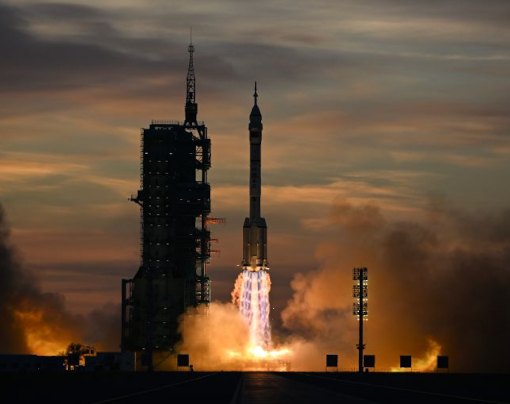
Shenzhou 24 Rocket Launch on Wednesday; Zinhua News
China Launches
Shenzhou 24 Spacecraft,
Docks With Station
| published November 25, 2026 |
By Thursday Review staff
On Wednesday, China successfully launched its Shenzhou 24 spacecraft atop a huge rocket and booster, and aboard were three astronauts—two Chinese and one Pakistani. The mission will be a huge step forward for China’s space program, and represents the first time a Chinese mission includes a foreign national among the crew.
The launch took place early Wednesday at the Jiuquan Launch Center in northwest China. Aboard the Shenzhou spacecraft was Pakistani astronaut Muhammad Zeeshan Ali, who joins Chinese astronauts Tang Hongbo and Wu Yi.
Later on Wednesday, the spaceship docked at the Tiangong Space Station, where the members of mission 24 met with the three members of the previous Shenzhou mission and posed for photos and brief videos. It is the third time China has placed six individuals in space at the same time.
The Tiangong Space Station (Tiangong translates as Heavenly Palace) was completed in 2021 and has since been temporary home to multiple Chinese astronauts and space missions. Like the International Space Station, Tiangong is equipped for a variety of scientific and technological experiments and testing, but it also contains several military applications.
This mission is considered by most space analysts to be one of several critical missions which will serve as technological and logistical stepping stones for China’s ambitious goal of placing its astronauts on the moon by 2031. China has also said it intends to build a permanent base on the lunar surface in the near future, which places the United States and China in what amounts to a second space race. NASA also has a goal of a permanent base on the moon, and the recent Artemis II mission around the moon brought that objective closer.
In Pakistan, the successful launch was hailed as a triumph for its science and space ambitions as well, and both countries found reason to celebrate the joint venture.
Though China’s military and technological goals are clear to most observers, President Xi Jinping described the mission—as he has with other Shenzhou launches—as emblematic of peaceful advancement, and another step toward international cooperation. The Shenzhou 24 launch came just days after a much-watched three-way summit—hosted by China—between Xi, U.S. President Donald Trump, and Russian President Vladimir Putin. The summit was seen as a major public relations coup for Beijing and a key moment in Xi’s goal of establishing China as a world superpower.
Official Chinese news services listed the nearly 100 scientific, medical and technology tests and studies to be conducted on the mission.
China’s ability to begin routinely launching manned missions to its space station is deemed essential to the longer range target of the moon. The recent success of the Artemis II Orion mission, which was the first time since the 1970s that humans had travelled to the moon, was also a critical test of U.S. space technology, and a crucial milestone toward NASA’s stated goal of a lunar base.
Both the United States and China have also indicated long range plans to send astronauts to Mars, though the start of those programs may be decades away.
Related Thursday Review articles:
Does Success of Artemis & Orion Signal New Space Race?; By R. Alan Clanton, Thursday Review editor; May 12, 2026.
Artemis II Launch Successful; Sets Stage For Future Missions; By R. Alan Clanton, Thursday Review editor; April 1, 2026.