
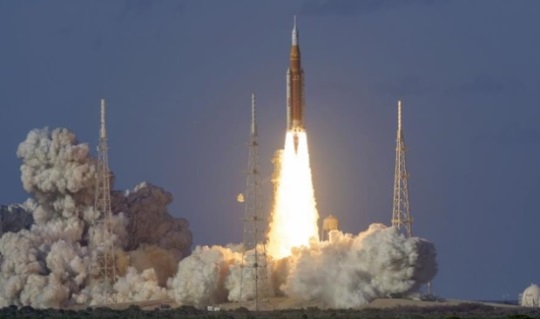
Photo courtesy of NASA/Bill Ingalls
Artemis II Launch
Successful;
Sets Stage for
Future Missions
| published April 1, 2026 |
By R. Alan Clanton
Thursday Review editor
On Wednesday, April 1, the Artemis II rocket system—carrying its Orion spacecraft—lifted off from launch pad 39B at the Kennedy Space Center in Florida. The much-anticipated mission will carry four NASA astronauts into deep space and around the moon, the first time humans have travelled to the moon since the end of the Apollo missions in the early 1970s.
The liftoff, originally scheduled for 6:24 p.m. Eastern Daylight Time, was delayed by about ten minutes. Despite a few safety checks and a few minor glitches, NASA stuck to its goal of completing the liftoff within the Wednesday evening launch window, which was itself heavily dependent on optimum weather conditions.
Wednesday’s launch of Artemis II and its Orion spaceship—dubbed Integrity—is a full test of the capacity of both the powerful rocket system, and of the sophisticated Orion spacecraft design. Both systems must operate effectively to pave the way for a series of future moon missions, and possible missions to Mars in the next decade. NASA’s long-term goal includes landing astronauts on the moon as early as mid-2028.
Aboard the Orion spaceship are four astronauts: Reid Wiseman (commander), Victor Glover (pilot), Christina Koch (mission specialist), and Jeremy Hansen (mission specialist). Artemis II includes several firsts for NASA crews: Glover will be the first African-American to travel to the moon; Koch will be the first woman to travel to the moon; Hansen will be the first Canadian (and the first non-American) to travel to the moon.
Though this ten-day mission does not include a landing on the lunar surface, it will serve as a full test of all systems and requirements to proceed with landings in 2028. Those lunar missions later in this decade will pave the way for the long-duration flights required to send astronauts to Mars. Among the most important systems to be tested: the life support mechanisms on board the Orion spacecraft, officially known as Orion CM-003. Another test was already successful only 25 minutes into the flight, when the all-important solar wings were deployed. The solar wings—each of which include some 15,000 cells—will be able to convert sunlight into energy, a critical weight-saving tool for all future long-duration space missions.
Records will likely be established when the Orion spacecraft makes its long arc around the moon, at which time its distance from the moon is expected to exceed 4,700 miles, greatly exceeding that outermost paths of any previous Apollo missions. Orion will also re-enter the Earth’s atmosphere at more than 25,000 miles per hour, exceeding even the fastest re-entry speeds of the Space Shuttles.
The last manned mission to the moon was in 1972, when Apollo 17 became the final chapter of the long Apollo program, and NASA astronauts Eugene Cernan and Harrison Schmitt walked on the moon.
Fair weather made it possible for thousands of people to watch the launch of Artemis II, the liftoff of which took place at 6:35 p.m.
Related Thursday Review articles:
Orion is Older Than You Think; R. Alan Clanton; Thursday Review; December 9, 2014.
Space Station View: The Nile at Night; By Thursday Review staff; October 5, 2015.