
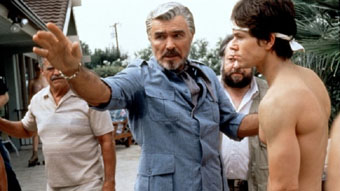
Image courtesy of Warner Brothers/
New Line Cinema
Reflections on the Passing of
Burt Reynolds
| published September 12, 2018 |
By R. Alan Clanton, Thursday Review editor
Regarded as one of the quintessential sex symbols of the 1970s, and by any measure one of biggest box office stars on the last century, his passing represents another page closed from a classic era of entertainment. Burt Reynolds, the former athlete turned iconic star of television and movies, died last week at the unlikely age of 82, thus bringing to an end a career which spanned decades, and included ups and downs, droughts and surges, missed opportunities and classic one-liners, all bound within his trademark rugged looks and famous impish laugh.
Though linked culturally and inextricably to the wider entertainment values of the Baby Boom generation, Reynolds was no Boomer himself. Like scores of Boomer icons—Marlon Brando, James Dean, Elvis Presley, Andy Warhol, Eric Clapton, Jimi Hendrix, Janis Joplin, all members of the super-groups The Rolling Stones, The Beatles, The Who, Led Zeppelin, writers like Hunter S. Thompson and Jack Kerouac—Reynolds preceded the post-War Baby Boom.
Unlike the aforementioned icons, from whom talents and achievements were appropriated shamelessly by those actually born after World War II, Reynolds occupied a space in the pop culture of America which defied easy generational placement—he was just as popular with older folks as he was with the younger generation of moviegoers and TV watchers.
Reynolds, who starred in nearly 100 motion pictures from the late 1960s until the recent teen years, passed away after cardiac arrest at a Jupiter, Florida hospital as friends and family members sat or stood nearby. The official cause of Reynold’s death has not yet been determined by the coroner, but Martin County officials confirmed a 911 call using Reynold’s home address was received earlier the same day that his death by cardiac arrest was announced.
Reynolds was perhaps best known for his comic and semi-comic roles in classic movies such as Cannonball Run (1981), and the hugely successful Smokey and the Bandit (1977) in which he starred alongside Sally Field, Jerry Reed and Jackie Gleason, a film which spawned several sequels and may be arguably his best known comedy.
But Reynolds also proved early in his acting career that he could handle the serious parts, including what film historians regard as his breakout performance in the tense psychological action thriller Deliverance, based on the novel by James Dickey, and, decades later, his Oscar nomination-earning performance in Paul Thomas Anderson’s emotional and atmospheric film Boogie Nights.
Reynolds made hundreds of appearances on television, from his earliest days in acting when he took on small parts in TV shows as diverse as Pony Express and Riverboat, as well as Route 66, The FBI, and Perry Mason. Later he would pick up a recurring role on the long-running series Gunsmoke, and in 1970 he was given the lead role in the TV series Dan August, which lasted only a few seasons but spawned numerous made-for-TV follow-up specials and movies.
By the middle 1970s and early 1980s, however, Reynolds was one of the most bankable stars in Hollywood, able to draw crowds to theaters often merely because his name was on the marquee. Though his style and tone was unvarnished and sometimes rough, his appeal made placed him on a star-power level rivalling the other famous Hollywood names of the 1970s—Warren Beatty, Jack Nicholson, Robert Redford, Paul Newman, Steve McQueen.
Burton Leon Reynolds sometimes told interviewers that he was born in Waycross, Georgia—a small South Georgia town near the Florida line—but later information and public records show that he was actually born in Lansing, Michigan (even at the time of his death, some news services and newspapers were in disagreement about Reynold’s place of birth) in 1936. As a toddler he lived briefly in Missouri, then in Georgia, but as a child moved to South Florida with his family, where—while in high school in Palm Beach—his athletic career took off. A superstar of the school’s football team, Reynolds was named All State in his sophomore year and by his senior year was “All Southern,” placing him squarely among the elite of high school gridiron players and at the top of the recruiters’ lists.
Even as his football career appeared to be taking off in his later teen years, Reynolds cultivated his fledgling interests in acting, and secured parts in local and college stage plays and community theatre.
But for a time, football was his passion, and it looked as though he might have a promising career on the field. After receiving a variety of full scholarship offers from various colleges, Reynolds chose Florida State University, where—as coincidence would have it—his roommate was future broadcaster and sports analyst Lee Corso. Though Reynolds had been a standout in high school and played extremely well his first two seasons at Florida State, a serious knee injury during a 1956 game caused him to miss much the rest of that season. The next year he experienced more medical problems, including internal injuries to his spleen and injuries to his other knee as a result of a car accident. In 1957 Reynolds was forced to walk away from football altogether and instead threw all his efforts into acting.
Ruggedly handsome and naturally charismatic, with a disarming sense of humor, Reynolds had little trouble finding a few parts here and there. He coupled his early stage work with odd jobs, including work in restaurants and driving delivery trucks. After some intervention by Joanne Woodward, who had meet Reynolds in summer stock theatre in New York, and some help from director John Forsythe, Reynolds began—like many actors—with small parts in the rapidly-expanding world of TV. Many of the parts were small—very small. But each role gave Reynolds a chance not only to develop his confidence, but also burnish his skills and his resume. Each guest appearances in a westerns or police crime drama would propel him to the next small part, a typically arduous process for young actors in those days.
One of his early TV roles was Quint, a half-native American blacksmith on Gunsmoke, a recurring character he would portray for several seasons. Then, after a few starring roles in the fair-to-middling, low budget movies Impasse and Shark!, Reynolds was—in an odd bit of Hollywood trivia—offered the lead role in the James Bond 007 series of films near the time that Sean Connery was discussing leaving the franchise behind. Interestingly, Reynolds turned the offer down, going so far as to question why the producers would be interested in hiring an American—and one surely unable to affect an English accent—to play a decidedly British part, written and conceived as a vehicle for the fictional top U.K. spy, James Bond. It would prove to be one of several missed opportunities for Reynolds, but one which in hindsight may have been the right thing for all parties involved.
But success would come knocking for Reynolds anyway. During the run-up for filming Deliverance, the role of Lewis Medlock (the part eventually taken by Reynolds) was offered to Charlton Heston, and, later, to Donald Sutherland. Both turned down the part, according to Hollywood legend because of the physical complexity, dangerous stunts and continuous outdoor exposure, and raw emotion required. Low on the list of contenders for the role, Reynolds got the part. Starring alongside Jon Voight, Ned Beatty and Ronnie Cox (all relatively unknown at the time), it is the story of four Atlanta friends who decide to go on a canoe trip down a wild, occasionally treacherous north Georgia river; their canoe adventure has been timed to take place in advance of the river being dammed for a major hydroelectric project. The film includes an infamous rape scene in which Ned Beatty’s character, Bobby Trippe, is assaulted by two local men; Reynolds’ character kills the rapist with a high-powered bow and arrow, but the other man escapes, thus setting in motion a sequence of action, evasion, tension and uncertainty—and, ultimately, murder by way of self-defense.
Though the film cost only about $2 million to produce and edit, it would rake in more than $45 million during its substantial box office run in 1972 and early 1973. Directed by John Boorman, Deliverance would receive three Oscar nominations and five Golden Globe nominations. The movie also burnished the acting reputations of all four of its principal actors, most especially Reynolds, for whom many critics heaped praise for his powerful but nuanced performance in a serious part. Reynolds himself often cited Deliverance as his personal best performance, and agreed that the role proved pivotal to his early success in Hollywood.
For Reynolds, flush from the surge critical success from Deliverance, the movie parts began to arrive quickly and in substantial numbers. Throughout the 1970s he appeared in multiple films each year, a decade of prodigious movie work which included Shamus (1973), The Man Who Loved Cat Dancing (1973), White Lightning (1973), The Longest Yard (1974), Lucky Lady (1975), Silent Movie (1975), Gator (1976), Semi-Tough (1977), Hooper (1978) and Starting Over (1979). Reynold’s name—like that of the other biggest stars of the era—was already proving to be a bankable commodity for Hollywood producers.
In 1977, however, Reynolds struck gold—almost literally—with his leading role in Smokey and the Bandit, a movie which would become arguably his most famous and endearing part. Portraying stock car hot rod Bo Darville (aka “Bandit”), and hired to illegally shepherd a truckload of Coors beer from Texarkana, Texas to Atlanta in less than 48 hours, the role was a perfect fit for Reynolds and his duel talents for comedic timing and non-stop action. The movie also paired him alongside Sally Field in what may have been one of the best comedy teams of the 1970s. Though simplistic in plot—indeed the film is basically one more-or-less continuous chase scene—the well-written dialog and the four-way comedic banter between Reynolds and Field, as well as Jackie Gleason (Sherriff Buford T. Justice) and Jerry Reed (truck driver Cletus Snow) keeps the film from going stale and, in effect, served to make the movie into one of the greatest film comedies in history. At a cost of only $4 million to produce, Smokey and the Bandit would eventually roll in a whopping $312.5 million that year alone, and another $7.5 million the next year, giving it the added industry distinction of having of the biggest cost-to-profit ratios in Hollywood history. The film continues to this day to pay royalties.
Smokey and the Bandit also sustained its box office power despite intense, ultimately transformative competition that summer and fall from both Star Wars and Close Encounters of the Third Kind. Smokey and the Bandit retains its power in video sales and rentals even now, decades later.
For Reynolds, the 1970s and early 1980s represented the first of his high water mark eras—and a period often as closely associated with his face and talents as any other actors save for Clint Eastwood, Robert Redford, and Paul Newman. Next on his list was Cannonball Run, another action-comedy-adventure film which spawned a franchise.
Despite enormous success and a windfall in salary during the era, Reynolds also famously turned down several notable parts—other than the James Bond offer. Paramount executives and producers wanted him for the part of Michael Corleone in the Francis Ford Coppola film The Godfather. When Reynolds shrugged, unsure about the potential of the movie and suspicious that the best-selling book could be reasonably adapted for film, the part went instead—some would argue appropriately—to a young Al Pacino. A few years later, Reynolds was also seriously considered for the part of Han Solo in Star Wars, a part obviously crafted to better suit his impeccable sense of comedic timing and his sometimes dry wit. Again, Reynolds turned down the offer. In later years he expressed regret at both decisions, but especially the rejection of the Han Solo role—the very part which took Harrison Ford from obscurity to stardom in less than one season. Star Wars went on to become the biggest money-maker of all time, and the franchise remains the biggest Hollywood juggernaut ever conceived.
But Reynolds’ career was far from over by the time the decade we most closely associated with him came to its end.
For the next 15 years he took on a variety of parts, including Sharky’s Machine (1981), The Best Little Whorehouse in Texas (1982), and Best Friends, which co-starred Goldie Hawn. By the end of 1982 Reynolds was voted most popular Hollywood star in the United States—the fifth time he had earned that honor by movie fans. The success of Cannonball Run spawned another sequel as well, but the next few years produced a string of box office disappointments, including Stick (1985), Malone (1987), Rent-A-Cop (1987), Switching Channels (1989), and Physical Evidence (1989). None were critically well-received despite Reynolds’ obvious earnest efforts to make the comic roles work and the serious roles gain traction.
Then, in the early 1990s, success returned to Reynolds in the form of two popular TV shows, B.L. Stryker (it ran only in the 1989-1990 season), and Evening Shade, which ran for a hearty four years, from 1990 to the end of 1994. Evening Shade, which was created by Linda Bloodworth-Thomason and narrated by actor Ossie Davis (one of the show’s regular characters), tells the story of former NFL football star Wood Newton (Reynolds) sidelined for life by an injury during his career with the Pittsburgh, Steelers. Newton now coaches the local high school team in the fictional town of Evening Shade, Arkansas. The show’s cast was stellar for the time, and included Charles Durning, Marilu Henner, Hal Holbrook, Michael Jeter, Elizabeth Ashley and Jay Ferguson. The show garnered critical praise and remained a high-ratings performer for CBS, but the generally high cost of the top-heavy cast may have played a central role in the decision in 1994 to end the show. Reynold’s twice won Golden Globe Best Actor awards for his work on Evening Shade.
More large and small parts came and went for Reynolds in the 1990s, including The Maddening (1995), Citizen Ruth (1995), Striptease (1996, based on the book by Carl Hiaasen and the screenplay by Andrew Bergman), and Mad Dog Time (1996).
Then, huge critical success came again to Reynolds despite his reservations about the subject matter.
Written and directed by Paul Thomas Anderson (Magnolia; There Will be Blood), Boogie Nights tells the overlapping fictional stories of a cadre of friends and co-workers in the porn film business in Southern California in the mid-to-late 1970s. Reynolds plays Jack Horner, a producer and director who so strongly believes in the artistic merits of his movies that he insists on shooting the features on film rather than make the conversion to videotape, as one of his financiers is pressuring him to consider. Horner has an eye for talent, and has a knack for developing “stories” that work within the rarified, sex-scene imbued genre of hardcore porn. He becomes a mentor and father figure for the young Eddie Adams (Mark Wahlberg in his breakout part), a recent high school dropout and (barely adult) runaway whom Horner meets in a restaurant; Adams has great looks, a fine physique, and the anatomical gifts for porn. Soon Horner makes Adams a star, each becoming rich in the process.
Reynolds, who originally objected to the script and strongly considered rejecting the role, nevertheless took on the part. Critically, it was another transformative moment for Reynolds, who was showered with praise for his performance in the film, and saw best actor and best supporting actor nominations roll in from scores of critics. Boogie Nights earned Reynolds his only Oscar nomination, several Golden Globe nods (he won for Best Supporting Actor), and a Screen Actors Guild award. Reynolds won Best Actor awards from the Chicago Film Critics Association, the Las Vegas Film Critics, and the New York Film Critics Circle. In addition to the accolades, it also once again proved that his acting abilities transcended straight comedy.
Though Reynolds famously did not get along with director Anderson during the filming, and later purposely declined taking a part in Anderson’s next movie, Magnolia, Reynolds later told interviewers that despite his initial trepidation about taking the part, he agreed that the movie was well crafted and regards his portrayal of Horner as his second-best performance, after Deliverance.
Reynolds would take on scores of roles over the next two decades, including memorable parts in Mystery, Alaska (1999, alongside Russell Crowe), The Crew (2000, alongside Richard Dreyfus), and the 2005 remakes of Dukes of Hazzard and The Longest Yard. Reynolds also made scores of TV appearances on shows like The X-Files, Ed, and American Dad, as well as performing voice or narration work in dozens of animated television programs and documentaries.
According to some media reports, Reynolds was rumored to be in early discussions regarding a part in a future Quentin Tarantino film, though he never lived long enough to see the first frame filmed.
Ultimately, Reynolds indelible impact on Hollywood and TV will retain its strength for decades. Smokey and the Bandit—now more than 40 years old as a movie—remains a staple of cable and streaming TV even to this day, and is regarded by many critics to be one of the all-time greatest comedies. Likewise, two of Reynolds’ most serious films—Deliverance and Boogie Nights—each maintain important places in movie history, and each for their own reasons. The former proved a game-changer for Reynolds, making him a star; the latter film became equally transformative, proving once again that Reynolds could truly act.
Related Thursday Review articles:
Shaken, Not Stirred: The Death of Roger Moore; R. Alan Clanton; Thursday Review; May 24, 2017.
Bill Paxton, Star of Apollo 13, Dead at 61; Thursday Review editors; Thursday Review; February 26, 2017.