
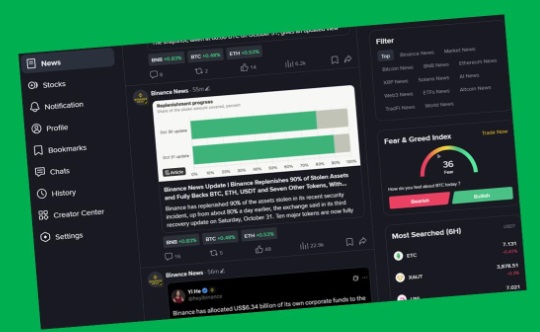
Screenshot of News Page on Binance website
Binance Heist is
Largest Crypto Theft
in History
| published October 31, 2026 |
By Thursday Review staff
A data breach at the huge digital currency exchange Binance earlier this week resulted in the theft of more than $6.3 billion in cryptocurrency, the largest theft of digital currency in history. The heist impacted thousands of customers and those holding various forms of crypto currency and crypto coins.
Numerous law enforcement and investigative agencies around the world have concluded that the hackers may have been connected to a North Korean operation known widely as Trader Traitor (the name it was assigned by U.S. investigative agencies more than two years ago), a group known to have been responsible for similar previous attacks and heists, including the theft of more than $1.5 billion from the Dubai currency exchange Bybit in 2025.
Trader Traitor is believed to be a highly specialized unit working at the behest and patronage of the North Korean military and intelligence community. Some evidence of the involvement of Trader Traitor came within hours, when large packets of the stolen digital cash popped up in digital wallets inside North Korea, and in other digital wallets of those with close associations with Pyongyang (including in Russia).
Last week's theft may have come by way of a compromised laptop computer belonging to an engineer working for Binance. Hackers were able to find their way into the accounts of Binance customers by way of the compromised laptop, and once inside the system, they were quickly able to drain some accounts in smaller units.
Most of the crypto currency held at Binance is safe since the vast majority of the value is held in secure, heavily encrypted offline caches, and this money is sometimes referred to "cold," since it is very difficult to move. However, most crypto currency exchanges also keep some of the customers' funds in "hot" accounts, which are those accounts designed to be easily and readily accessible by customers when it comes time to spend the currency or to trade it for other crypto currencies. This mostly liquid coin is what the hackers targeted.
The North Korean military and intelligence community has gone to great lengths in recent decades to expand its reach into hacking and digital theft. Though almost entirely sanctioned and cut off from most of the world—other than its occasional dealings with Iran, Russia, and China—the regime in North Korea has turned to hacking as a tool to find the cash needed to expand its missile and rocket technologies, and to continue to fulfill its nuclear ambitions.
Since very little of the digital currency in Binance's exchange is backed up by any governmental guarantee—such as money kept in banks in the U.S., the U.K. or scores of other countries—so those customers who lost part or all of their digital currency will be required to communicate with Binance. Binance has already stated to media and to customers worldwide that it will "cover all losses," though it did not explain exactly how it would make good on those missing funds.
Binance said it reacted swiftly as soon as the breach and theft was detected, and among the steps the bank took: the freezing of any of the stolen crypto currency before it could be further moved or traded or exchanged.
Related Thursday Review articles:
U.S. Economy Added 162,000 New Jobs in August; By Thursday Review staff; September 4, 2026.
Bank of America to Inject $250 Billion Into U.S. Infrastructure; By Thursday Review staff writers; August 15, 2026.