
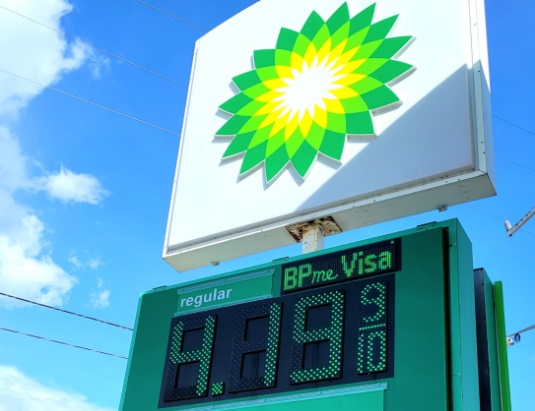
Photo by Thursday Review
BP Chair Ousted,
Disputes Claims of Misconduct
| published May 29, 2026 |
By Thursday Review staff
BP wasted little time explaining its firing of board chairman Albert Manifold earlier this week, praising him for introducing “focus and pace to BP’s transformation,” but in the same statement indicating that Manifold was dismissed for “governance oversight and conduct issues it deems unacceptable,” describing its decision as “decisive action.”
According to several media reports and several articles in the international business press, Manifold’s behavior has been regarded as both aggressive and freewheeling. In addition, there have long been rumors that Manifold had multiple sexual relationships with other BP employees, and that none of these relationships were disclosed at the time of his being elevated to role of chairman.
One of Manifold’s most notable actions after taking over as BP chair in October 2025 was to fire then-CEO Murray Auchincloss in December. Manifold then agreed to hire Meg O’Neill, who within weeks began to complain about Manifold’s frequent interventions in her decision-making, as well as his reportedly abrasive style.
This week, Manifold has struck back in the media, telling some reporters that his ouster was based on invented tales and distortions of the facts. On Thursday, Manifold released a statement to the media in which he claimed most of the allegations made against him were outright lies. “At no point in my tenure as chairman of BP has anyone raised with me any issue about my conduct or my relationships with my colleagues,” Manifold said in the statement.
Rumors of his interference and micro-management had stuck with him from the start of his tenure, though on this point he also disagreed, offering the explanation—deemed odd by some business analysts—that he had in fact “only spent 13 days in BP’s London office so far this year,” and that he had been busy with other business activities.
Manifold said that in all his 40 years of working in business, he had never been accused of either business misconduct or of inappropriate sexual behavior. He also pointed to what he described as his own lean working style: walking to work, buying his own lunch in nearby restaurants and delis, and eschewing the use of chauffeur-driven limousines and corporate jets, though other BP executives make frequent use of these perks. In his statement he pointed out that he made his own coffee.
He acknowledge only that he “pushed hard and challenged people directly,” and that he was unrelenting on the specific issues he deemed most critical, such as high performance, cost-cutting, and shareholder communication. Manifold suggested that it was his push to cut costs and make the company lean which made enemies at the top and prompted his ouster.
Manifold’s departure is one of many turnarounds at the top of BPs corporate structure in recent years. Though the company showed significant profits in the first quarter of this year—compared to under-performance by both Chevron and Exxon-Mobil in the same period—BP has dealt with significant infighting and power struggles within its top ranks. Helge Lund was dismissed last year after heavy pressure from shareholders and negative reporting in the business press. Bernard Looney, Auchincloss’s own predecessor was fired two years ago. He too was alleged to have failed to report sexual and romantic relationships with others at BP before he was made Chief Executive.
In Manifold’s statement, he said that he refuses to accept the image that is being painted. “What I do not accept is that lies can be told about me, nor that anyone should be allowed to hide behind anonymity when commenting on my time at BP.” He also points out that he was brought aboard as chair with a very specific mission to reshape BP’s priorities and to usher-in changes in the company’s priorities and strategic vision. “There is a considerable distance between driving an organization with urgency, and the characterization of my conduct that is now being put about.”
Ian Tyler will serve as interim chairman of BP.
Founded more than a century ago, the multinational, energy conglomerate BP is based in London. Among oil and gas companies, it is one of the biggest players—a mega competitor which includes previous legacy oil companies and buyouts (Standard Oil, Standard of Ohio, Castrol, ARCO, Amoco) and a multitude of subsidiaries and energy interests. From 1909 to 1935, BP was known as the Anglo-Persian Oil Company; from the middle 1950s until the 1990s, it was generally referred to as British Petroleum.
Under the BP logo (or those of Amoco), BP is sold at gas stations in every part of the world. Its two largest mergers were with Standard Oil of Ohio in 1978, and Amoco in 1998.
Despite the wild fluctuations in oil prices—the result of the U.S. was with Iran and blockages of tankers in the Persian Gulf—BP has managed to eke out a good first quarter. Like some other companies, BP was able to shift priorities and reroute oil from other parts of its supply chain in order to avert the worst outcomes, though it may eventually feel the challenge becoming more complex if the fighting continues and the Strait of Hormuz remains a problem.
Related Thursday Review articles:
Pain at the Pump Equals Pain at the Grocery Store; Thursday Review staff; Thursday Review; April 12, 2026.
Who is to Blame for the Spirit Airline Debacle?; By Thursday Review staff, Thursday Review; May 2, 2026.