
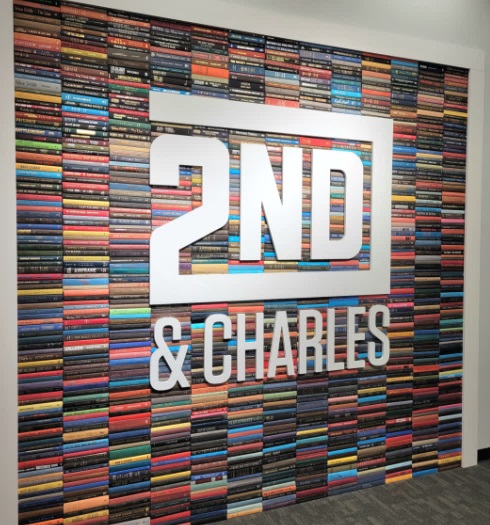
The 2nd & Charles "book wall" inside a store in Baton Rouge, LA
The Steady Growth
of 2nd & Charles
| published June 16, 2026 |
By R. Alan Clanton
Thursday Review editor
For book lovers—and by that we mean those folks who love the feel of an actual book, as opposed to digital versions—the growth of retailer 2nd & Charles is a welcome sign that print is not dead. It is also a godsend to anyone who loves books but struggles with clutter, crowded bookshelves, or has books stacked high on tables, desks, chairs, and even in closets. In short: too many books.
Some of our regular and irregular Thursday Review readers will ask the obvious follow-up: is there such a thing as too many books? Well, yes, there is such a thing. And the arrival of a 2nd & Charles in your city or town may be the answer to this conundrum.
A wholly owned subsidiary of Books-A-Million (BAM!), the business model for 2nd & Charles includes not only discounted books across almost all categories and types, but also a well-crafted system for taking-in your unwanted books in good condition and reselling them. And for those who prefer the onsite experience of handling and touching books, a 2nd & Charles store easily beats out Amazon or e-Bay when it comes to offloading your excess books and replacing them with newer stuff.
This system has brought about a robust period of growth for 2nd & Charles. The formula is so effective that parent company Books-A-Million is in the process of converting some BAM! locations into 2nd & Charles retail stores. Near Jacksonville, Florida, a second location is already being prepped in a former 21,000 square foot BAM! retail slot in Orange Park Mall. That conversion will be finished later this year. In Baton Rouge, Louisiana, 2nd & Charles has outgrown its modest strip center space and is now moving to a store with nearly twice the square footage. Similar upgrades are taking place in other parts of the country.
Founded in 2010 in Alabama, 2nd & Charles has perfected the sort of buy-sell-trade system which has become highly popular. The store is often talked-up as a hipster environment—something the retailer does not contest—but a visit to one of the 40 retail locations clearly dispels that image: many customers are on their 40s through their 70s, and there can also be a smattering of families with kids in the store.
The 2nd & Charles buyback and trade program enables customers to let go of many gently used or good condition books for trade-in or credit, while allowing hundreds of shoppers to browse books with the expectation of a decent discount. And by generally shunning books in bad condition—hardbacks or paperbacks—the store creates an environment that greatly resembles that of a pristine bookstore with crisp, new inventory. The discounts can range from mild to substantial, and include everything from the classics to manga, from fantasy to science fiction, from history to biography, and all forms of niche genres. Thus, the feedback loop is strong between the book buyer-seller-trader and the staff of any 2nd & Charles, and those who rely on 2nd & Charles for offloading are therefore inclined to treat their books with care.
And this process of buy-sell-trade extends beyond books to include music, videos, games, and even collectible toys. 2nd & Charles is not to be confused with the sort of retail bookstore like Barnes & Noble wherein almost all products and books are brand new, even when on the clearance tables; but likewise, 2nd & Charles deliberately avoids the musty reputation of a traditional clutter-driven used bookstore, especially when one examines the generally good-to-excellent condition of the books, games, DVDs, Blu-rays, and music offerings. This makes 2nd & Charles popular in college towns like Fort Collins, Colorado, Gainesville, Florida, and the aforementioned Baton Rouge, but also in suburban locations near to families whose appetites for games, DVDs, and books for varying ages may create—to say the least—high pressure for rapid turnover of media items, as well as shifting tastes and priorities in books.
The bookseller’s business model (2nd & Charles rarely builds from the ground up) does not include strictness about retail location, except where a book or game desert might exist: the company can just as easily convert an old Staples or Office Depot location into a bookstore as it can convert a former recliner shop or furniture store (a review of the 2nd & Charles website shows one location that’s a dead-ringer for a former Ace Hardware). But once converted, the store feels new, and gives the vibe of being exceptionally dedicated to the quality handling of books, DVDs, games and collectibles.
2nd & Charles got its start in Hoover, Alabama more-or-less as a spin-off from Books-A-Million. The goal was to create a large retail operation which could take-in and then sell gently used media, most especially video games, DVDs, Blu-rays, and music. The success of that first location quickly spawned an opportunity to include books in the business model, and that in turn gave the retail concept a higher level of flexibility—depending on the market—than simply a traditional game store, music shop, or bookstore. This integration of various media also vaccinated the retail chain against the frequent “format” meltdowns when one type of media (VHS tapes, for example) become quickly obsolete and are replaced with something else. 2nd & Charles appeal to collectors and those buyers simply interested in “nostalgia” or retro products will always find something of interest.
The 2nd & Charles formula also works in spite of (or perhaps alongside) that of Amazon, which began to dominate first book sales, then almost all forms of media and music, as the company seized the high ground of online retailing in the late 1990s and throughout the aught years. For those who want to touch and handle the merchandise—games, music and videos are one thing, but book people tend to be much more persnickety about gauging quality through tactile encounters—2nd & Charles is reliable; no more repackaging the book or toy or DVD which was damaged in shipping from an Amazon fulfillment center.
Parent company Books-A-Million has already converted a dozen of its locations into 2nd & Charles stores—a sign that the buy-sell-trade system is working well for both customers and the retailer.
Books-A-Million got its start as a simple newsstand operation in Florence, Alabama in 1917, run by a 14-year-old entrepreneur and high school dropout named Clyde W. Anderson. Anderson figured out how to quickly get hometown newspapers from around the country—some found in newsstands in Atlanta or Birmingham—into the hands of engineers and construction workers building the Wilson Dam on the Tennessee River.
Anderson steadily built the newsstand—originally located on Court Street in Florence—into a growing bookstore, added a coffee kiosk, and in the next few years the business grew. It was a newsstand and book business that endured for decades until Clyde Anderson’s son took it over in 1950 and began to add more stores, starting in the South. By the 1960s it had rebranded to Bookland, and by 1980 the chain had grown to 50 stores. In 1988, Anderson and Bookland bought out Gateway Books, another book retailer with dozens of retail locations, mostly in malls and shopping centers. In 1992 the company became Books-A-Million and all stores were rebranded as such.
Books-A-Million is headquartered in Birmingham, Alabama. Its current chairman and CEO is Clyde Anderson, grandson of the founding Anderson; Clyde Anderson also manages other major businesses, including American Promotional Events, one of the largest sellers of consumer-grade fireworks and holiday-themed accessories in the U.S., and Anderson Media Corporation, a major distributor of DVDs, Blu-rays, music, and games.
Related Thursday Review articles:
Reflections on the Passing of Tom Wolfe; By R. Alan Clanton; Thursday Review editor; May 16, 2018.
Jawsat 50: How a 1975 Blockbuster Changed the Movies, and the Beach; By R. Alan Clanton, Thursday Review editor; august 5, 2025.