
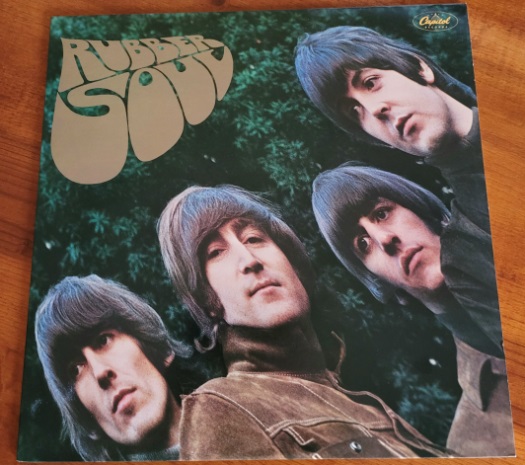
Photo Thursday Review/Cover, EMI/Capitol Records
When The Album
Took Over Rock & Roll:
Rubber Soul at 60
| published December 21, 2025 |
By R. Alan Clanton,
Thursday Review editor
Sixty years ago—in December 1965—The Beatles released their album Rubber Soul. Rock and Roll music was never quite the same after that, for one of the records’s greatest legacies is that it immediately inspired—some would say forced—pop music artists as diverse as Mick Jagger and Keith Richards of the Rolling Stones, Brian Wilson of the Beach Boys, and Ray Davies of the Kinks to rethink everything they thought they knew about their music. Rubber Soul had a similar effect on Bob Dylan, Lou Reed, and all members of The Byrds.
Brian Wilson famously described Rubber Soul as the first album in which “every song was a gas!” In fact, the album Pet Sounds was, in large part, Wilson’s and the Beach Boys' response to Rubber Soul. Jagger and Richards have both said that Rubber Soul challenged them to up their game, as it were, and thrust them into the studio to write all-original songs for their April 1966 album, Aftermath.
However, it can also be argued that some of these same artists were providing influence the other direction, toward The Beatles, who were themselves soaking up the developments and the sounds and the lyrical styles of Bob Dylan, The Byrds, The Animals, The Yardbirds, and others.
In fact, the dynamic was working both ways as a sort of creative competition evolving between the Beatles and their closest musical rivals—intentional, to a degree, but also highly organic as rock and roll arrived at its tenth (roughly) year and as artists grew restless with the existing creative templates, however successful these seemed. The question of whether the Beatles were the primary drivers of change, or whether those gradual shifts came from Dylan or Roger McGuinn or Eric Burdon or others becomes, in retrospect, largely irrelevant: the race was on. Songs like the Jagger-Richards composition “Satisfaction” arrived to the ears of the Beatles at the same moment that the formidable songwriting team of John Lennon and Paul McCartney was already consciously hungering to change the game.
Either way, for Beatle fans the world over, Rubber Soul was a turning point—some would say the turning point. Most music historians point to Rubber Soul as the defining moment when a part of rock and roll became “progressive,” that sometimes hard-to-define term applied to the kind of rock music which embraces some form of forward movement from the past. Bo Diddly, Chuck Berry, Elvis Presley, Jerry Lee Lewis, Bill Haley & The Comets—well, they had all done their things and taken rock music to a cohesive sound and place. Now, what can be done proactively to push this music further, deeper, and perhaps even into new places and new sounds?
Reading through some of the notable biographies and auto-biographies of those closest to the music of the era—and this includes Bob Spitz’s massive bio of The Beatles, Barry Miles equally copious Paul McCartney: Many Years From Now, Christopher Andersen’s Mick: The Wild Life and Mad Genius of Jagger, Kenneth Womack's Long And Winding Roads: The Evolving Artistry of The Beatles, and Peter Brown & Steven Gaines’ All You Need is Love—it becomes very clear that 1965 was the year in which lightning was bound to strike. It becomes something of a parlor game to pin down exactly what and who provided those influences to The Beatles, and in turn how substantial was the influence flowing outward from output by the Fab Four.
What is important is that Rubber Soul became that turning point. After Rubber Soul, record labels could hardly restrain the flood waters, and the result—one could argue within the very short time span of four-to-five years—were bands and artists as diverse as Led Zeppelin, Santana, Lou Reed, Three Dog Night, Jefferson Airplane, Yes, Deep Purple, Cream, and Emerson, Lake & Palmer. The explosion had begun, and Rubber Soul had been one of the defining catalysts for the new sound.
The development of what became Rubber Soul came at a time of profound actual soul-searching and emotional change for The Beatles and their immediate entourage. Among other factors, their long-time producer, George Martin—who had become very much a father figure to the four Beatles—had arrived at an important business juncture with the record company EMI, and he was seeking a improved financial arrangement: namely, a better salary (inconceivably, in those days his earnings were around 75 pounds per week), and less chiseling by EMI over expenses, some of which the record company had been demanding Martin pay back. Negotiations went on for at least a year, by which time Martin had grown frustrated enough to say goodbye. It was a radical idea at the time, but Martin would walk away, form his own production firm, and in effect take The Beatles with him.
This development—long in the making—helped unshackle The Beatles from their reliance of pop singles, for Martin’s classical music background meant he was keen to see his band’s musical output move forward, and he was willing to take risks few other music professionals would accept.
In addition, all four Beatles had grown weary of touring and the pressures of live performance—a difficult enough proposition for many rock performers but considering the shrill nature of the madness and chaos that followed them, stressful in the extreme for John, Paul, George and Ringo. Their August 1965 tour begun with the famous, record-breaking show in Shea Stadium, New York, and had also included shows in Toronto, Atlanta, Houston, Chicago, Los Angeles and a few other cities. Their final August 31 performance at the Cow Palace in San Francisco had wrought numerous problems and incidents that did not portend well for the four musicians who hungered for their privacy and simply wanted to write new music. They were at the literal fever pitch of their career, constantly in the glare of bright lights and popping cameras, but they had grown exhausted by what they deemed the pointlessness of live appearances where their music could be barely heard above the screams and noise, and where fanatical mayhem had become a legendary issue. As described in Tom Wolfe’s book The Electric Kool-Aid Acid Test, the show at the Cow Palace probably sealed the deal: Coke bottles were thrown, fans were injured by the crowd crush near the stage, hundreds of fans had attempted to jump over the barricades, security guards were overwhelmed, the screams of girls overpowered the music, and vehicles in the parking lot (including the lavishly painted bus on which Ken Kesey and his friends had travelled) were damaged by flying junk, including jelly beans). There were hundreds of cases of people passing out, more than could be treated by security or medical personnel.
For The Beatles, this was enough, and they basically reached a collective decision that they would prefer no more live shows for the remainder of the year. In truth, they would have preferred no more tours at all, but their 1966 US Tour was already being organized (it would, ironically, also end in San Francisco with their August 29 show in Candlestick Park).
After the Cow Palace performance, The Beatles had a few weeks off and a welcome rest, and then it was back to the studio where they were scheduled to begin work on their next album. There was more than a bit of pressure, since they had a only a few weeks in which to create and record enough new songs to fill up an entire LP, for the goal at EMI (and Capitol Records) was to have the record available in retail stores before Christmas.
As a testament to the songwriting skills of John Lennon and Paul McCartney, not only were they to meet this deadline, but they were to do so with what amounted to an unprecedented amount of high quality music: 14 songs total, 11 of which were the work of Lennon-McCartney, two of which were credited to George Harrison (whose own songwriting skills were beginning to blossom), and one song for which credit was given to Starkey (Ringo Starr) in addition to Lennon-McCartney.
If the formula for Beatle success prior to Rubber Soul was that of LPs with notably radio-friendly hit songs and simple tunes of boy-meets-girl and love=fun, then Rubber Soul quickly proved to be a departure—so significant a departure that even some Beatle fans seemed taken aback at first by the stark change in mood and bearing.
The arrangement of the tunes on the LP set the tone quickly, with two significant departures from what had been the proven formula, “Drive My Car” and “Norwegian Wood,” two songs which make it clear The Beatles were moving into new territory.
“Drive My Car,” mostly the work of Paul, bends genders and upends stereotypes to tell an ironic and somewhat fanciful story of an ambitious woman who intends to go to Hollywood heights (“I wanna be famous, a star of the screen”) and asks the singer if he’ll drive her car. When the singer/narrator demurs at first (“I told the girl that my prospects were good”), she chides him for “working for peanuts,” and insists she “can show you a better time.” The song concludes with our narrator finally agreeing to “start right away,” only to be informed she has no car. “But I found a driver, and that’s a start.” For The Beatles, the song broke through several thin walls, not least of which were the not-so-veiled references to sex—and even who can take the lead in sexual activity. Paul and John had deliberately but playfully injected this double entendre into the thread of the song. The song also implied sexuality with its “you can drive my car, and maybe I’ll love you,” another toying with the intentions while avoiding any direct reference to intimacy.
The song is irrepressibly bluesy but also upbeat, and author Bob Spitz described the music as “rich with imagery and innuendo.” George’s guitar work added a gritty, darker edge to an already comically twisted song. Infectious in the extreme, the song’s vibrant pace is structured by a dominant bassline (Paul), some of Ringo’s most driving drum work to date, and a persistent cow bell throughout adding a touch of percussive humor to an already likeable song.
“Norwegian Wood” is next—full title on the album: “Norwegian Wood (This Bird Has Flown)” and another song in which things are not as they seem and where roles have been reversed (“I once had a girl, or should I say, she once had me.”) and again sexual innuendo is aplenty. Our narrator has been invited to a woman’s room; she suggests he sit anywhere, but there is no chair. Later, they drink after wine, she informs him she works in the morning, and he must sleep in the bathtub. When he wakes the next day, the woman is gone. “And when I awoke I was alone, this bird had flown. So I lit a fire, isn’t it good? Norwegian wood.” Though without saying it directly, our narrator has been jilted and has exacted a terrible revenge by burning down her flat. Or, has he? Maybe he has simply lit the fireplace. We are left with an ambiguous ending to this short story.
George also played a role in “Norwegian Wood.” The music itself—the minimalist, rueful melody, the eastern guitar work—was, again, a departure for The Beatles, and another significant step into a more progressive, complex sound. “Norwegian Wood” was also a deep thrust into the emotional, introspective form of composition which would become the hallmark of many of John’s best songs from Rubber Soul onward. “Norwegian Wood” is notable also for one critical—some would say seismic—shift in style: it includes complex sitar arrangements performed in the studio by George Harrison, what some music historians believe may have been the first time the sitar was used in any western recording—pop, rock, soul, jazz, or other mainstream form. This was a game-changer for popular music, for The Beatles going forward, and also for the scores of performers and rock bands who embraced this exotic sound and its power to evoke mystery and emotional disclosure. For The Byrds, the Rolling Stones, Bob Dylan, and others, the sitar work was a mind-blower. For George, the impact of the sitar and other Indian music remained with him for the rest of his musical days.
The third song on Rubber Soul again shattered boundaries. “You Won’t See Me” is a bright, brassy, neo-jazz number which was mostly the work of Paul who was then at the apex of his troubled, strained relationship with the actress and singer Jane Asher. Like “Norwegian Wood,” it is introspective but also blunt. There is no ambiguity here: the song is about a man unable to reach his girlfriend by telephone, which instantly becomes symbolic of the couple’s larger issues. In Barry Miles’ book, Paul describes the song as having a Motown flavor and feel. “It’s got a James Jameson feel. He was the Motown bass player, he was fabulous, the guy who did all those great melodic bass lines.” Paul noted that there were only a handful of others using this method, and he cited Brian Wilson of the Beach Boys in addition to those in Detroit. The lyrics are unfiltered, and sound very much like actual words which might be used as a couple argues, and song’s last stanza becomes more painful and desperate: “Though the days are few, they’re filled with tears, and since I’ve lost you, it feels like years…” The Motown texture is underpinned by an ironic do-wop “ooh la la la, ooh la la la” throughout the song in what may be a nod toward The Beach Boys iconic harmonies, or, a direct take on the swaying dance moves of some of Detroit’s most famous performers. It’s a sad story wrapped in shiny, bright paper, and one of several songs which revealed Paul’s growing unhappiness with his relationship with Asher. And it was another of the “non-fiction” songs on Rubber Soul which showed how much the principal songwriters were diving deeply into their personal spaces for creative output.
Still, few Beatle fans were prepared for the true introspection of “Nowhere Man,” John’s slow, acidic take on his own depression and insecurities. Written in part after a night of excessive drinking and recreational drugs, the song rudely broke through one of the same thin walls that separated The Beatles widely disseminated image, and the dark realities they faced from touring pressures, constant publicity, and the strain this took on their relationships. After a long night of writer’s block and self-doubt, John awoke in a sullen mood, declaring himself a “nowhere man.” Thus the spark that became the song, which, according to Spitz’s biography, wrote itself very quickly. This was another radical departure for The Beatles, and another deep look inside John’s emotional torment, his only remaining firewall the strange third person approach to the song—John outside himself looking back at what he has become. Musically, the tune is slow, repetitive, circular, and if not for the beauty of the harmonies could easily be taken as a “downer” song. But John, Paul, and George’s impeccable three-part harmonies skewer a chance for an easy way out, and seem to imbue the song with an inexplicable likeableness for such a strikingly sad song.
It is not so much a song about “loss” as much as a song about feeling lost. “Nowhere Man” would, for John, open a wide gateway to scores of such introspective, soul searching tunes that would find their way onto later Beatle albums and even into John’s solo work after the Beatles’ breakup. Paul told Barry Miles that Paul always felt the song was about John’s dissatisfaction with his marriage, though most music critics suggest the song was—interestingly—one of the first Beatle song not about romance or love. No matter, the song was yet more previously uncharted territory for The Beatles, and another composition which forced dozens of other musicians and bands to follow suit.
The first four songs along would have been enough to rock the world—not to mention sell albums. But The Beatles had reached a tipping point in their creative place, and they wanted to pour more into this record.
George’s “Think For Yourself,” the fifth tune on the LP, quickly helped to establish George as a fluent songwriter in his own right, and pushed The Beatles forward into harder rock. With its insistent combination of fuzzy bass line and grungy guitars, the song was a major departure from the happy-go-lucky sounds of early singles and albums. Like the introspective songs by Lennon and McCartney, “Think For Yourself” also turns inward toward what seems to be a strained relationship. This, however, may be only part of George’s intentions, since the song can just as easily be taken for having a larger meaning—perhaps even telling those listening to the song that they are the ones George is imploring to think for themselves. Either way, George is asking us to understand the world as being a complicated place, and that decisions have consequences. Indeed, the political and cultural possibilities of the lyrics—once seen in that light—are hard to un-see. Many music historians have interpreted the song as one grand double-entendre, a song about a romantic relationship under stress, and a song urging all of to lead a more examined, purposeful life.
As in the case of other Rubber Soul songs, George’s “Think For Yourself” wrought an immediate and long-lasting influence on other artists and bands, and established a benchmark for The Beatles going forward. “Think For Yourself” pre-shadows George’s ongoing development as a songwriter, as well as his continuing interest in Eastern religion and philosophy, both factors which would drive the astounding experimentation and diversity of later Beatle albums—Revolver, Sgt. Pepper’s, and Abbey Road, to name but three.
If there was ever a song which combined the emerging Sixties pathos with the underlying raw energy of rock and roll, it was “The Word,” a song musically which could have been the work of the Rolling Stones, but spiritually the work of Dylan or Joan Baez. The first four lines sum it up: “Say the word and you’ll be free. Say the word and be like me. Say the word I’m thinking of. Have you heard, the word is love.” The song compares love to sunshine and to light, and few listeners will mistake this for a traditional love song about and a boy and a girl. Hippie lyrics aside, the song is built upon a heavy funk motif and an insistent bass line unlike anything ever attempted by The Beatles to that point—so driving and thrusting as to feel like a dance number, though just as clearly meant to contain more than a backdrop for gyration. John took lead vocals on the song, but George and Paul each double-tracked some highs and lows, with Paul adding a falsetto track. Again reaching for the Motown style, Paul recorded the bassline on a separate track, and the pulsing funk foundation of the song belies that this—like George’s “Think For Yourself”—is hard rock, not bubble-gum-soda-fountain stuff. If Paul’s heavy bassline was not enough to sustain the vibe, Ringo’s powerful drumming—shadowing Paul’s bass—makes the song oddly irresistible as enticing bridge into hard rock. Some critics disliked the shrill harmonies, but this too may have been deliberate on the part of the Lennon-McCartney duo, a way to push the paradox (“Everywhere I go I hear it said, in the good and the bad books I have read.”) and the sell two messages at once: a world in which people choose love over hate, and a signal that The Beatles themselves were stepping forward musically, away from their beloved simple love songs such as “I Want to Hold Your Hand.”
As some historians and critics have pointed out, “The Word” is not and ode to “eros” love, but the broader agape love, unconditional love, another theme all The Beatles would approach with greater abandon on later albums. John, in particular, would carry this philosophical baggage with him for the remainder of his creative life, through his music with The Beatles, through his wider associations and his political stances, through his years with Yoko Ono, and well into his later musical chapters and solo work. John’s robust activism for peace in the late 1960s and early 70s was always accompanied by an insistence on promoting love (as an obvious antidote to war). Again, a composition on Rubber Soul proved to be a harbinger of the direction of the band as well as one of its founding members.
“Michelle,” mostly the work of Paul, was another out-of-the-box song, and another striking example of how much The Beatles had matured as songwriters and musicians. The provenance of “Michelle” goes back a long way, and had its origins in college art parties that Paul attended with John in their youth. Paul, by his own admission, used the rather cheeky and cheesy ploy of trying to convince English girls that he was French, thinking this would give him better chances with the young women. Paul would spend hours in conversation speaking with his best phony French accent. He would also noodle a bit on the guitar, and—citing as his primary influence guitarists like Chet Atkins and Colin Manley—which he later developed into a minimalist, vaguely European sounding set of chords. Some years later, it was John who urged Paul to revisit “that French thing you used to do at Austin’s [Mitchell] parties?”
The seventh track—and the final song on Side A of Rubber Soul—became that “French” ditty, expanded and fully developed into a somber, almost sadly romantic piece about and young man who speaks very little French who is smitten with a young woman who speaks no English. The Chet Atkins style finger-picking is nevertheless cautious, spare, and gently flowing, lending the song a melancholy vibe unlike most previous Beatle “love songs.” And there are a few French phrases, developed with the help of Jan Vaughan, wife of Ivan Vaughan, a mutual friend of John and Paul. Jan, as it turned out, taught French, and even coached Paul on the pronunciation of the French lines used in “Michelle.” Sont les mots qui vont tres bien ensemble, tres bien ensemble. Paul was thrilled by the chance to include these lines, which helped to pin together the lines in English. John’s suggestion that the song be included was for neither want of material nor for a desire for softer music, but as way to stress the evolving sound of The Beatles in what they surely understood was their breakaway moment of musical development. The musical complexity of “Michelle” effectively left behind what had been all previous Beatle ”love song” formulas and strategies, and raised the bar—as it were—for their relationship odes going forward.
“Michelle” was also seen by many critics at the time as a kind of period piece song—a tune in which the narrator has taken the listener into the 1920s or 1930s milieu, but with the subtlety only Paul could have mustered as a rock musician born in 1942, during WWII. The song also broke a few rules. Jazz critic Steve Race noted that the melody contains what music traditionalists would have regarded as clashes in the chords, but John and Paul ignored (or were unaware) this convention, and proceeded anyway, which Race called “entirely unique, a stroke of genius.”
“Michelle” became the unexpected biggest hit on the LP, and one of the band’s biggest selling singles of all time. Even those musicians and critics who chided the band for inclusion of such a “soft” song on an otherwise edgy, groundbreaking album (Dylan called the song a “cop-out”), could hardly argue with the song’s immense popularity. And in retrospect, “Michelle” serves an invaluable purpose as the truest of the love songs on Rubber Soul, and the closest tune to a bridge from the music of the same Beatles who had just completed filming Hard Day’s Night—a light comedic mockumentary chock full pantomimed performances of their most pop-oriented love songs.
Side B starts with one of those rare songs which puts Ringo front-and-center for the vocals. “What Goes On” is a deliberate nod toward American country music, and an endearing gesture to one of rock and roll’s oldest sources outside of R&B: rockabilly. The song occupies an exclusive place in Beatle history and catalogue, as it is the only tune for which authorship is giving to Lennon-McCartney-Starkey, and, like "Michelle,” the song’s provenance is (according to John’s recollection) as old as The Beatles themselves. The song was an also-ran to another also-ran from early in 1963, second place, as it turns out, to the tune “One After 909,” which itself got tossed back onto the shelf when the band ran out of time one afternoon while in the studio.
Both songs had been early rockabilly options for The Beatles when the overlap between American R&B and proto rock included many fusions with country “swing” and western sounds. Early rock and roll acts like Carl Perkins, Jerry Lee Lewis, Johnny Burnette, and Jimmy Clanton had established a solid rep with just such a hybrid sound, and even Johnny Cash and Elvis Presley had proven that it was possible to draw substantial followings from both sides of this fence. For Ringo, who was more fascinated with the American country music sound than the other Beatles, songs like “What Goes On” and “One After 909” were rich with possibility (“One After 909” would finally establish its bona fides on Let It Be.)
Though in the final mix Ringo’s voice is left thin, almost wiry, the song still resonates through its quirkiness and becomes very hard to resist. Its catchiness seems to defy all conventional Fab Four logic since the song seems so unusual, but, in yet another decision to make Rubber Soul electrifyingly different from all previous LPs, John and Paul insisted that the song be included. Like “Michelle,” this musical oddity helps to frame the other songs, and for those Beatle fans who would listen to the entire album from start-to-finish, this Side B starter easily sets the mood for Act Two. Another bit of Beatle Trivia: the song was recorded in one take during the wee hours with the backing vocals added later. George’s sure-footed guitar work, reminiscent of Carl Perkins, rallies and carries the song soundly to its conclusion. Though arguably the weakest tune on Rubber Soul, over the years it has managed to gain some stature, and improves with each listen—likely the result of its ability to surprise each time.
The second song on the B Side is “Girl,” mostly the work of John. It is another highly personal, almost confessional piece, and was clearly written when John was experiencing doubts about his past and current romantic relationships. Another sharp break from the typical boy-meets-girl love song of The Beatles’ previous works, “Girl” transports the listener into John’s inner monologue about how he defines women, and more to the point, who he may consider his ideal mate. The song expresses doubts, fears, insecurities, and frustrations, but also slips into a fantasy place—even suggesting that the “girl” for whom he “recalls” could be non-existent.
However, “Girl” also offers unvarnished and clearly confessional elements that point to very real emotional altercations, and includes one of the most dramatic, melancholic questions: “Was she told when she was young than pain would lead to pleasure,” followed shortly by “That a man must break his back to earn his day of leisure.” The lines would result in some contention years later as each Paul and John would claim credit for these expressions; Paul cited it as a secular thrust into the yin and yang of human life and immoderation; John claimed the lines were his earliest hostile parry and thrust at Christianity as an institution and a first attempt to step into atheism. No matter the origins or intentions, the song’s ambiguous quest and melancholy theme was wildly out-of-the-box for The Beatles.
Musically, the song at times bears echoes and hints of eastern Europe, perhaps Albania, Serbia, Greece, Bulgaria, and this romantic overlay heightens the sense that the song is a wistful paean to what John can never find—though a few years later he says that Yoko Ono was indeed that girl, the one for whom he seems to yearn in “Girl.” The melody alternates between a mourning, yearning tone, and brief, repetitive interludes of supreme joy, including breathy exhales and sighs; John wanted an intimacy that verged on the uncomfortable, and he found it by over-dubbing the breathing sounds—mostly John, close to the microphone, gently sucking-in air. These seemingly invasive sounds (and others) were added in the mix, lending even more emotional weight to the tune, and marking another threshold crossed by The Beatles as they moved away from their traditional pop love songs.
One of the most remarkable and likeable songs on Side Two is “I’m Looking Through You,” another Lennon-McCartney composition mostly the work of Paul. A standout among the upbeat tunes, it again revisits the relationship troubles between Paul and Jane Asher as her career trajectory moved away from Paul’s orbit. With a foundation of an unabashed rock and roll power song, Paul tells the story of the growing distance in unvarnished poetry. I’m looking through you, where did you go? I thought I knew you, what did I know? You don’t look different, but you have changed. I’m looking through you, you’re not the same. The tune features joyous guitar hooks, a powerful dance bassline, and impeccable drum work by Ringo, tambourines, finger clicks and hand claps, not to mention one of the best melodies composed to that date by any Beatle. Unlike previous Beatle love songs, Paul pulls no punches: Love has a nasty habit of disappearing overnight. As author Barry Miles points out, “the lyrics are unusually specific and personal for Paul, who normally preferred to universalize his songs.”
Paul takes the lead vocals, but John’s voice can be heard in the harmonies throughout. At a time when The Beatles and producer George Martin were also willing to begin to toss more experimentation and diversity into the recording sessions, the song features a rare instance of Ringo on keyboards—in this case a Hammond organ that was in the studio. The slick structure almost obscures the song’s blues underpinning, but it is interesting to note that when the band first recorded the song in late October, the intent was to make it a slower song, not unlike “Nowhere Man.” They ended up choosing this faster, more rollicking version, a decision which in retrospect works effectively for its seamless fusion with the older pop style Beatles—a love song about love’s propensity to sometimes fade and fail.
Musically the song is a beachhead toward some of the great Beatle songs of their later career, and many critics and musicologists have noted the similarities between “I’m Looking Through You” and the raucous hard-tempo, hard rock work found in later songs like “Get Back” and “Lady Madonna.”
“In My Life” remains one of the most iconic of the Lennon-McCartney collaborations, and one with a complex emotional history. Sung by John with Paul on backing vocals and George on harmonies, the song is filled with nostalgia, though it clearly not a musical scrapbook nor a travel piece, despite the opening lines. There are places I’ll remember, all my life, though some have changed, some forever, not for better, some have gone and some remain. A sweet song and anything but sorrowful, it is nevertheless another yin-yang story, of the living and the dead, of happier times and sad, of memories real and of memories skewed by time.
“In My Life” caused some contention in later years between John Lennon and Paul McCartney over the true authorship of the song, one of those rare Beatle songs where there was disagreement about the principal composer. In interviews, John has always taken most of the credit, though he acknowledges Paul’s assistance with both the middle eight and with some of the lyrics. John also admits the song went through significant changes and heavy revisions to edge of away from being full nostalgic claptrap and bubble gum (John said “it was ridiculous!”). Originally a “journalistic vision of a trip from home to downtown on a bus naming every sight,” John and Paul eventually reshaped the song into a “love” song about people from their past, effectively shunting aside the sightseeing and morphing the substance into a song about friendship and love (in this vein, very much akin to the pathos found in “The Word”). In some of the same interviews, John’s pride in the song is evident. “That was the first time I consciously put my literary part of myself into the lyrics.”
Disagreement comes into play for the overall sound and composition of the song. In Barry Miles’ book, Paul suggests that John’s earlier versions of the song had stalled hopelessly, and that after that help with middle eight, Paul went to work de-constructing the journalistic and purely travelogue components of the song, then, brightening up the melody itself to lift it out of its doldrums. But both Paul and John agree that the song was a true gem, once properly cut and polished, and that the tune deserved John’s more soulful vocals. And again, producer George Martin enters the story very directly: it is Martin’s contribution to the song found in the colorful, baroque-classical harpsichord bridge, an addition that again emphasized that The Beatles were experimenting with sounds far outside the comfort zone of traditional pop rock. In fact, years later Martin explained that he wrote the piece on the piano, but found that he could not perform it as intended at speed at which John and Paul preferred; the solution was to record it at half-speed, then mix it back into the final cut at full speed, the effect of which was to simulate—not-quite-by-accident—the sound of a harpsichord. Still, the widespread belief that The Beatles had used a harpsicord in a rock and roll song inspired other bands and performers of pop music to do the same, effectively opening up yet another floodgate of experimentation.
The kerfuffle over the provenance and creative aspects of the song also point to the parallel turning points for both John and Paul, and their stoic, perhaps even rueful acknowledgement that with Rubber Soul they are closing a chapter, leaving a large expanse of time for only memory. As author Kenneth Womack notes in his book Long and Winding Roads: The Evolving Artistry of The Beatles, “As with the likes of “Help!” and “Yesterday,” it was certainly a song over which claiming authorship was a worthy goal indeed.”
“In My Life” defies an easy definition of genre. A slow rock song clearly, but just as clearly it is a love song across any category. It is also classical, and not just because of that brief performance on the harpsicord by Martin. “In My Life” is one of those songs that could be easily picked up and covered by almost any musician in any musical style, and could be found at home just as easily on recordings by mainstream soloists, traditional pop singers, country-western, or jazz, even big band. Bette Midler famously performed the song in the movie For the Boys in 1991. The song remains one of the most beloved Beatle compositions by fans and critics. In 2004, Rolling Stone magazine placed the song at 23 on its famous list of “The 500 Greatest Songs of All Time.”
The album’s twelfth song seems a throwback to an earlier Beatles sound, and at first feels more like it would have been at home on Hard Days Night or Help. In fact, as Womack points out based on his research, “Wait” is precisely that, a leftover from Help. In Womack’s interpretation, “Wait” was therefore a weak entry onto Rubber Soul, but other critics (myself included) consider it a gem nonetheless. Probably composed mostly in the Bahamas, it is primarily the work of Paul, though the three-part harmonies allow for so much room for the voices of John and George that song feels more collaborative. Still, the lyrics are hardly the happy-go-lucky stuff of early Beatlemania: as in other songs on Rubber Soul, the lyrics reflect Paul’s disenchantment and frustrations with his relationship with Jane.
Musically, “Wait” is unusual: most of the song is in a minor key, rare for The Beatles in that era. The song’s inclusion came almost literally at the last moment as Rubber Soul was still one song short of their original (and ambitious) goal of 14 songs. Additional vocals and other musical elements were added; Ringo plays the maracas and a tambourine to spruce up the percussion, and John and George’s voices were double-tracked to add layers to the chorus. Pedals were used to enhance and alter the guitar work, adding that strange, almost twisted, grinding feel.
Undoubtedly the most Byrd-like of all the songs on Rubber Soul is “If I Needed Someone,” George’s second contribution to the album. Here, listeners find echoes and threads of the other rock and roll influences in 1965—some Yardbirds sounds, a self-conscious nod toward Dylan, and the unmistakable impact of the inventive guitar work of Roger McGuinn and David Crosby of the Byrds. Another song indicating how much George had matured as a guitarist and a songwriter in his own right, “If I Needed Someone” was another game-changer, and another song to portend the greater musical shifts in play in the U.S. and in the U.K.
In addition to the use of a 12-string Rickenbacker guitar, George again brings the sitar into play, along with unusual and exotic harmonies from eastern and Indian music. This was another seismic moment—The Beatles were deftly incorporating the sounds which impressed them, and other bands were very clearly watching every development which came from The Beatles’ time in the studio. The song includes layers of John and Paul’s voices double-tracked, giving the chorus a layered effect. Some critics at the time called “If I Needed Someone” George’s best work to date, and indeed the song was heavily covered by other bands within just a few years, including The Hollies (their version of it went to #20 on the British charts), and The Kingsmen. Decades later, in 2004, Roger McGuinn would record his own version of “If I Needed Someone” for his album Limited Edition.
Rubber Soul ends with “Run For Your Life,” which, like “I’m Looking Through You,” uses a relentlessly upbeat melody and tempo to express what is essentially a somewhat nasty, bitter story of jealousy and insecurity—so bitter a little tale that the narrator of the song tells the “girl” that he’d rather see her dead than to be with another man. This was not an enlightened tune, even for the most laissez-faire elasticities of the middle 1960s. According to Womack, John was later embarrassed by the song, though its place on the album musically—the final cut—perhaps serves as its own weird coda to the era of the joyous, puppy-love Beatles songs. It may too have forced John to reassess his creative output, a song so unashamed of its brutishness alongside songs like “The Word” and “In My Life.”
One obvious and important aspect of Rubber Soul is that—at that time—the album certainly felt different to its listeners in the United States and Canada than it did to fans in the United Kingdom and some parts of Europe. Americans first got a wholly different vibe from Rubber Soul since it had been the practice of Capitol Records in the U.S. to shave off 2-to-4 songs from any Beatle LP, saving these tunes for other “compilation” albums (Yesterday and Today is an example of this), thus insuring hearty sales of both singles and albums in North America. Only after The Beatles were to create their own label did this practice subside (imagine either Sgt. Peppers or Abbey Road with three missing songs!) and were The Beatles more fully able to control the total arrangement of LPs in the U.S.
Only years later would most Americans get to hear Rubber Soul as it was intended, with all 14 tracks intact. Example: my original LP, purchased around 1972, is shorn of “Nowhere Man,” “What Goes On,” and “If I Needed Someone.” But, added is “It’s Only Love,” another leftover from a previous Beatle album. In the very earliest days of The Beatles, this would have impacted the mood and aural texture of an LP very little, but by the time listeners and fans get to Rubber Soul, the album is becoming a more potent force in the way rock musicians and performers choose to express their output. In fact, most music historians point to Rubber Soul as that catalyst for change.
The Hey Jude album, originally title The Beatles Again, was one such example of an LP in which stray singles, songs never aligned to an album, or those orphans removed by Capitol Records were collected and placed onto one full album. It had been the brainchild mostly of Allen Klein at Apple Records, since an existing agreement between all the business parties was at least one “compilation” album per year. Coming as it did between Abbey Road and Let it Be, the Hey Jude collection was intended to fill in the slight gap between albums, but also to collect all the outlier songs. Thus the strange, almost jarring juxtaposition of very old Beatle songs like “Can’t Buy Me Love” and “I Should Have Known Better,” alongside proto-70s acid rock like “Revolution” and “Rain.”
Clearly, Rubber Soul works best for Beatle fans—or any music listener for that matter—as The Beatles and producer George Martin had originally envisioned, even with a very small handful of perceived “weaker” songs reinstated to the total package (again, I quote Brian Wilson: every song was a gas!) and in the original order.
Rubber Soul's legacy is enduring. Many of the great “Best Of” compilations and intermittent list-makers such as Rolling Stone magazine include Rubber Soul as one of the most influential and important albums ever created; in 2012, Rolling Stone ranked Rubber Soul at number 5 on its list of "500 Greatest Albums of All Time.” This can make the business of such lists somewhat contentious to much later readers, since any such list is likely to be top-heavy with The Beatles most impressive work. Though some historians and critics might argue the point, Sgt. Pepper’s Lonely Hearts Club Band may be the greatest rock and roll album ever recorded. It too, was influential, but was it as pivotal in its day as Rubber Soul was in December 1965? Likewise, any such list, expanded—say—to 20 LPs—would surely need to include both the aforementioned Abbey Road and Let It Be (though this may be rooted in a nostalgia for that era).
In December 1965, Rubber Soul was the album to beat, and anyone who listed to it understood that rock music had changed. According to Philip Norman, author of George Harrison: The Reluctant Beatle, producer George Martin always felt that Rubber Soul was the album Martin was most proud of since it showed “a new, growing Beatles to the world.” The album so transcended everything previously recorded by The Beatles that it they would never be able to retreat or fall back on their original creative ground, even as they continued to revisit the roots of pure rock and roll with songs like “Get Back” and “Back in the USSR,” or even as they lavished in the fundamentals of blues with songs like “I’ve Got A Feeling.”
John Lennon on several occasions indicated to interviewers that The Beatles’ musical development flowed—consciously or unconsciously—alongside some of their interests in the spiritual, in eastern philosophy and religion, their own growing awareness of the world (in particular, the Vietnam War), their own sensitivities to injustice, and, predictably, their experimentation with mind-altering drugs. Rubber Soul, John said, was the “pot album,” whereas Revolver, which was released in 1966, was the LSD record. Whether he meant this literally or metaphorically becomes irrelevant in hindsight.
Either way, Rubber Soul helped usher-in the second half of the 1960s, along with some of the clichés we expect and many of the most exuberant and astonishing of the musical developments. Rubber Soul was the critical turning point for the band itself, that moment when The Beatles left their joyous pop song origins behind and moved into a new land of almost limitless musical creativity.
Related Thursday Review articles:
A Splendid Time is Guaranteed for All:Sgt. Pepper at 50; Kevin Robbie and R. Alan Clanton; Thursday Review; June 14, 2017.
George Martin & The Beatles' First Record; Kevin Robbie; Thursday Review; March 18, 2016.