
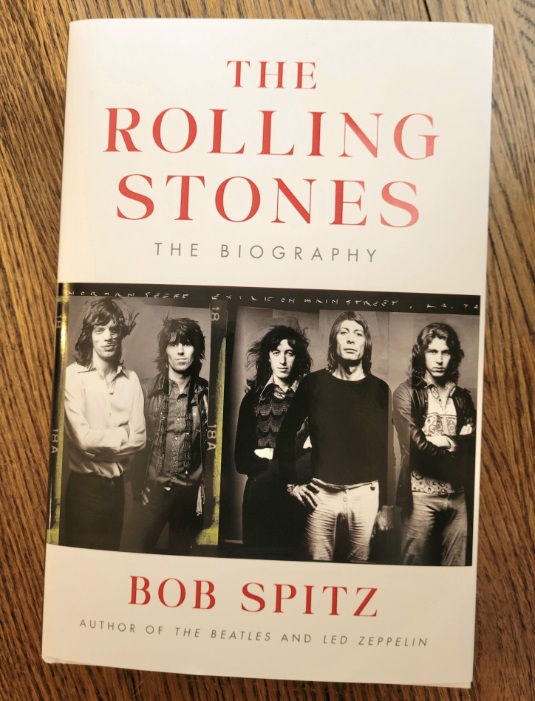
Photo by Thursday Review
Book Review
The Rolling Stones:
The Biography
| published July 11, 2026 |
By R. Alan Clanton, Thursday Review editor
Author Bob Spitz is thorough to a fault, meaning—for those readers who miss my point—he writes long. If you drop that freshly-arrived box containing his latest biography, you’re likely to break a foot, or damage the floor inside your front door. In the most literal sense, Spitz’s work is not light reading.
But this is not a complaint. Indeed, Spitz’s best books move briskly, compellingly, and rarely feel like the mighty door-stops for which they could easily be mistaken. His latest volume—The Rolling Stones: The Biography—arrives freshly printed from Penguin at a weighty 605 pages (not including extensive notes and index), though this is, improbably, still lighter and thinner than his The Beatles, which rumbles in at 860 pages. And at 880 pages, Spitz’s book Reagan: An American Journey, if loaded improperly, can topple container ships and Amazon delivery trucks alike.
Spitz long ago established his chops as one of the preeminent writer-journalists able to tackle towering figures from the late 20th century with remarkable skill through a combination of relentless research and elegant writing, and his subjects have included no less than The Beatles, Led Zeppelin, Julia Child, and the aforementioned Ronald Reagan. He has also written about Woodstock, Bob Dylan, and the New York Knicks. Readers (like me) who can endure weighty biographies of contemporary giants of politics and music will never tire of Spitz’s books, nor will they complain that he is offering too much detail.
And another thing about Spitz: he does not flinch from the grimiest, grittiest, or grubbiest of truths. Thus it was inevitable that he would soon tackle rock’s most relentless gaggle of octogenarians without becoming squeamish.
If only through sheer endurance and audacity, The Rolling Stones are the greatest rock and roll band in history. And there is a majority of thought that suggests the Stones achieved that title decades ago, before they advanced into extreme old age—a condition which their core members seem unwilling to accept easily. Indeed, the Rolling Stones seemed to have managed the impossible: an indestructible career in rock music, well into old age, without becoming clichés, punch lines, or a nostalgia act.
Furthermore, they have reached this improbable milestone despite the infamous rap sheet they’ve authored and their open taunting of the Grim Reaper.
For those who want the unvarnished story, this is it. Spitz glosses over very little, and covers the grimy facts in every chapter from the earliest days of the 1960s to—basically—last week: booze and drugs, girls and women (halfway through the book I lost track of the number of out-of-wedlock pregnancies core band members had fostered), paternity lawsuits, bad marriages, tax evasions, unpaid bills, wrecked hotels, damaged limousines, smashed cars, arrests at airports, and—oh, did I mention booze and drugs?—overdoses, visits to emergency rooms, rehab stays, and near death experiences visited through any or all of the above activities and behaviors. Clearly The Rolling Stones were all those things our parents and grandparents warned us about, and they indulged in every form of hedonistic carelessness health experts for decades have declared with scientific certainty will kill us in our youth.
As a testament to the completely counter-intuitive fact of their existence, a drunk, heavily stoned, aged 63 Keith Richards famously fell from a tree (the branch broke), landed on his head and shoulder, suffered serious head injuries and shoulder dislocation, underwent cranial surgery in a New Zealand hospital—and lived. How can we not still remain transfixed by this band even after all the years that have passed?
Spitz follows the boys from childhood, and in the first couple of chapters this is essentially teenage pals Mick Jagger and Keith Richards. This unlikely pair has found each other, two kindred spirits, each so intensely fascinated with American blues music that they literally speak the same coded, intricate language of musical obsession. Their shared passion for the records of Muddy Waters, Robert Johnson, Howlin’ Wolf, and Chuck Berry is deep and—as it turns out in London—rarefied in the extreme.
As teenagers Jagger and Richards know all these names; Willie Dixon, Sonny Boy Williamson, John Lee Hooker, Little Walter, Shakey Jake Harris. And these two English kids know of Chess Records in Chicago, and they know the difference between the riffs and rolls of Jerry Lee Lewis and those of Chuck Berry. They understand the nuances, the flavors, the colors, the chords; Chicago blues, Delta blues, Memphis, Little Rock, Tupelo, St. Louis.
Their bond is immediate, and, after they soon stumble upon Brian Jones, a band is already in its infancy. The boys visit the blues clubs in London and other cities, transfixed by what they see and hear. With the later addition of Bill Wyman on bass, and still later, with jazz drummer Charlie Watts on percussion, The Rolling Stones begin to gain traction amongst the British kids hungering for the music that will shatter all those conventional sounds of their parents and grandparents, and something that moves beyond the fun-loving lite rock 'n roll they hear on the BBC.
Some of the club owners and venue managers have open disdain for what they see and hear in the young Rolling Stones. But hardly any of these same businessmen are willing to shun the band, for the group soon develops a following that packs those dance halls and small clubs. Brian Jones is a savant—a musical chameleon with an uncanny ability to understand almost any instrument in his hands, and —at first at least—the band’s de facto leader. Richards is a virtuoso of the guitar; the instrument is merely an extension of his arms and hands, and he has a singular, intuitive feel for how to meld blues and rock into something powerful. Richards knows almost every chord and every note of the blues. The teenage Jagger is not by nature a musician, but his feel for showmanship and stagecraft is unstoppable, uninhibited, primal, with moves that could put Elvis to shame. Spitz shows us an early band with a formidable chemistry both musically and literally.
Spitz is never far away from the context of what is happening in the larger tableau of popular music in the U.S., the U.K. and elsewhere, and by 1964 The Beatles have begun their rapid ascension. But The Stones are never far away—neither much behind or ahead—and in some ways are shattering the boundaries and testing the limits. Like The Beatles, the Stones were gaining not only traction but a reputation for inciting screaming and riotous bedlam. The Beatles famously made a sport of this—the good-natured Liverpool lads causing the girls to swoon and faint. With the Stones, however, a new template was being cast: concert venues were often standing room only, with shrill forms of chaos, crowds surging starting from the moment the band started playing, and an edginess to the chemistry, something almost dangerous, even palpably dangerous. Spitz describes the live music as “hard-charging songs banged out mercilessly.” Mick and Brian, especially, taunted the audiences. But the more the band was despised by the cops, the authorities and the schoolmarms, the more the kids wanted it.
Spitz follows this steady trajectory upward on the great crest of rock music—an American invasion of Britain and the British Invasion of America. When The Beatles grew weary of the mime and the theater of performing largely deafened by the screams, they turned to the studio and focused on pure creative energy—spawning one of the greatest surges of musical inventiveness seen in popular music. But The Stones thrived on the audience, the crowds, the mobs, which inevitably grew larger and larger, and the band’s reputation grew simultaneously more sordid and more potent as record sales rocketed upward. Spitz shows of a group with hubris and balls, but also one finally reckoning with mortality. Brian Jones death in July 1969 was officially the result of drug overdose and alcohol combined with drowning; he was found face down in his swimming pool. Spitz is not the first to raise the disturbing parallel theory that he may have been killed by his own staff—a maintenance-handy man named Frank Thorogood.
With Brian’s death, The Rolling Stones are at one of the major crossroads, considering taking a long hiatus from recording and touring, or halting altogether. After some back-and-forth, they opt to honor their fallen bandmate by plugging forward, defying death and celebrating what will become their next chapter. Within days they add Mick Taylor to their line-up, first as a temporary measure, but then on a permanent basis when Taylor’s talent and chops lend new energy to the band and help usher the music forward into the 1970s.
Spitz takes us into the creative flow which landed the Rolling Stones inside the legendary Muscle Shoals recording studio in Alabama; it was here that the band recorded several of their most astounding songs, including “Wild Horses” and “Brown Sugar.” The songs were defining moments, high water marks for creativity, with “Wild Horses” becoming an instant blues-folk classical ballad, and “Brown Sugar” establishing itself as one of the greatest pure rock and roll guitar-laden cuts ever recorded.
Within the week, the band and its entourage fly to San Francisco, to the hurriedly prepared Altamont Speedway. Only a short time after the love and peace and light legacy of Woodstock, Altamont would—infamously—swing the pendulum sharply into the darkness, and become one of rock’s most dismal days. Though recounted in documentaries and books—and heavily investigated and exposed by the magazine Rolling Stone afterwards—Spitz offers a clear retelling of what became arguably the darkest chapter of the Rolling Stones long career.
Thinking perhaps it was a clever convergence of the age, the band employed California chapters of Hells Angels to serve as security, the bikers’ only form of payment being unlimited beer, hard liquor, and even harder drugs, which the Angels consume openly and heavily, setting the vibe meter to extremely bad at the start of the festival. Many of the Angels were packing handguns, though those bikers with chains, clubs, knives, and pipes seemed even more fearsome. Only a few feet in front of the stage were the hapless rock and roll fans, themselves doped up, dehydrated, and loopy, an eerily eccentric mishmash of hippies, peace freaks, slithering young women, surfers, potheads, and Haight-Asbury flower-bedecked young people. Some of the most obese were naked; others were hallucinating. For the Angels, stoked on their own hard drugs, it was a recipe for disaster.
In fact, the Angels’ campaign of violence against the crowds had begun earlier, during sets performed by Santana and Jefferson Airplane. By the time The Stones finally took the stage, the scene was surreal, grotesque, and would lead to scores of serious injuries and the death of Meredith Hunter, who was stabbed multiple times just a few yards from the stage.
In the days and weeks after Altamont, and as the Stones sought to distance themselves literally and figuratively from the grisly scene, the recriminations and the blame was passed far and wide. But the band was moving onward anyway, into what remained of the 1970s. In March of 1971 they release Sticky Fingers, the culmination of much of that work in Muscle Shoals and again in London. Sticky Fingers raced to number one first in U.K. and then weeks later in the U.S., and catapulted several songs onto the charts worldwide, including "Brown Sugar," "Wild Horses," and "Can't You Hear Me Knocking."
Some of their albums from this era became classics quickly, others—like the double album Exile on Main Street—saw their critical fortunes rise with time. Goats Head Soup was followed by It’s Only Rock ‘n Roll; Some Girls was followed by Emotional Rescue. Some albums saw the Stones attempting resets, but most saw the Stones remaining loyal to the core passion and the central themes.
Some Girls arrived in record stores amidst the fever that was disco and the furor that was proto-punk, and the album defied those musical trends. It was the first Stones album to contain new guy Ronnie Wood on guitar after the departure of Mick Taylor. Not only was Wood now fully integrated into the band, the album produced a string of huge hits: “Miss You”; “Beast of Burden”; “Respectable”; “When the Whip Comes Down”; and “Shattered.” Some Girls was also universally and consistently praised by fans for the album’s refocus on the Stones’ basic themes of punchy, hard-hitting, blues-based rock and roll—danceable, to be sure, but neither disco nor glitter rock nor punk.
Spitz also covers the complex legal battles—an unfortunate reality of many rock bands—over control of music, songs, lyrics, royalties, and, inevitably, unpaid taxes and unpaid bills. There were more paternity lawsuits, notably Marsha Hunt’s demands for child support for Mick’s daughter Karis. Lives spent with significant days on the road or in studios placed predictable stress on families already living in the strange and rarefied world of rock celebrities, but for The Stones, these tribulations seemed extreme even when compared to the most notorious of other rock bands. Even then, Mick and Keith excelled at the extremes.
“The Glimmer Twins seemed to attract an inexhaustible share of controversy,” Spitz writes of the Stones of that era. “The others—Bill, Charlie, and Mick Taylor—conducted their lives with more conventional parameters. Mick and Keith lived the rock ‘n roll life without regard for the consequences.”
Musically, the band seems indestructible despite the legal battles, the drug busts, the never-ending tempests, and especially the changing musical times as the 1980s usher-in an explosion of new sounds across the globe, including all forms of punk, reggae, electronic music, and a New Wave movement with dazzling variables and visuals, which fed the insatiable appetites of the tens of millions of young people who watched MTV and other music channels. Indeed, by the time the band enters the 1980s with two more big albums and more tours—Emotional Rescue and Tattoo You—they’ve solidified their place as the greatest rock and roll band in the world. Emotional Rescue and Tattoo You are culturally and musically potent, as they burnish the band’s secure place in a long, complex era in which almost all 60s and 70s bands are washed away, some into the narrow niche of nostalgia, others shunted into nightclubs, others into oblivion or fragmented by early deaths.
Spitz also shows us a Mick Jagger with an ever-expanding appetite for showmanship and massive, big-budget, big-stage tours—each new rock and roll tour larger than the previous, and each tour of the Americas and Europe and Asia a grander, more lavish spectacle. Despite a few spats, Keith—the more fundamentalist of the original pair—generally defers to Mick’s ambitions and passions for full-scale entertainment. After all, Mick’s business sensibilities by the middle of the 80s have kept the money rolling-in. The band is so big that they have the cajones and the clout to enlist bands as big as Van Halen, Journey, and The J.Geils Band to perform opening acts. Two back-to-back shows in the Cotton Bowl in Dallas, Texas feature Z.Z. Top as their opening act; more than 150,000 fans pack the football stadium on both nights.
The Rolling Stones persist through the late 1980s and the early 1990s despite the heavy mileage they have inflicted on their bodies and their souls. But there are terrible feuds and fights. Their brief era of separation—Mick and Keith each produce significant solo work, and Bill founds a restaurant called Sticky Fingers—ends with rapprochement between the Glimmer Twins in January of 1989. After airing grievances, Keith and Mick decide to start working on songs, and the rest of the band quickly fall into the groove. Their goal is breathtaking and ambitious—a whole new album, and a world tour. The album becomes Steel Wheels, and again proves to the world that these guys have no intention of suffering the indignities that most rockers face by their middle age.
In mid-August 1989 The Rolling Stones roll their tour into North America. Despite the super-sizing of their previous shows, Steel Wheels/Urban Jungle Tour becomes the most complex and expensive rock and roll tour ever conceived. But it fills football stadiums and soccer stadiums worldwide. The stage set—which included 300 car headlights, 2000 lightbulbs, giant inflatable “honky-tonk women,” and immense metallic homages to “steel” and metal—was eight-stories tall, and incorporated mechanisms to shoot fireworks, ignite explosives, and secure the unprecedented number of huge speakers. Either Living Colour or Guns N’ Roses opened for the Stones in most of the U.S. shows. Shows are sold-out. At RFK Stadium in Washington, D.C., 105,200 attend; at Shea Stadium in New York, more than 124,000; in Jacksonville, Florida on November 25, 1989, all 62,637 available seats are sold, packing the Gator Bowl to capacity. Similar sellouts occur in Birmingham, Oakland, and New Orleans. Four consecutive shows in the Los Angeles Memorial Coliseum draw 360,000, for each show.
The tour’s vast success—and that meant lots of money flowing-in to the Stores’ pockets—enables Mick and Keith to proclaim themselves immune to the traditional ravages of rock and roll time. Keith declares to the press that after Steel Wheels, the band has now merely reached Chapter Two of their career. Indeed, the band continued to ramp up their power and their showmanship throughout the aught years and into the teens.
Steel Wheels was followed in 1994 by Voodoo Lounge, itself a remarkable work for an album written and performed by musicians by then already improbably old for rock, though it notably did not produce any significant single boom in the U.S., and sold much better in the U.K. and other countries. Still, the success of Voodoo Lounge set the stage for 1997’s Bridges to Babylon, which received mildly good reviews and mixed remarks, but still stood tall enough to propel the Stones on yet another staggeringly massive world tour—108 shows in a dozen countries, and more shattered records for attendance.
The Voodoo Lounge and Bridges to Babylon era demonstrated that the Rolling Stones had become a force of nature when it came to live appearances—no other rock or pop performers could match the power, grandeur, and immense draw that the Stones could summon when they were in their favorite element: a huge stadium performing for tens of thousands of adoring fans, of all ages. By the time they completed their next studio album of 16 new songs of original material—A Bigger Bang—which was released in 2004, the Stones were able to generally sell-out any sized arena or stadium within minutes. The Bigger Bang tour broke all records by any performer or group, earning more than $500 million, and it included a stop at Super Bowl 40, where the Stones performed in front the 68,000 in attendance in Detroit, and the more than 90 million viewers on U.S. television.
Touring became the Stones’ most potent and lucrative preoccupation. Appearance for the 14 On Fire tour included massive sold-out shows in Zurich, Tel Aviv, Vienna, Melbourne, Sydney, Abu Dhabi, Shanghai, and a series of three shows in Tokyo which drew 147,493 fans for each performance.
Spitz’ wraps up the book with Bill Wyman’s retirement (he was unofficially replaced by Daryl Jones for most studio activities and many live shows). Then came Charlie’s semi-retirement for health reasons, and later his 2021 death at age 80; it was a blow to the band’s very core. Charlie had been with the band from the very beginning, and had become rock and roll’s preeminent and most enduring drummer, surviving well into advanced old age and outliving Cream's Ginger Baker, Led Zepellin's John Bonham, The Who's Keith Moon, and Rush's percussion virtuoso Neil Peart (Peart had died of glioblastoma in 2020).
Upon receiving the news of Watts’ passing, the remaining members—Mick, Keith, Ron—agreed to press on to honor Charlie’s love of music and his lifetime commitment to the band. Charlie died from squamous-cell carcinoma. The three remaining Stones happily stride forward even now, past the point that Spitz had completed his biographical work. Spitz’s thoroughness is as relentless as the band itself, though he clearly sees fit to more rapidly sail through recent decades as a package deal of tours and releases of live albums and best-of compilations.
The Rolling Stones remain that paradox to the one of the central tenets of rock music philosophy—always understood as a vaguely rebellious youth philosophy—and it requires quoting from Pete Townsend of The Who: I hope I die before I get old.
Clearly the Rolling Stones intend to perform, tour, and probably record until they can do so no longer. Let’s hope they live to be very old.
Related Thursday Review articles:
Fifty Years After Frampton Comes Alive!; Music review by R. Alan Clanton; Thursday Review; April 9, 2026.
Dire Straits, Brothers in Arms: 40th Anniversary; Music retrospective by R. Alan Clanton; Thursday Review; September 6, 2025.