
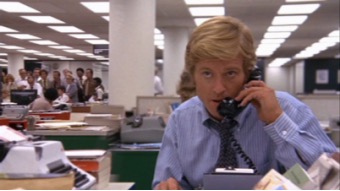
Image courtesy of Warner Brothers
Robert Redford: A Look at his Life and Legacy
| published Sept. 20, 2025 |
By R. Alan Clanton, Thursday Review editor
Like some high achievers of his generation, Robert Redford had multiple phases to his life.
There was the young hooligan growing up in Van Nuys, California, who strongly considered baseball as career and salvation. There was the art student turned stage and set designer who took a sharp turn into television acting, landing him scores of small parts in the expanding business of TV. Then, after a few small parts in movies, there was Butch Cassidy and the Sundance Kid, the 1969 anti-hero anti-mythology western which propelled him almost instantly from the B-List to top star.
And after two decades of being one of the world’s biggest movie stars, Redford turned to directing and producing, launching into shaping movies that pegged the meter of handsome filmmaking and critical success. Finally, there was the Redford who founded Sundance and the film festival of the same name—an event, a collaborative organization, and a mechanism for fostering independent films and advancing the creativity of a whole new generation of moviemakers.
Charles Robert Redford died in September at age 89. A quiet service with only a few friends and family members was held a week later.
Redford’s job title, at the time of his death, was CEO and President of the Sundance Institute, the Utah-based operation which had become arguably his longest lasting legacy. Sundance, formed in 1981, challenged the studio system and eventually became a rival to Cannes.
That late phase of Redford’s life might alone be enough to cement his place in film history. But it’s impossible to overlook his stardom, which, by the start of the 1970s placed him at the very top of Hollywood’s most bankable stars. 1969’s Butch Cassidy and the Sundance Kid thrust him into stardom, throughout the 70s he appeared in dozens of box office winners, from Jeremiah Johnson (1970) to The Sting (1973), from The Way We Were (1973) to The Great Gatsby (1974).
If his stardom by the beginning of the 70s was secure, The Sting cemented it for the ages. Starring opposite Paul Newman—with whom the chemistry had worked so well in Butch Cassidy and the Sundance Kid—Redford proved to audiences and critics that he could effectively work outside of what might have easily become a pattern of typecasting. The Sting won numerous Oscars that year, including best picture, and Redford was nominated for Best Actor. The Sting also commanded the box office, becoming that year’s biggest money-maker. That same year Redford appeared opposite Barbara Streisand in The Way We Were. Directed by Sidney Pollack—who would go on to partner with Redford in many more films—the period piece remains one of the most famous love stories ever filmed, and a film with a political edge crafted to challenge political dispassion and apathy, a factor Redford would later seek in some of the films he would direct in the 1990s.
Only a year later Redford would star in a film adaption of F. Scott Fitzgerald’s novel The Great Gatsby. Directed by Jack Clayton from a screenplay by Francis Ford Coppola, the film seemed a perfect fit for Redford’s natural charm and good looks. Redford played opposite Mia Farrow as Daisy, a young Bruce Dern as Tom Buchanan, and an even younger Sam Waterston as Nick Carraway. As film history would reveal, Redford wanted the part badly but had to wait while producer Bob Evans offered the role first to Warren Beatty and to Jack Nicholson. However, Beatty and Nicholson each turned the part down, reluctant as they were to work with Evans’ first choice for Daisy, Ali McGraw. When McGraw herself pulled out of the project (she had divorced Evans’ and was in a new relationship with actor Steve McQueen), all the pieces came together for Redford to take on the part of Gatsby.
The Great Gatsby was a success at the box office, though many critics were underwhelmed by the film, some citing its lack of emotional connection to the characters, the film’s sometimes morose pacing, and a disconnection from the narrative wrought largely by what Roger Ebert called “overproduction.” Still, most critics felt the screenplay remained more in touch with the original novel than two previous film adaptations of the Fitzgerald classic, and there were few complaints about Redford’s role as Gatsby.
Redford’s next role, in 1975, would prove his chops as actor seeking to work outside of all forms of typecasting. Three Days of the Condor, directed by Sydney Pollack and based on the action-spy novel Six Days of the Condor by James Grady, helped to establish not only Redford’s versatility and range, but also his personal desire to challenge the system. Stylish, handsome, and meticulously paced, the film tells the story of a small CIA front operation in New York City (The American Literary Historical Society), which in fact runs sophisticated computer analysis of books and publications from around the world in an effort to find patterns and code embedded in the stories, and to seek ideas for other clandestine possibilities. When the overlords of the operation want this boutique front shut down, they do so by having everyone in the building killed—except for Joe Turner (Redford), who has left the building to pick up lunch when the murders occur. On the lamb and fearing for his life, Turner must sort out why he is being sought, and for what mysterious reasons, pitting his skills against a cabal of senior officials within the CIA. Co-starring Faye Dunaway, Cliff Robertson, and Max von Sydow (as a memorable assassin), the film bristles with the sort of edge that Redford sought. Moreover, for a film which by design includes much technology and sidebar gadgetry, Three Days of the Condor remains surprisingly fresh and relevant, in part through Pollack’s directorial skills, but also through its timeless theme pitting a single person against “the system,” in this case a massive intelligence agency at war within.
Later that same year, Redford starred in The Great Waldo Pepper, the story of a skilled daredevil pilot who has missed the action of World War I, but seeks glory instead as a showman and barnstormer in the 1920s. Loosely based on the real-life exploits of pilots like Speed Holman, Ormer Locklear, and others, the movie received lukewarm reviews (along with raves for its spectacular aerial scenery), but still managed to draw sufficient audiences to break the $10 million mark at the box office.
But Redford was eager to pick up the thread where Three Days of the Condor had left off. As early as fall of 1972, Redford had been an avid follower of newspaper and magazine articles about Watergate—the scandal in which burglars had been caught by police inside the Watergate offices of the Democratic National Committee in June of that year, burglars with links to officials inside the administration of then-President Richard Nixon. Many of these articles had been written by Washington Post reporters Bob Woodward and Carl Bernstein. Later, Redford read cover-to-cover Woodward and Bernstein’s best-selling book All The President’s Men, an inside account of the investigative trail followed by the two young reporters. By 1974, and flush with financial success from his roles in The Sting and other films, Redford purchased the rights to the book for a reported $450,000—unprecedented at the time for a non-fiction book. Redford wanted to make the movie, and soon, before history had a chance to whitewash or sanitize the story, and before its legacy had become old news. Though The Post’s editor Ben Bradlee was at first reluctant to collaborate or even condone the making of the movie, he quickly decided it was strategically better to take an active role, especially to make certain that the film did not deviate wildly from the journalistic principals which Bradlee felt were central to the story.
After much back-and-forth between competing screenplays by William Goldman and Bernstein/Nora Ephron, Redford began his collaboration with director Alan J. Pakula. Pakula sought more revisions from Goldman. Later, Pakula and Redford added more touches. In the meantime, a nearly full-scale replica of the Washington Post newsroom was constructed in Burbank. Hundreds of desks—identical down to the colors and the drawer handles—along with typewriters, telephones, file cabinets, office swivel chairs, trash cans, coffee mugs, and a thousand phone books and city directories were added to the décor to lend authenticity. Redford, along with actor Dustin Hoffman who would portray Bernstein, haunted the Post’s real newsroom in D.C.
All The President’s Men became arguably the best movie about the world of newspaper reporters ever made (see our Retro Review in Thursday Review: Sunday, January 19, 2014). In advance, the film’s timing confounded many critics, who thought it too soon. After all, the subject of Watergate was still a divisive and nasty topic. To quote my own words from my 2014 article, “there was a method to this production madness. By seizing the story quickly, while the coals and ashes were still glowing, producer Redford and director Pakula ensnared the fresh collective memory and individual thought processes of the principals involved, and managed to produce an historical retelling with great accuracy and without the typical injection of “composite” characters and glossed-over discrepancies.”
In addition to Redford (who played Woodward), and Hoffman, the film starred Jack Warden, Martin Balsam, Hal Holbrook as the source known as “Deep Throat,” and Jason Robards—in one of the best performances of his long career—as editor Ben Bradlee.
All The President’s Men was a huge success critically, receiving almost uniformly positive reviews. It also commanded the Academy Awards that year, receiving eight nominations and winning four total Oscars. Pakula and Robards both won top honors in the New York Film Critics Circle Awards, and Goldman won top honors from the Writers Guild of American Awards. Redford was a co-producer of the film, his first foray into the world behind-the-camera, but a substantial milepost for his career which one day would draw him into directing and producing.
Redford’s remarkable run in the 1970s also included A Bridge Too Far, the massive, sprawling film retelling of Operation Market Garden—the sweeping allied offensive of World War II involving troops spread over Belgium, France and the Netherlands. Based on the book by Cornelius Ryan, the mega-budget movie included a top-heavy cast and massive amounts of money spent of battle sequences and heavy effects, but Redford’s part is memorable as an American commander who must get his men safely across a dangerous point in the river while under heavy fire. In 1979 Redford again collaborated with director Pollack for The Electric Horseman, co-starring Jane Fonda (his co-star from his early Barefoot in the Park).
And in 1980 Redford took on the role of Henry Brubaker in the prison film Brubaker, a thinly-disguised retelling of the prison scandals in Louisiana and Arkansas where mass graves were discovered, and where rampant corruption was coupled with the torture and abuse of prisoners. Despite the unpleasant subject matter, Brubaker was a success at the box office, earning it more than $37 million against its $9 shooting budget. And again, it solidified Redford’s skills as an actor, shunting aside his good looks in favor of a gritty story about individuals fighting a corrupt system.
Redford’s brief acting hiatus from 1981 to 1984 is the calm—as it were—before his next momentous and memorable on-screen eruptions. In 1984 the film The Natural was released. Directed by Barry Levinson, and based on the novel by Bernard Malamud, Redford portrays Roy Hobbs, a kid whose astonishing baseball gifts are apparent by the time he reaches his teenage years, and, as a young man—days after being recruited to appear at tryouts in Chicago—is struck down by a gunshot from a deranged woman. Hobbs survives, only to make a return to the baseball game he so dearly loves years later in his 30s. The story is mythic, in some ways a barely shrouded retelling of the Arthur legend, which Malamud had intended in his classic novel.
The Natural–which co-stars Glenn Close, Kim Basinger, Wilford Brimley, and Robert Duvall—is another strikingly handsome film, with idyllic images of baseball juxtaposed onto impeccable set designs and lavish period costume accuracy. A few critics took issue with the script’s deviations from the original novel, as well as the movie’s inconsistent pacing. Other’s complained that the film was more homage to Redford than to baseball, though even Redford’s antagonists agreed he filled the part of the lefty home-run hitter with natural skill (as a young man, Redford had wanted to play baseball professionally). In all ways, the film became a classic, and remains beloved by those who adore baseball, or those who enjoyed composer Randy Newman’s iconic, soaring soundtrack. The film also pits humble heroes against the brazen heroes—modesty against hubris in deeply classical and Arthurian legend terms—and includes some of the most memorable David versus Goliath moments ever filmed. Composer Newman and cinematographer Caleb Deschanel each won top honors at the Oscars. (Thursday Review ranks it at 18 in our Top 20 Great American Movies).
Then, in 1985, came another successful collaboration with Sydney Pollack, the stunning Out of Africa, based largely on the autobiographical writings of Isak Dinesen. Starring alongside Meryl Streep, Redford made the part of Denys Finch Hatton his own despite the character being British in Dinesen’s original writings. A stunning masterpiece from a cinematic standpoint, the film suffered a few negative reviews for its over-length and its slow pace; some critics offered the view that the film, while sumptuous, needed some basic editing. Other reviewers found the juxtaposition of old fashioned romance atop a gorgeous big screen period piece highly satisfying, especially in an age when most of what passed for “romance” from Hollywood in the 1980s was cheap though glossy sex. And, like The Natural, the film suited Redford well, though a few reviewers concluded that his character felt aloof and mercurial to the point of being a cypher (traits that some who knew Redford suggested were closer to the reality than many of the characters he played).
Out of Africa swept the Academy Awards for that year, gaining 11 total nominations and winning eight Oscars—though Redford himself received none (the film won for Best Picture and Best Director; composer John Barry won for Best Original Score).
Through the 1980s and 1990s Redford appeared in a dozen more movies, among them the romantic drama and courtroom yarn Legal Eagles (co-stars, Debra Winger and Darryl Hannah), the political thriller drama Havana (with Lena Olin and Alan Arkin), and the high tech computer caper film Sneakers (with Sidney Poitier, Dan Aykroyd, and Ben Kingsley). All three films did well at the box office, and Sneakers, particularly, proved that Redford was still able to act as part of a great ensemble cast, without overshadowing his co-stars.
Then, in 1993 came Indecent Proposal, in which Redford portrays an ultra-rich businessman, John Gage, who injects himself into the lives of a young professional couple who are struggling financially: Gage, intrigued by Diana (played by Demi Moore), offers the couple $1 million if she will spend the night with him, but her husband David (Woody Harrelson) declines the offer, though they change their minds the next day. Redford and the cast, not to mention director Adrian Lyne received some degree of pushback; in many circles the movie was deemed sleazy at best, and unabashedly anti-feminist at worst. Some critics lashed out at the film for legitimizing prostitution. But other critics, among them female writers, countered that the character of Diana was intelligent and strong, and portrayed as having control over her decisions, and an adult making the sort of decision about intimacy which adults ought to be able to make. Slickly produced, carefully paced, and well-acted, the movie remains something of a litmus test for those who first view it. Indecent Proposal also demonstrated that Redford was not easily swayed by the possibility of controversy.
But to fully appreciate Redford’s huge impact on movies and how he preferred to seek ways to operate outside of the Hollywood machine, one must rewind the tape a bit back to the start of the 1980s. Always yearning to have a fuller understanding of filmmaking as an artistic vehicle and as a business process, Redford turned to producing and directing. As first, it ran parallel to his acting, and later would become one of most significant legacies.
For his first time out as a director, Redford chose what would have been a significant challenge even for a seasoned, veteran filmmaker: a screen adaptation of Judith Best’s 1976 novel, Ordinary People, for which Alvin Sargent wrote the screenplay for Redford’s Wildwood Enterprises. Starring Donald Sutherland, Mary Tyler Moore, and Timothy Hutton, the film tells the difficult and anguishing story of a family trying to cope—each hour, each day, each week—with the loss of their oldest son, younger son Conrad’s brother (Hutton), in a boating accident. The movie was a breakout for all the lead performers—especially for Mary Tyler Moore, whose portrayal of the mother remains one of Moore’s most searing and electrifying performances. Both Sutherland and Moore were nominated for Oscars, and Timothy Hutton won for Best Supporting Actor (Judd Hirsch, who plays Hutton’s psychiatrist, was also nominated for Best Supporting Actor—a rare case of two nominations for the same distinction from the same film).
Ordinary People also won Oscars for Best Picture and Best Director (for Redford), as well as Best Adapted Screenplay (for Sargent). The film went on to sweep other awards as well, grabbing five Golden Globe Awards (Moore won for Best Actress, and Redford again won for Best Director), and winning the prestigious Directors Guild of America award for Outstanding Director.
Effectively knighted by Hollywood for his skill as filmmaker, Ordinary People paved the way for Redford to direct many other films according to his exacting standards and his vision of movies outside of the mainstream of formulaic success, a remarkable achievement in the 1980s and 1990s when the “franchise” concept had taken hold as the preferred business model for motion pictures.
Redford went on to direct numerous movies which achieved great critical success while also drawing wide audiences, including the visually stunning, beautiful A River Runs Through It, (1992) starring Craig Sheffer, Brad Pitt, and Tom Skerritt, a movie that many critics deem the break-out role for the young Pitt, and the film that gave the very young Joseph Gordon-Levitt his first film role (he was 10 years old when the movie was made). Shot on location mostly in Montana, A River Runs Through It was nominated for three Oscars, and won for Best Cinematography (Philippe Rousselot). Redford was also nominated for Best Director at the Golden Globes that year. The film also features Redford’s voice as narrator.
Redford also directed Quiz Show (1994), a lavish and detailed period piece set in the early days of American television, and retelling the true story of the infamous quiz show scandals of the 1950s. The story tells of the most famous of these incidents, when it revealed that some winners on the hugely popular NBC show "Twenty-One" had been supplied with the answers to questions, in some instances even rehearsing their responses and emotional reactions each time they are told by the emcee they got the answer right. At the heart of the story are Herb Stempel (played by John Turturro) and Charles Van Doren (played by Ralph Feinnes), and the relationship between these two famous contestants and the show’s producers. Pitted against the deception is a young congressional attorney named Richard Goodwin (played by Rob Morrow) who is tasked with sorting out the corruption. Quiz Show is handsome and atmospheric, capturing not only the look and feel of the middle-1950s with uncanny skill, but also the background sense of foreboding during the Cold War era of television’s meteoric rise within American culture, and the way that ratings seemed to supplant all other considerations. Quiz Show was nominated across the board at the Academy Awards and the Golden Globes, but interestingly won few top honors.
Then, in 1998, Redford struck movie gold again. Based on the novel by Nicholas Evans, The Horse Whisperer tells the story of a man who is gifted with horses, especially those with troubled lives or traumatic experiences, as is the horse belonging to young Grace MacLean (Scarlett Johansson). Starring also Kristen Scott Thomas, Dianne Wiest, Sam Neill, and Chris Cooper, the terrain and narrative are close to Redford’s personal home turf in the idyllic modern West. The Horse Whisperer was also the first time Redford both starred in—and directed—the same film.
Redford rounded out the decade with another sports masterpiece, The Legend of Bagger Vance. Based on Steven Pressfield’s book The Legend of Bagger Vance: A Novel of Golf and the Game of Life (itself based very loosely on an ancient Hindu story of challenge and perseverance), the screen version stars Will Smith, Matt Damon, and Charlize Theron, and tells the Depression-era story of a special exhibition match between two gold greats in Savannah, Georgia, and the entry of a golfer who has seemingly lost his mojo, but is shepherded rekindled success through the help from a mysterious caddy.
Through the aught years Redford starred in another dozen films and directed several more, including The Last Castle (2001), directed by Rod Lurie, a taut story of a military prison in which a well-known Lieutenant General (played by Redford) is sent for disobeying orders and engaging in an unauthorised military incursion. The film co-stars James Gandolfini as Colonel Ed Winter, the prison's commandant. The movie was fairly well-recieved by critics, but did not live up to expectations at the box office. Redford also went on to star in other films in the aught years, including Spy Game (directed by Tony Scott), The Clearing (2004), An Unfinished Life (2005), and Lions for Lambs (2007), a political thriller co-starring Meryl Streep and Tom Cruise, and another film which he directed.
But many film historians and filmmakers argue that Redford’s greatest legacy was the creation of Sundance, the organization and festival which encouraged so much independent moviemaking and fostered much creativity, especially in an increasingly risk-averse industry dominated by ever-larger entertainment conglomerates. Redford took a famously front-line position—and a literal street-level stance—bringing Sundance to the forefront (some friends recall his insistence on personally handing out leaflets and pressing the flesh at the earliest Sundance events) and fearlessly building the concept into something that could not merely challenge other film festivals, but also create a pathway for young, innovative directors.
The location of Sundance predates Redford’s stardom. Early in his career, while taking small parts in television shows, Redford was on a cross-country motorcycle journey when he came across small parcels of land in the remote and rugged Provo Canyon area of Utah. Instantly smitten by the land and its beauty, he bought a few acres, and built a minimalist cabin. Later, in the 1960s, flush with his earnings from Barefoot in the Park and Butch Cassidy and the Sundance Kid, he bought more land in the same area, this time more than 5000 acres. When he founded Sundance in 1980, it seemed perfectly fitting—if not poetic—to place his fledgling idea of the film institute in the idyllic and remote location.
And by 1981, scores of young screen writers and would-be directors attended the first meetings, including the first “Lab” of 17 independent filmmakers, and by 1983 the first totally “lab-funded” and backed film reaches audiences; El Norte won numerous awards and won over critics (including those skeptical of Redford’s goal of creating quality film from such small budgets).
Indeed, the films by independent filmmakers such as Steven Soderbergh (sex, lies, and videotape) and Quentin Tarantino (Reservoir Dogs) owe much of their early breakout and success to Sundance and the workshops.
The Sundance website offers these words: “Bob’s vision of a space and platform for independent voices launched a movement that, over four decades later, has inspired generations of artists and redefined cinema in the U.S and around the world.”
Related Thursday Review articles:
2001: A Space Odyssey: Fifty Years Ago Science Fiction Changed Our World; R. Alan Clanton; Thursday Review; April 12, 2018.
Die Hard at 30: Come Out to the Coast, Have a Few Laughs; R. Alan Clanton; Thursday Review; Sept. 19, 2018.