
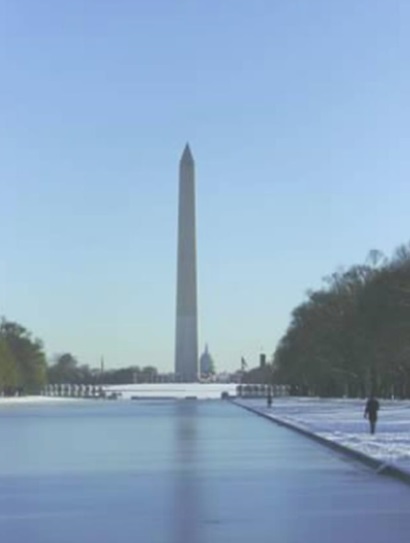
Photo courtesy of Prof. Pam Brown
Reflecting Pools
& Draining Swamps
| published August 7, 2026 |
By R. Alan Clanton
Thursday Review editor
Amidst all the hue and cry and hubbub in the news recently—paints peeling, sealants failing, water drained by the millions of gallons, accusations of vandalism, lousy contractors, substandard work—it occurred to Thursday Review web designer, artist and writer Lisa Whitten to ask me recently who had commissioned the original construction of the Reflecting Pool on the National Mall in Washington, D.C.
Even with my moderately good memory for American history, neither easy nor complex answers arose. “Well, it was commissioned probably by congress, or by some president,” was about the best I could come up with while I fidgeted with the remote control, squirming as I watched silent images of U.S. Attorney Jeanine Pirro, Interior Secretary Doug Burgum, and Senator Chuck Schumer. The television sound muted, I shrugged.
I knew for certain only that it was basically a part of the original design for the Lincoln Memorial, and from my own footfalls around the place on more than one occasion, I knew that it was designed—at least in large part—to offer a long, detailed, shimmering reflection of the Washington Monument’s sleek, elegant vertical lines if one was standing at the foot of the Lincoln Memorial. Likewise, the pool’s surface would offer a crystalline, upside-down reflection of the Lincoln Memorial in all its stout grandeur if one was standing at the opposite end looking west, with one’s back to the Washington Monument. (And we had photos taken by Professor Pam Brown, an occasional Thursday Review writer and reporter, to prove it).
The two great memorials would complement each other in this way, which was indeed part of the plan when the first designs for the Lincoln Memorial and the pool itself were developed by architect Henry Bacon.
Bacon, one of the leading lights of the Beaux-Arts Movement, lived barely long enough to see his grand neoclassical project completed; he died in February of 1924, ten years after the project began and less than two years after its main components had been completed.
Among the other things I kinda-sorta knew: the pool, and in fact much of the area around the Lincoln Memorial, required many truckloads of landfill sand, rock and dirt to raise the surface enough just to be able to begin any form of construction; Washington’s frequent derisive moniker “swamp” is not some allegorical reference to the grubby nastiness that is politics—it refers to the actual insect-infested marsh that once existed across a substantial swath of what is now the western side of D.C., and what was then the muddy, marshy edges of the Potomac River.
Lisa Whitten seemed annoyed by all this yammering and simply repeated her original question: yes, yes, but who commissioned it? Who requested it to be built in the first place?
Our intensive Google searches yielded very little more than what I had already spouted off, and generated an infinity of news articles about the Recent Troubles—an ongoing brouhaha with endless tentacles, dozens of conspiracy theories, tales of shoddy workmanship, visions of knives and box-cutters, and certified instances of derangement. In other words: something to offend everyone and get the blood boiling.
So, I had to close the Google app on my phone and start some actual research (I often use “books” for this task). Within minutes I learned a few new things. Bacon had studied architecture at the University of Illinois at Champaign-Urbana, and had been a leader within the great Beaux-Arts movement, an ironic or perhaps poetic fact of his biography since his most enduring creation had been an unmistakable homage to the greatest of the Greek architectural achievements, the Parthenon in Athens.
Indeed, the Lincoln Memorial is a textbook lesson in the neoclassical: 36 fluted Doric columns each at 44 feet in height; a robust interior “exterior” wall which leans about two degrees inward to compensate for the optics when viewed at a distance; classical cornices, and a broad foundation of shallow Athenian steps, making it a “temple” of Democracy.
At either end of the expansive front steps are two stout buttresses, each adorned with its own marble tripod holding aloft flambeau-like urns. Those tripods and marble urns are two of only a few flourishes meant to appeal to the Beaux-Arts.
Then, stretching outward toward the east, toward the center of Pierre Charles L’Enfant’s great cross-structured, radiant layout of Washington, D.C., is the Reflecting Pool (officially called the Lincoln Memorial Reflecting Pool), running more than 2000 feet in length and 167 feet wide. The pool dominates the ground acreage just as the Washington Monument points with such minimalist vertical power upward, and just as the Lincoln Memorial stands with resolute patience. The pool acts as an empathetic source of balance between two of the most emphatic pieces of Washington architecture.
Designed to be “reflective” both literally and spiritually, it’s placement was not intended as something to become iconic, but that’s what has happened: over the many decades the areas around the Reflecting Pool have become the site of great events and famous speeches and gatherings; examples include the August 1963 March on Washington, which featured Martin Luther King as its keynote with his “I Have A Dream” speech before nearly a quarter of a million people, and the October 1967 anti-Vietnam war rally which drew at least 115,000 protesters.
The pool’s use in movies and television is also well known: Mr. Smith Goes to Washington (1939), Forrest Gump (1994), Nixon (1995), and Spider-Man: Homecoming (2017), are but a few examples.
The pool and its surroundings attract tens of thousands of visitors each year as people walk the National Mall (or arrive by cab or bus) to visit the various memorials to American history. For its reflective quality and design, and its remarkable ability to offer visual and spiritual cohesion to the western end of the National Mall, the pool is sometimes called a “water mirror” or a “waterscape” for its stoic, elegant beauty. Nearby, along the northern flank of the Reflecting Pool, is the impressive chevron-shaped memorial to those who lost their lives in the war in Vietnam. It is only a few hundred feet from the Lincoln Memorial. To the south is located the Korean War Veterans Memorial, heavily shaded and also a short distance from Lincoln’s figure. And at the eastern end of the pool is the World War II Memorial, opened in May of 2004 and dedicated by then-President George W. Bush. The World War II Memorial’s oval pool offers a deliberate echo of the Reflecting Pool itself, most especially when viewed from the east looking west toward Lincoln.
The decision to place the WWII monument in that location was not without controversy since the major complaint was that it would interrupt the sweeping, continuous view along the National Mall, with the Capitol Building at one end and the Lincoln Memorial at the other, with only the dramatic Washington Monument in the center. But the designers sought to confirm and validate the flow, and in the end, most agreed that the WWII Memorial’s placement works well and serves to provide harmony to the Mall’s great vista, and by extension, the elegance of the Reflecting Pool.
According to the National Park Service, as early as 1867 Congress had authorized the creation of what would soon be called “The Lincoln Monument Association.” Previous statues and busts erected in the Capitol Building and in smaller parks around D.C. had been viewed as falling a bit short of the larger goal of honoring Lincoln in a big way.
At first, the Congressional mandate did not offer much in the way of a timetable, and much national priority was given instead to the obvious costs of Reconstruction for a nation struggling to claw its way back to normalcy after a brutal and costly Civil War. Still, Congress—supported by President Ulysses Grant—set in motion some of the basics, including commissioning Clark Mills to sculpt a massive statue of Lincoln intended to be erected in a more central location. That project foundered, hampered by arguments about the final cost, fights over locations, construction and design problems, and even political fights. For another decade, the project languished, stalled as it was by a variety of factors.
Finally, however, in 1901, plans were afoot for major renovations and redesigns of large parts of Washington. Leading the effort was U.S. Senator James McMillan, who wanted to see Washington revamped in such a way that the city better reflected the growing prestige and influence of the United States.
L’Enfant’s grand drawings and maps were dusted off and given a closer look, and Congress and some D.C. planners also saw the completion of a Lincoln memorial as a clearly-defined opportunity to bring the westernmost end of the Mall to a logical and idyllic terminus at that ragged, swampy edge of the Potomac River. McMillan created a Senate Committee for the purposes of overseeing the grand rebuild-redesign, and several well-known architects and builders were brought to the table to offer advice and designs. Maps still exist showing the one of the proposed McMillan Plans, dated 1901. On at least one of these maps the Reflecting Pond is painted as an elongated cross—a sort of liquid cross within the larger cross of L’Enfant’s larger design, but with a proposed structure near the very spot where the Lincoln monument was being considered.
Within a year, most were in agreement that the right location for the Lincoln Memorial was at the edge of the Potomac—the logical place. Almost simultaneously, the Commission and its team approved the construction of a bridge to connect the contiguous part of Washington, D.C. to the Virginia side of the river, and most notably to Arlington National Cemetery, the place where so many of the Civil War fallen had been buried. McMillan and his fellow committee members intended the bridge to be a symbolic link between north and south, between the former Union and the former Confederacy. The bridge would honor the nation’s unity while at the same time celebrating its new robust and dynamic growth.
Still, debates raged in both the House and the Senate for years, even after most elements had been agreed upon—most especially the general location—and even after other U.S. Presidents had more-or-less weighed-in in favor of a Lincoln monument, including Theodore Roosevelt. Budget and political feuds set the project back many times, but Senator Shelby Cullom of Illinois dug in his heels and made the memorial a priority, leading various alliances with the introduction of at least four separate bills over a five year period before he met with success in 1910. President William Howard Taft was chosen to head the commission.
By this time, previous sculptors and architects had fallen away from the project or had passed away. It took yet another act of Congress to get the ball rolling, as it were, as by that time Lincoln's standing in U.S. history had grown substantially, and his legacy seemed even more important as something to be honored in a large way. In 1911, Congress explicitly formed the Lincoln Memorial Commission, and in 1913 later found sufficient support for the Potomac River location to authorize funding for construction with a budget of $300,000.
Henry Bacon was hired as the chief architect, Daniel Chester French was commissioned to create the huge statue of a seated Lincoln, and Jules Guerin was brought to the team to paint the massive, 60 foot murals found on the walls inside the memorial.
Even with the money in hand, things were a struggle. Indeed, to suggest that “ground was broken” on February 12, 1914 (the official start of construction) would be a misleading statement: much of the area was still a huge, boggy, swampy quagmire. One of the project’s contractors, M.F. Comer of Ohio, alongside Bacon and Senator Joseph Blackburn of Kentucky conducted a groundbreaking of sorts on a patch of dry ground while a small crowd looked on, though actual work would not begin for months.
Most newspaper accounts from the era suggested that there was widespread skepticism about the integrity of the ground, and contemporary photos of the early stages of construction show clearly standing water, large muddy pools, and steam and gas-powered pumps at work to shunt the water aside. Since almost all of the land was being filled-in with sand, rock, crushed stone, and dirt, it took one full year for the foundation to be completed, inspected, and deemed sound. Even with the pumps operating almost continuously, standing water remained a factor.
According to the National Park Service’s website, while a reliable bulkhead was constructed along the Potomac, engineers poured 122 massive concrete piers which went down all the way to the bedrock, no easy task while keeping the water at bay. More concrete piers were then added, then still more, with a series of heavy steel-reinforced concrete arches atop that layer. Atop that they built placed the marble floor, which at the last moment engineers decided to also reinforce with steel to accommodate the heavy Lincoln statue.
In 1915, the project slowed to a crawl while the First World War raged in Europe; the number of available workers for the project (mostly men) shrank, and materials and resources were diverted to the war. Still, Congress authorized enough money and material to keep construction moving. Marble was brought in from Alabama, Tennessee, Colorado, and Georgia, with granite from Massachusetts and limestone from Indiana.
While the Memorial building was being completed, other specialized crews worked on the Reflecting Pool, which Bacon wanted to have completed by the time of the inauguration of the monument. Work on the pool went quickly, but even in the period from 1916 to 1918, there was a sense there could be problems; think of constructing a pool in a backyard which is surrounded by swamp or marsh, then multiple that by a factor of 1000. Still, much of the Reflecting Pool work was completed in time despite some uncertainty that the filled-in land had settled sufficiently to support the weight of the water in all places.
On May 30, 1922, Lincoln’s eldest son Robert Todd Lincoln, an attorney and businessman (by then aged 78), helped dedicate the Lincoln Memorial alongside three U.S. Presidents as scores of U.S. Senators and Representatives stood nearby. Photographs of the momentous occasion show Robert Lincoln with William Howard Taft, Calvin Coolidge, and Warren G. Harding. Work on the Reflecting Pool continued for a few months after the Memorial’s dedication.
Though the massive Lincoln Memorial remained steady and intact, the Reflecting Pool finally began to run into problems by midway into the century, when engineers and inspectors began to notice in the 1980s that the pool was sinking, by some accounts, a fraction of an inch each year. And there were leaks. It turns out that Bacon and his contractors built the bottom of the pool by pouring a layer of asphalt over the graded dirt and soil, then, adding a layer of tile. But the porous asphalt used in 1917 and 1918 eventually proved no match for the sometime moist, shifting soil and mud below—this despite the best efforts to drain the swamp and get the fill dirt settled sufficiently.
After decades of patching the intermittent problems and defects, money was set aside in 2009 to rebuild and rework the pool. When the crews began to dig in 2010, they discovered the situation was worse than they thought, with unstable mud, clay and wet sludge under the pool, and a large area where water had seeped and had been collecting for decades. Among the things deemed necessary for the nearly $40 million task: the removal of some of the mud, and the installation of thousands of wood pilings, along with gravel and rock to support the foundation for a new base for the pool. And where for decades the water in the pool had been simply filled using metro city water—a very expensive process in times of low rain and drought—the new pool design would use recycled and recirculated water from the nearby Tidal Basin or from the Potomac.
The Reflecting Pool was formally reopened on August 31, 2012 amongst much fanfare and excitement. But the celebrations were short-lived: the recirculated and recycled water was found to promote algae, so much so that the Reflecting Pool was closed again within a few weeks, and had to be drained…again. (At the time, this prompted Thursday Review features editor Earl Perkins to write, “It seems we can drain the swamp in Washington, but we can’t pull Washington out of the swamp.” It may be worth noting that Earl graduated from the University of Florida, and as most TR readers know, that Gainesville football stadium is sometimes referred to as The Swamp).
After many more hundreds of thousands of dollars were spent on the algae issue, the National Park Service concluded the simplest remedy would be to increase the dosage of ozone disinfectant being used in the pool. Things went smoothly for a few more months until contractors working on the new National World War II Memorial—just a few feet from the eastern end of the Reflecting Pool—accidentally damaged the retaining wall and some of the water flow, triggering more repairs which were completed in 2015.
Then, in the warm weather of 2017, came the “blood flukes,” or schistosoma, a parasitic outbreak which in swimming pools can cause something known as “swimmer’s itch,” but in 2017 may have been the cause of the mysterious and sudden deaths of at least 80 ducks and other birds throughout May and June that year. More chemical changes were made, and more tweaks to the disinfectants were employed. By the end of 2017 things seemed stable and the waters looked good.
The two great American conditions--short attention spans and even shorter memories--mean that history has a way of repeating itself, sometimes comically, at other times not-so-humorously. President Trump’s recent attempts to make the Reflecting Pool more appealing to the eye—his goal was to give it a swimming pool blue, which he later revised to be American flag blue—have managed, as these things often do, to divide almost everyone along all imaginable, and some unimaginable, lines. And it has set in motion the usual finger-pointing accompanied by scenery-chewing histrionics.
Still, all will eventually be well with the pond and with the Republic. L’Enfant’s ingenious and mathematically beautiful plan for Washington, D.C. remains a work-in-progress, much as the United States remains an evolving story. And the answer to the question of “who commissioned the Reflecting Pond?” remains too complicated for a one-name or one-sentence answer.
But in the meantime, we offer this advice: if you’re gonna’ build a really big pool, make sure you drain that swamp.
Related Thursday Review articles:
Paul Rivera's Midnight Ride: A Closer Look at the DNC's Postmortem; By Bob Armstrong, Thursday Review contributor; June 5, 2026.
Lindsey Graham Dies at 71; By R. Alan Clanton, Thursday Review editor; July 12, 2026.