
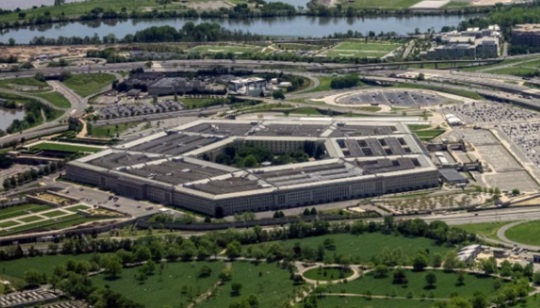
Photo courtesy U.S. Air Force;
photo by Air Force Tech. Sgt. Ned T. Johnson
Pentagon to Defend
Against Foreign Threats
in Midterm Elections
| published September 30, 2026 |
By Thursday Review staff
On the last Monday of September, Secretary of War Pete Hegseth issued a brief memorandum announcing that the Pentagon will take the lead in identifying and neutralizing threats and potential threats from foreign actors in upcoming elections in the United States.
The directive accompanied a press release sent to media sites September 28, and the media release included a link to read the more detailed directive.
“In direct support of President Donald J. Trump’s commitment to election integrity,” the media release said, the Pentagon will “mobilize a comprehensive, whole-of-government defense of our election infrastructure from foreign adversaries.”
The memo itself—dated September 22—was directed to the top officials at several government agencies, among them the Commander of the U.S. Cyber Command, the Director of the National Security Agency, the Director of the Defense Intelligence Agency, and the Director of the National Geospatial-Intelligence Agency.
In the memo, Hegseth effectively directed all those agencies under his command to place a priority on protecting the integrity of U.S. elections from foreign interference.
“In my role as Secretary of War,” Hegseth said, “The Department of War (DoW) will effectively wield its capabilities to protect and uphold the reliability of America’s voting mechanisms against external manipulation and disruption from foreign actors, while maintaining the fundamental freedoms that characterize our country.”
As in the press release, which was prepared by Pentagon spokesman Sean Parnell, Hegseth’s memo cited Trump as the catalyst for the initiatives. On his stump speeches and at many major events, Trump talks about his concerns about election interference, sometimes within the context of his belief that the outcome of the 2020 election was fraudulent and that he—not Joe Biden—was the rightful winner.
Hegseth’s memorandum does not identify any culprits or name any nations, nor does it clearly suggest that there is a credible threat lurking out there. Though in the past decade concerns about such outside interference has focused on Russia, or, more recently on China, the war between the United States and Iran has raised the more immediate possibility that Iranian actors and agencies may attempt to target the upcoming midterm elections as a way to lash out at the U.S. and at Trump.
Indeed, scores of recent breaches of infrastructure management, water systems, electrical grids, and other city or state agencies across the U.S. have been largely attributed to what the FBI and other investigative agencies believe is the work of one of Iran’s secretive cyber warfare units. Iran has not emphatically denied this, nor has it claimed responsibility; still, much of the forensic analysis of these breaches show signs of Iranian involvement.
One of the key factors in the upcoming midterm elections is the tight, razor-thin margin held in the Senate by Republicans, and a desire by Democrats to break that majority. A dozen states are in play for potentially pivotal Senate races, with Democrats seeking to topple GOP control and Republicans hoping to retain their majority.
Some Democrats have worried openly that the Trump White House will attempt to leverage the power of various government agencies to try to intercede in the outcome of some of those races if things get too dicey or too close. By one theory, the Trump administration will use the window in which slower-counting states—Michigan, California, Massachusetts, Maine—tally their results to cast doubt on the legitimacy of the outcomes. In some of these states, the outcomes of Senate or House races are deemed too close to call, and the prolonged delay as votes are meticulously counted might offer opportunity for some to see conspiracies or manipulation at work.
California is well-known to be the slowest when it comes to producing a complete count (Florida is at the opposite, and is generally regarded as the fastest to produce a full count despite its infamous mishaps in the year 2000). According to the not-for-profit California Voter Foundation, the delays have grown somewhat worse in recent years, not better; this despite technologies now widely in use in scores of other states. In 2025, Governor Gavin Newsome signed-off on legislation meant to quickly improve the situation and speed up the vote tallying, but to no avail.
In an article back in June, Washington Post writer Praveena Somasundaram looked into the issue when Californians has waited an agonizing four or five days to get results in a number of key races, including the mayor’s race in Los Angeles and the gubernatorial race.
“Officials knew before the election that they would be accused of vote-rigging,” Somasundaram wrote on June 6, “as they have in past cycles in which Republicans lost ground as late ballots were counted.” Indeed, Republicans have become generally skeptical of outcomes in those states where the long delay in completing the count seems to produce a decisive shift in the final hours of counting.
But spokespersons for California’s elections systems say their method of slow counting is meant to achieve three critical things: a meticulously hyper-accurate count, virtually no chance of any form of digital or data interference, and the broadly-stated goal of “ease-of-voting” and fairness. Among the features of voting in California: a direct comparison of signatures with the signatures on file, a very slow process indeed for the most populous state in the country.
Newsome’s proposed legislation is pending, working its way through the legislature. Meanwhile, several lobbying groups are pushing for even more money to be set aside in future budgets to add the technology needed to make things move faster, including a proposed $55 million in funds recommended by the California Voter Foundation
Whether the long counting window in the slower states actually provides an opportunity for foreign actors to intervene or manipulate the outcome is unclear, since in those states most of the verifying is done by hand and by direct visual verification. The more likely scenarios—as were the concerns about Russian interference in 2016 and again in 2020—include meddling by China or by Iran, but only in those states where there is ample opportunity to breach electronic and digital election systems. And Iran’s axe to grind may be far more potent while the war still rages (ironically, squeezing many of the same Americans who enthusiastically supported Trump in 2024, and creating the very real risk that some of those same voters may choose the upcoming midterms to express their disappointment with Republicans).
In the meantime, Hegseth and the Pentagon have said the military will throw in its substantial resources and skills to ward of interference by foreign actors.
“Our nation’s ability to conduct free and fair elections is a steadfast principal of our democracy,” Hegseth said in the memo’s closing. “Assuring and protecting this ability is a no-fail mission, and the DoW will do its part in supporting this whole of government effort.”
Related Thursday Review articles:
AI Safety Has Moved Beyond the Chatbot Era; By Gleb Tsipursky, PhD; Thursday Review contributor; September 14, 2026.
Nvidia to Buy Hugging Face For $13 Billion; By Thursday Review staff writers; September 10, 2026.