
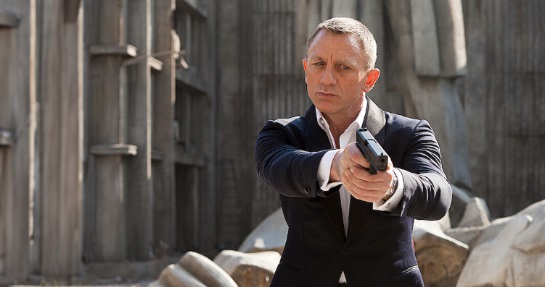
Image courtesy of EON/MGM
Is the Next
James Bond Film
in the Works?
| published June 21, 2026 |
By R. Alan Clanton
Thursday Review editor
With the 2021 movie No Time To Die, two things happened to the immortal franchise that is James Bond: Daniel Craig retired from the role, which was already expected and agreed upon; and that particular series of movies brought itself to a terminus whereupon our hero and protagonist dies. End of story.
Except, of course, it was not the end of the story, merely a closure to the Daniel Craig chapter of the enduring, never-ending saga, followed by a well-deserved hiatus for the British secret agent.
In June we learned officially what had been in the wind of rumors for months: a reboot of the Bond series is being planned, six years after Daniel Craig's last words were spoken and the final frames in No Time To Die faded into the credits.
It's a sticky debate, of course, and learned minds can disagree, but the years of Daniel Craig may have been the best ever for the character James Bond and the 007 tales. Craig was an ideal jumpstart to the new millennia: rugged, battle-scarred, flinty, imperfect, still irascible, still resistant to authority, but dedicated to a fault, loyal, and committed to the cause, whatever that cause was—be it that of the Union Jack (or by extension the Stars and Stripes).
Craig was the right actor to embrace both sides of the classical Bond movie fascination with technology: Craig 's version of James Bond was both a formidable embracer of high tech, as well as a sturdy skeptic. This Bond understood that certain things could only be accomplished by action—through gunplay, through physical prowess, though fisticuffs, through seduction.
Daniel Craig was also the right guy to extend the previous legacies, which was no easy task: his predecessor, Pierce Brosnan, even looked like what we all thought a James Bond should look like. Over the decades, writers here at Thursday Review have weighed in with their opinions: author and writer Michael Bush prefers Sean Connery, essentially the original Bond against which all others are measured; writer and poet Maggie Nichols preferred dashing Roger Moore and his debonair, smooth, dapper élan; historian, educator and TR co-founder John Herndon leans toward Timothy Dalton—smart, complex, intellectual, dry. Others have played Bond as well, including George Lazenby and David Niven. But after Daniel Craig, we must move on.
So, quietly and in secret, actors and actresses are reading for parts and being tested, and soon the all-important casting decision will be made. And an overall plan, it seems, is beginning to coalesce around a reboot, at least according to MGM Studios' executives, among them Courtenay Valenti. After No Time To Die, the family trust which owned the Bond franchise—basically Barbara Broccoli and Michael Wilson—sold the casting control and the decision-making to Amazon MGM. Amazon MGM will call the shots, but, according to Valenti, "with care and deep respect" for the legacy. Valenti called it the "dream of a lifetime" and "a responsibility we don't take lightly." Sometimes statements like this make me squeamish; we've heard this sort of thing before, often right before a concept gets ruined in the wrong hands. Lest we forget that Batman has had its ups and downs (how did George Clooney work out?), and few will ever regard Star Trek: The Motion Picture as anything more than an expensive test-screening, a sort of trial run for the much better films that followed.
But, back to the business at hand.
Those top ten lists which highlight possible James Bond replacements have been circulating around the web continuously since 2021—so many years that some of the top names in once in contention have disappeared altogether and been replaced by newer names, including several much younger actors—among them Tom Francis, Callum Turner, Tom Holland, and Harris Dickinson. Some are so young in appearance as to make a true reboot not merely possible, but practically essential from a narrative standpoint. Do we want a Bond who looks to be a mere 23? Jacob Elordi is on many short lists; an Australian, he is said to be gifted at all forms of U.K. accents, including the refined Scots-Brit blend needed to play Bond. Elordi also bears an uncanny resemblance to Dalton.
A few "older" actors are still in the running, including Tom Hardy (he resides atop many of the lists of favorites) and Aaron Taylor-Johnson. Hardy looks the part and could clearly embrace the role as we all understand it; Aaron Taylor-Johnson would fit the role well assuming the reboot includes a substantial kick-forward into the next decade or so of filmmaking. With a gentle shave and a modest haircut, he too looks the part and could carry it with ease. Both actors have been fully vetted with audiences and are frequently voted "right for the role."
Other actors have publicly stated they were never asked, or were asked, but had turned down the part. Despite some rumors, Idris Elba told British interviewers that he was neither asked to audition, nor did he take seriously the ongoing chatter that the next Bond would be a person of color, such as himself. Elba acknowledged he was flattered by the attention, but said "Bond is big all over the world, and audiences won't go for a black male, an African male, playing Bond." At age 53, Elba might also be a tad elderly to take on the role anyway, since a true reboot is surely what the producers seek to spark. If there is to be a Bond of color, some lean toward London-born David Jonsson, now 32. Jonsson has proven himself in films as diverse as Rye Lane (2023) and Alien: Romulus (2024).
But I'll stop for now. Rampant speculation at this point is meaningless (except for those big betters using apps like Polymarket) since Amazon MGM will likely make an announcement within the next few weeks (at least according to media and Hollywood rumors), and probably not later than early August.
Much depends of that key casting question, and then the saga can begin again in earnest. Film industry analysts are suggesting that principle shooting could begin as early as November of this year, but only if all goes well in the casting, and only if the script ideas gel appropriately and get the all-important green light.
According to The Guardian, most of the elements are in place, with Denis Villeneuve set to direct, and screenwriter Steven Knight handling the principal scriptwriting—for now.
Nostalgia aside, and avoiding the parlor games and barroom brawls about who was the better Bond (typically, these dust-ups occur during the arguments about Sean Connery vs. Roger Moore), the Daniel Craig era was arguably the true "2nd" golden age for the series. Craig, vis a vis all those writers and some savvy directors, was able to take the series into the new century with an ease that would have been problematic for some of the previous actors, and even a bit tricky for the handsome, slick, erudite Pierce Brosnan (as Jack Nicolson was born to play the Joker, so it was that Mr. Brosnan was imbued with the Bond looks and charisma from birth).
Daniel Craig was not an easy choice, and his selection was not without controversy: shorter than all the previous actors, and with sandy blond hair to boot, he was not deemed appropriate for a part most often identified as "tall, dark, and handsome." Nevertheless, Craig brought a form of panache to the role, as well as a toughness—and fragility—not previously seen. In his 2006 debut appearance—Casino Royale—Daniel Craig effectively silenced the nay-sayers and the sceptics. At the time, all previous Bond actors were alive save for Niven, and all were impressed. Even Roger Moore suggested that Craig's redefinition of the part was transformative, telling reporters that Craig was now "the Bond."
It was helpful from a narrative standpoint too that the writers chose Casino Royale, effectively one of the earliest of the original stories by author Ian Fleming, and the title of the first full-scale novel about 007. First published in 1953, it was made into a farcical variant for the screen in 1967, with Niven as Bond, Peter Sellers as Evelyn Tremble, William Holden as a CIA agent, Orson Welles as Le Chiffre, and Woody Allen playing the diminutive but megalomaniac villain, "Jimmy Bond." It was a visual feast, an elaborate extravaganza, and a big screen hoot—but it was not what audiences really wanted in their 007 films. And soon thereafter, die-hard James Bond fans essentially barred the 1967 Casino Royale from the canon (it was produced not by EON/MGM, but by Columbia Pictures). As parody, it succeeds, though weirdly. It's not as bad as you might have heard, and it is still funny to watch, especially for its top-heavy cast.
But why was this helpful to Daniel Craig, his fellow cast members, and director Martin Campbell? If Campbell and Craig could overcome the sticky stigma of parody, silliness and camp still clinging after nearly 40 years, then as a team anything could be accomplished in the new millennia of Bond. Campbell had previously directed Golden Eye (1995) with Pierce Brosnan, and he had both a deep understanding of the Bond franchise vis-à-vis Broccoli and Wilson, and also an apparent sense of how to move the franchise forward. For all parties involved, Craig's casting and the choice of choosing Casino Royale as the new starting point proved smart, as well as pleasing to moviegoers.
Casino Royale was a huge hit on its opening weekends in the United Kingdom and in the U.S., earning more than $14 million on opening day in the U.S., and some $40 million by the end of the weekend. It was also the most successful film in the U.K. for the year. After seeing the film upon its opening in London, Roger Moore himself wrote that "Daniel Craig impressed me so greatly in his debut Casino Royale by introducing a more gritty, unrefined edge to the character that I thought Sean Connery might just have to move over."
A few of the Bond films starring Daniel Craig are among the best ever made, and at least two rise to the form of cinematic high art beyond the narrow or broad confines of spy movies and international intrigue. Indeed, Skyfall is, in my book, the best Bond film ever made, and an apt prelude to the next chapter, as it takes audiences back—almost literally—to Bond's orphan childhood in Scotland and his earliest affinities to spywork and special ops.
This set us up for Spectre, and the re-introduction of Bond's most enduring super-villain foe: Ernst Stavro Blofeld. Blofeld reveals himself to be, in his own words, "the author of all your pain," and the master operator behind several of Bond's previous antagonists. By the end of No Time To Die, both Blofeld and, tragically, Bond himself, die, in a sort of Shakespearean roundabout of revenge, counter-revenge, and stoic acceptance of death. Thus, the stage is cleared and swept clean, and we await news on how the whole thing will be rebooted.
Now a quarter century into the new millennia, and 25 years after 9/11, the filmmakers can embrace the many "new normals" of our world, as well as the mind-bending new technologies even more fully than in the Daniel Craig years.
Imagine the possibilities, but also imagine the competition with real news. Mastermind criminals, twelve-digit swindlers, election rip-offs (or the appearance thereof), hack attacks and top-level swattings, assassinations of top corporate executives, schemes to use drones with machine guns to attack a UFC event on the White House lawn, the Epstein files and members of the royal family, stolen data, artificial intelligence and data centers, weaponized drones, the rise of the new normal billionaire class (Elon Musk is a trillionaire), and people so wealthy that they can launch rockets into space—all these real-world news items make Bond's previous escapades and antics seem laughable (remember when the worst thing we could imagine was a blackmailing megalomaniac threatening to launch a Gemini-era rocket from his secret lair inside an island shaped like a pineapple?).
And with wars in the Middle East, the Ukraine, on all of Israel's borders, and even in flashpoints in Myanmar and along the India-Pakistan border, the possibilities seem unlimited for intervention by a really tough, effective British secret agent. And one who knows how he likes his martinis mixed.
In the meantime, with Amazon MGM now calling the shots, the hardcore Bond followers can settle for a new series which begins later this year called Young Bond: Silverfin, which will apparently star Isaac Rouse as a—you guessed it—very young James Bond, orphan, rebel, and teenager attending Eton College. Rouse got one of his earliest starring roles as Charlie Bucket in the stage adaptation of Charlie and the Chocolate Factory, which was directed, interestingly, by Sam Mendes, the same Sam Mendes who directed Skyfall and Spectre. The Young Bond: Silverfin scripts have been adapted from the novels of the same name by writer Charlie Higson.
As for the next feature film, Amazon MGM has a lot riding on the success of the big screen reboot. In early 2025, Amazon reportedly peeled off £790 million (or about $1 billion—yes—Billion with a capital B) to buy total control of the 007 franchise from EON and the heirs of Albert Broccoli. A billion dollars might just about pay for Bond's next car, a few good suits, and a license to kill, but it's a huge investment, and a big risk, if the next James Bond does not lure audiences into the theaters.
Related Thursday Review articles:
Welcome to My Secret Lair: A Look at SPECTRE With Daniel Craig; By Michael Bush; Thursday Review; November 26, 2015.
Shaken, Not Stirred: Reflections on the Life of Roger Moore; By R. Alan Clanton, Thursday Review editor; May 24, 2017.