
Photos by Alan Clanton
A Cathedral
of the American Political Gothic
| published November 19, 2025 |
By R. Alan Clanton, Thursday Review editor
This is sort of a travel review, but it is also a book review. Let me explain.
First, Baton Rouge was not on my travel bucket list. Being the sort of geek who loves lists, I indeed have a travel bucket list, and it includes scores of places I would like to visit in the United States and beyond. But Baton Rouge was not necessarily among those locations.
Nevertheless, I went in with a group of friends from college to visit another college pal—very recently retired—who had generously offered, if we made the journey, to take us all out to what is advertised as one of the best seafood places along the Mississippi River. As it turned out we never saw the inside of that seafood place, but, more about that later.
But what we did see turned out to be pretty amazing. Granted, our tight circle consists of the sort of nerds more impressed with history than glamour, and more easily entertained by a bookstore than an outlet mall.
 */ */
*/ */
 /* */
/* */
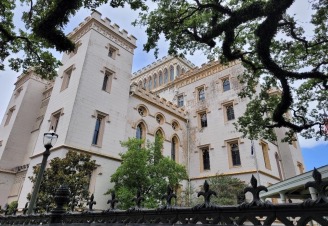
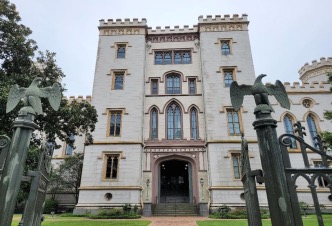
Thus I parked the car and the five of us walked up the generous incline of North Boulevard to the entrance of Louisiana’s Old State Capitol—arguably one of the most unusual buildings one would encounter in any state capital in the United States, and surely the most strikingly unique structure would will see along the Mississippi River, discounting the dramatic vision of the new state capitol building only a quarter mile to the north.
To even the most architecturally uninitiated, the Old State Capitol building stands apart as something almost misplaced in time and context, so seemingly unrelated to the surrounding buildings as to appear to have become unanchored from its origins. For starters, there is the classicism of its gothic drama. Even then, the Old Capitol Building circumvents an easy architectural niche, since the impressive structure is actually regarded as Neo Gothic—part of a mostly 19th Century revival of the Gothic style, a trend in a few places in the U.S. and Europe which lasted even into the very early 20th Century.
Prior to 1846, New Orleans was the capital of Louisiana. But like many other states, there was a fundamental belief that secondary or tertiary cities and towns better served the interests of a state, rather than a state’s most populous urban area (in this respect, it is easy to find examples in almost every part of the country: Sacramento, CA; Albany, NY; Annapolis, MD; Harrisburg, PA, to name four examples). Geography and distance could also be a factor; towns near the heart of a state would provide less distance for legislators to travel.
So, after a series of debates in the legislature between 1843 and 1846, Baton Rouge was finally selected to serve as the new capital city. The city of Baton Rouge donated a tract of roughly four acres of riverfront land, and atop that bluff rose the Neo Gothic architectural masterpiece which served as Louisiana’s legislative home until May 1932, when the current skyscraper—about ten blocks to the north—opened to much fanfare.
After some years of neglect and deterioration, the Old State Capitol building saw a resurgence of prestige, and over the decades has seen gradual improvements and repairs. By the 1970s, it was recognized as an architectural marvel and an important part of American history. It is now a significant tourist attraction and a museum, with a dazzling number of features worthy of hours of browsing and gazing. Among its amenities is a substantial book store.
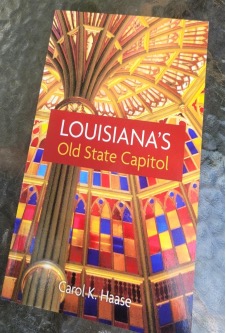
It was in the book store where we discovered Carol Haase’s book Louisiana’s Old State Capitol, published originally in 2009, and indeed this is where our travel article morphs into a book review. Sort of.
Haase, a graduate of LSU, has compiled a remarkable 100-plus page history—the fascinating, colorful and sometimes turbulent story of how the Old State Capitol came into existence, and of the politics within, often combative and eruptive in the heady and sometimes surreal days of Huey Long and his loyalists and adversaries (the politics of Louisiana in those years was rough and sometimes divisive, and that era in Baton Rouge history bears an uncanny resemblance to some of our Washington politics today). Indeed, the no-helmets-no-gloves nature politics of the Pelican State of that era adds much to the colorful history of the Old Capitol—as if its dramatic architecture were not enough.
Haase’s book is a smooth, approachable, and fast read. She has done a marvelous job of weaving the political thread of each era with the building’s continuously evolving tapestry of events and personalities. The book also helps to connect the many seemingly disparate design elements, and tells the stories of the many efforts over the last century to keep the grand old building in healthy condition—a sometimes monumental task which included local, state and federal monies (one major overhaul took place under the auspices of a WPA project in the 1930s; 120 workers were employed just to renovate the grounds), as well as donations from private individuals and much volunteer work.
Since its completion in the 1850s, the Old State Capitol has had its share of advocates and supporters, but it has also endured many detractors, including a few notable people who scoffed at the building’s decidedly un-Jeffersonian non-classical appearance. Whereas many U.S. State Capitol buildings reflect their designers’ fascination with—and reverence for—the U.S. Capitol building in Washington, D.C. (indeed, some state’s legislative homes are found in structures barely distinguishable from the one found at the east end of the famous Mall), what is found in Baton Rouge stands in elegant defiance of this standard. Designed by James H. Dakin, this grand example of Gothic Revival was scorned by some critics, including Mark Twain, who famously thought of the Old Capitol as a visual abomination, and a waste of good riverfront property to boot.
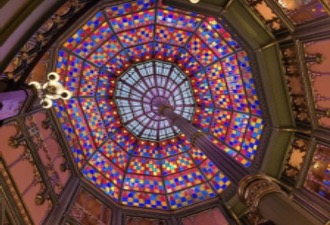
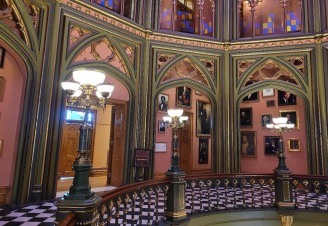
But well into the 20th Century, even those unmoved by the building’s storied history grew to appreciate the stunning design with its tall cathedral windows and fortress-like turrets. Once in the doors, visitors need only walk a few more steps to discover some of the striking features inside the building, including a grandly winding staircase which dominates the central rotunda, and the dazzling light display of the stained-glass dome high above—a remarkable site which renders many visitors both awestruck with faces and eyes temporarily tilted upward.
Another benefit of Haase’s book is that she includes numerous photos, drawings and engravings of the building through the decades, including one showing the exterior intact despite ruinous damage to the interior after a fire broke out in 1862 while the building was occupied by Union troops. The building lay largely deserted after the fire, until a massive restoration in the early 1880s led by William Alfred Freret. Freret’s huge renovation included several key improvements—among them the aforementioned glass dome added in effect as a skylight to provide better lighting for the previously sullen, dark rotunda. Freret also added a fourth floor to allow for more office space. Photographs from that era also show that Freret’s renovation included painting the entire exterior a dark, brick red—the net result giving the Capitol the look of an academic structure somehow misplaced from a campus.
Louisiana’s Old State Capitol Building remained the center of the political hive for decades more. The era of Huey Long wrought massive public works spending in the state, and among the great projects Long sought to achieve was a capitol building big enough to house all legislative offices and official business. The result, after many years, was the new capitol building for which construction began in December 1931. A stunning example of the Art Deco style, it too is an architectural marvel, modelled closely on a similar design which had been completed in Nebraska only a few years earlier. (More about the current Louisiana State Capitol Building in another article). Again, Haase’s book covers the long period after the new capitol was built, including some years of neglect for the old building, and its long history of repairs and modifications throughout the World War II years and afterwards.
Recognizing both the tumultuous history within and the striking architectural gem of the building, the Old State Capitol gained recognition in 1973 on the National Register of Historic Places, allowing the building and the grounds to become eligible for some federal funds, and ensuring that any future improvements kept the building’s original design more-or-less intact.
In the meantime, Haase’s lively and well-written book is a must, especially if you like to mix history, architecture and books with your travel.
Haase’s book is not available on Amazon (Amazon lists the book but shows only the Kindle version is available). But it can bought in the gift shop inside the Old Capitol, or through Pelican Press/Arcadia Publishing.
As for that seafood place in Baton Rouge, on the night we planned to gorge outselves on fish and shrimp, we arrived at a reasonable time for dinner only to find the parking lot packed so solid it was obvious the place was jammed to the point of hopelessness. Hungry and also somewhat exhausted from several days of tourism, we dropped back and punted (something LSU fans may not be accustomed to but we Florida State folks know all too well), and travelled a short distance to Red Zepellin Pizza, where we ordered our food, enjoyed the decor, and then took our delicious pizzas back to our AirBNB. (More about the connection between Red Zeppelin Pizza and the new state capitol in a future piece).
Related Thursday Review articles:
Shengsi Island: To Heck With the Fog; Michael Bush; Thursday Review; November 21, 2015.
Istanbul's Hagia Sophia; R. Alan Clanton;Thursday Review; September 27, 2014.