
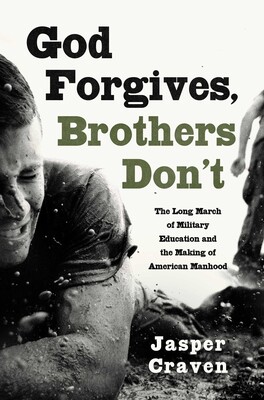
Image courtesy of Simon & Schuster
God Forgives, Brothers Don't
| published June 12, 2026 |
By Bob Armstrong
Thursday Review contributor
During World War II, General George Patton once instructed American GI's to cut the guts out of enemy soldiers and "use them to grease the treads of our tanks." During the late sixties and early seventies, despite the power and influence of the anti-war movement over young men of draft age, the soldiers and Marines humping the boonies in Vietnam gave a full-throated endorsement to the informal decree: "Kill 'em all and let God sort 'em out." After all, might the South Vietnamese (friend) be a North Vietnamese (enemy) agent?
On Easter Sunday of this year President Trump threatened to blow up bridges and power plants in Iran if the Strait of Hormuz remained closed. He put it in tread greasing terms: "Open the f***'in Strait, you crazy bastards, or you'll be living in Hell."
Enter an expert in sorting things out in the Department of Testosterone. Jasper Craven, a prominent freelance journalist with a focus on military affairs and veterans' issues, has written for the New York Times, Politico and Harper's Magazine, among others. In God Forgives, Brothers Don't: The Long March of Military Education and the Making of American Manhood, Craven examines how military education shapes American masculinity, fosters its toxic traits, jacks up totalitarian tendencies, and drives war into the forever wars.
Craven gives much attention to West Point, but its credo of "Duty, Honor, Country" must stand uncomfortably tall next to a long history of upperclassmen abusing the plebes with head banging and hazing. And, cover-ups. For example, General Douglas MacArthur acknowledged he had been compelled to preform deep knee bends over broken glass as a plebe, but during a congressional inquiry in 1901 he emphasized the revelations of hazing abuse had been "greatly exaggerated" in news reports.
Rather than exaggerate the hazing, a few years later in 1908, the New York Times pointed out that graduates claimed hazing "benefits character" and brings "a mother's darling down to earth." About once every generation or so since the darlings got paddled, West Point, the Naval and Air Force Academies, other military schools and countless fraternities at state universities, announce they will abolish the practice.
A few culprits get slaps on the wrist, the schools do a dash of PR, then wait for the temperature to drop. "A long list of military school Superintendents have pledged to eliminate hazing," Craven notes, "and none has ever put the final nail in the coffin."
The greatest test for West Point came during the Civil War, symbolically underscored by the school uniform colors—blue and gray. The Union and the Confederacy. Three quarters of the military officers who filled the ranks on both sides hailed from West Point, including Robert E. Lee, President of the Confederacy Jefferson Davis, and the North's commanding general Ulysses Grant. Public officials in the north attacked the school itself simply because of its distinguished alumni south of the Mason-Dixon line. One senator suggested the school's epitaph should read "Died of West Point's Pro-Slaveryism. Lincoln's secretary of War, Simon Cameron, said the school was infested with "extraordinary treachery" and argued for abolishing it.
From the age of treachery to the age of Trump, the superintendents for college students at West Point and all the other military schools have promoted the values of manliness, militarism and "white male conservatism," says Craven. "Military education is not a dying, outmoded brand, but a generously resourced, always-and-forever force in shaping the American man."
If only. Military education in the United States is closer to a spent force. The number of military boarding schools, high schools and colleges has shrunk from 280 after the Civil War to 140 today, according to the Association of Military Colleges & Schools of the United States—a drop by half even as the population increased from about 40 million in 1870 to over 340 million today. Still, many of the current crop of young men—and a few young women—who survived (or thrived on) the hazings can be found walking the halls of the Pentagon.
For Craven, the Pentagon represents the "military's perpetual beating heart, America's largest federal office building and a striking symbol of Washington's insatiable war habit." Reading that sentence stressed me out so bad I had an attack of PTND—Post Traumatic News Disorder. My mind crashed back to an anti-war demonstration on October 21, 1967, where beat poet Allen Ginsberg led the crowd in a chant intended to levitate the Pentagon into the air where it would hover until all its evil emissions evaporated thus bringing the war to an immediate end.
Like the author of Howl, Jasper Craven is a levitationist. His chants, set out in a well-researched and smoothly written book, are designed to send the West Point campus spiraling upwards into the Milky Way, where it will vibrate for eternity next to the Pentagon. Meanwhile, back on earth, if it is the case that God forgives and brothers don't, then it is also the case that God punishes severely while brothers forgive each other and band together with honor when the time comes to fight for something worth fighting for.
Bob Armstrong is a journalist and writer, and the author of a new memoir, No Exit From Vietnam, available on Amazon.
Related Thursday Review articles:
Saving Lives in War; By Bob Armstrong; Thursday Review; May 18, 2026.
"Crack the Sky, Shake the Earth" A Look Back at Tet; By Kevin Robbie, Thursday Review contributor; February 14, 2015.