
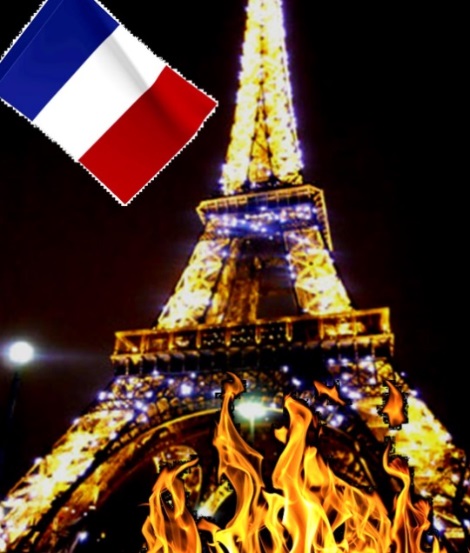
Photo-composition by Thursday Review;
Photo of Eiffel Tower, Sarah Herrin for Thursday Review
In France, Curfews
Are In Place To
Curb Spreading Violence
| published October 20, 2026 |
By R. Alan Clanton,
Thursday Review editor
Across France, cities and towns are imposing curfews and shutdowns in an attempt to tamp down a growing wave of violence and destruction which swept across the country. Monday night, much of the rioting and looting had calmed down, though there were still instances of isolated ransacking and vandalism.
More than 2,700 people have been detained or arrested, and French law enforcement says many more arrests will follow.
Over the weekend, demonstrations by as many as one million people began to escalate into violence, with masked protesters smashing retail stores and shops, setting cars and trucks on fire, and ransacking some shopping districts. Vandalism was also reported—and widely seen in hundreds of videos online—across dozens of cities in France.
By Sunday, some of the violence had tipped over into wholesale looting of retail shops and restaurants with police either in retreat or unable to quell the disturbances. The French Interior Minister said that the government had “lost control” of the situation over the weekend. By some accounts, 200 police officers had been wounded across France, and all told some 2,700 arrests have been made (though official totals remain unclear).
By Monday night, the mayors and police chiefs in a dozen cities had imposed some form of curfew.
The curfews, according to Sebastien Lecornu, French Prime Minister, will be partial or “limited” in some cities and towns, but Paris may face a total shutdown if the violence cannot be stopped. In Marseille, the second-largest city, officials banned all gatherings of any kind, for now. Officials in Lyon were considering the same action as of Monday evening.
The demonstrations began two weeks ago, though they were at first largely peaceful. The initial protests began with student walkouts as a result of anger over school funding and the poor conditions of some schools and colleges. But within days, the protests began to enlarge to include other issues, and the demonstrations began to take on more strident political overtones. Like several European countries, France has seen its politics divide sharply between rightwing movements and a variety of ultra-left groups.
As the size of the crowds grew, so too the combustible mix of political language and hostility—much of the anger directed at French President Emmanuel Macron. Macron has faced intense criticism for government spending cuts and sharp reductions in many social programs and entitlements. Many younger people in France say that Macron’s cuts to schools, tuition programs and education have cut too deeply.
But those protests were soon joined by still more, with many demanding the French government do more to curb rising food prices and escalating energy costs. Recent polls among the French electorate indicate that the cost-of-living is the most serious issue going into France’s national elections in April. But as some French analysts have pointed out, the protests were largely “hijacked” by ever-more violent components of rioters.
The massive protests, the French government acknowledges, quickly devolved into full scale rioting and looting over the weekend which blossomed far beyond vandalism and setting cars on fire. By Saturday night, many of the protesters were wearing ski masks, hoodies, face masks, and tactical gear. Photos and videos taken in Paris Sunday night and again on Monday show wanton looting of stores and shops. Though there are no clear numbers yet, estimates suggest that the property damage across France has already exceeded half a billion dollars. Some videos show individual or family shopkeepers attempting to defend their own stores without police assistance. Other shops, once stripped bare of products, have been deliberately torched by the protesters.
By Sunday, many of the protesters had turned their rage against public buildings and public institutions, with widespread spray paint vandalism of antiquities, statues, buildings, and even the torching of some older civic buildings in Limoges, Bordeaux, Lyon, and Marseille.
In Limoge, rioters set fire to the historic town hall, built in the 1880s; within hours of the start of the fire the building was gutted, along with its famous clock tower. In Lyon, after ransacking and looting the 170-year-old offices, masked rioters set fire to the historic Tourism Office on Place Bellecour. In Bordeaux, rioters smashed shop windows, set cars and SUVs on fire, and after looting stores set some retail locations on fire. In Marseille, even small kiosks were vandalized or destroyed.
Though France has seen violent protests in the past, the pre-election rioting over the last week may be the worst in the nation’s history. Some finger-pointing has already begun between extreme leftist political groups and some rightwing groups.
French Interior Minister Laurent Nunez, who has offered to resign, told the media that there was a “lack of anticipation” regarding the possibility that the violence would escalate from Thursday through the weekend. Across France, many police departments were simply unprepared for the worst. Macron rejected Nunez’ offer of resignation, insisting that he needed Nunez and other experienced law enforcement leaders on the job until calm can be restored and the streets cleared.
French government officials and some law enforcement chiefs are assigning blame on extreme leftist groups, and specifically the leader of the hard-left party, Jean-Luc Melenchon. Melenchon, a presidential candidate, has flatly denied inciting or encouraging the violence, and has demanded that the government offer proof.
But the most rightward of the presidential candidates—Marine Le Pen—has already seized the political initiative by citing the violence as reason enough for France to change its political direction. Le Pen’s National Rally Party (NR) has been leading in some polls since late summer, and her candidacy is certain to gain strength if French voters see leftwing authorship in the current violence and lawlessness.
Among the factors which government and police agree took them by surprise: initial expectations of about 200,000 demonstrators proved inaccurate, as some half a million people took to the street; the speed with which the “anarchist” and leftwing components of the protests—numbering into the tens of thousands—gained traction within the demonstrations, and turned quickly into violence, with a shockingly heavy emphasis of vandalism and looting. Some French law enforcement officials have said that the rioters used social media to rapidly organize themselves to piggyback on the main demonstrations. French Justice Minister Gerald Darmanin blamed the lawlessness on a lack of useful police and security intelligence gathering, pointing out that a significant percentage of the worst offenders arrested or detained this weekend had previous police records—some for theft, robbery, street crimes, and past political violence.
As of Monday afternoon, police estimated that some 2,000 shops and stores had been vandalized and looted.
Fears that the violence might easily spread into neighboring countries have spurred some European leaders to immediately take proactive steps to avoid the scenes now coming from France.
In Italy, some protests had already turned violent, forcing police into the streets to quell the destruction and looting. In Milan, hundreds were arrested after a wave of young people moved through the streets setting fires, smashing windows and doors, vandalizing cars, and setting newspaper kiosks and trash bins on fire.
Deputy Prime Minister Matteo Salvini said that the Italian government will use temporary measures to keep cities under control through curfews and by detaining anyone under the age of 18—even if those young people have committed no crime. Italy is also tightening its normal procedures at ports and at border crossings to ensure that outsiders are not entering the country with the intention of joining in the violence. Early Monday, the government deployed at least 500 soldiers to Milan to assist local police.
But the worries over violence and looting—against the background of events in France—forced any shopkeepers in Milan and in other Italian cities to remove merchandise from windows and shelves, and hire additional armed security to discourage vandals and looters.
In Portugal, the government and police sought to clear encampments of protesters in both Lisbon and Porto out of concern that these so-far peaceful gatherings could turn quickly ugly. Though the demonstrations and encampment in Porto began about a week earlier, the size of the gatherings in other Portuguese cities grew over the weekend, in part in sympathy for events in France, but also to protest the cost-of-living, affordable housing, and rising food and gas prices.
Likewise, the size and restlessness of protests in Spain and Belgium have grown measurably in recent days, spurring those governments to also consider deploying additional police.
Related Thursday Review articles:
Amd Just Like That, Germany's Establishment Went Kaput; By Bob Armstrong, Thursday Review contributor; October 17, 2026.
Paris Terror Attacks: Do They Change the ISIS Narrative?; By R. Alan Clanton, Thursday Review editor; November 14, 2015.