
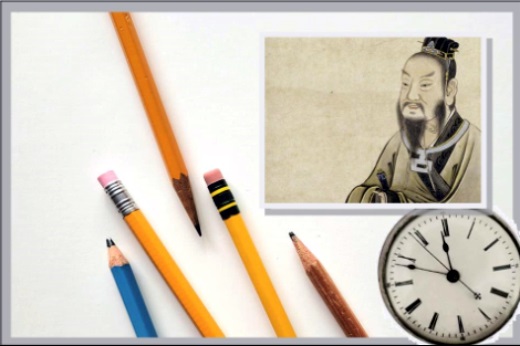
Photo-composition by Thursday Review;
painting on Mencius by Kano Sansetsu, circa 1632
Homework in China
| published August 8, 2026 |
By Bob Armstrong
Thursday Review contributor
In a previous story, "Chinese Couch Potatoes," I wrote about young people "lying flat," that is shunning work, responsibility, and ambition in favor of kicking back and doing as little as possible. Now I'll flip the switch and report on an educational movement in China rooted in grueling homework. This program is so demanding that even the brightest high school senior applying to Harvard would be petrified encountering what is called Dujing, or reading classics, mostly Confucian-centered texts.
The Dujing movement emerged in the early 2000s as an after-school program. This caught the attention of many parents who pushed for the development of full-time Dujing schools where 6th to 12th grade students read texts for—here's where the first-year Harvard brainiac gets busted—eight hours a day.
Writing in the quarterly academic journal, Telos (Spring, 2026), Yukun Zeng, an anthropologist now teaching in Germany, runs through the daily schedule of his middle school classmates hunkered down at their desks in a suburb outside Beijing. The morning recitation included reading aloud excerpts from what are called the "Four Books" prepared by Song dynasty scholars in the 12th century. These four works serve as an educational foundation through rigorous reading, writing, reasoning and ethical awareness. They are:
--"The Great Learning" outlines a path to moral self-cultivation.
--"The Doctrine of the Mean" stresses impartiality and moderation which is almost identical (if not ripped off) from Aristotle's "Nichomachean Ethics" where the "golden mean" of virtuous behavior vacillates between the vices of excess and deficiency.
--"The Analects of Confucius" is a compilation of the master's dialogues emphasizing ethics, respect for elders, and virtue in governance.
--The last book, entitled "Mencius," features the work of a philosopher by that name who taught that human nature was essentially good. His "four beginnings" analyze virtue, shame, and compassion along with the notion of a benevolent state under the guidance of enlightened rulers.
Locked down in his assigned seat throughout the day starting at 5:20 AM, Yukun Zeng and his fellow students, after morning calisthenics, work through seven "time block" reading sessions, the last one ending at 5:30 PM. After dinner, two hours of "self-study" (homework). Bed check at 9:50 PM.
The seven daily reading blocks each last about an hour. This cycle begins with a round of guided reading by an instructor followed by several rounds of group reading and discussion. It concludes with one or two rounds of individual recitation. "Each round could span days or weeks" said Yukun Zeng, "allowing students to absorb the material incrementally until they can recite entire texts from memory."
This educational movement is well-suited for the Confucian revival over the past decade which permeates society and champions the belief in an intellectual and ethical superiority of Chinese culture. Then Dujing delightfully contradicts its Confucian-centered "Four Books" system by including in the curriculum a comprehensive study of Western thought. According to the syllabus at one school Dujing aims to create cosmopolitan citizens "who have a thorough knowledge of both East and West." At another school, the Wenli Academy, students study the Chinese classics along with classes in English, Ancient Greek, Latin literature and Sanskrit. (If that last one revs your East-West engine, check out the Hindu University of America in Washington, DC, which offers a Sanskrit Studies program.)
Most of the students immersed in this incredible educational adventure are 13 to 17 years old, although some have been reading Chinese classics since first grade. What their parents have in common is a love of great books and not much love with the state-controlled curriculum set forth in the Compulsory Education Law of the People's Republic of China. For example, Article 14 in the law states that "Teachers should be committed to the cause of socialist education" and "raise their own ideological and cultural levels." Article 2 is more explicit, pointing out that the party-state governance is in charge of an educational program "In accordance with Marxism-Leninism, Mao Zedong Thought, and the theories of constructing socialism with Chinese characteristics." President Xi, the current Mao clone, is big on Chinese characteristics.
Despite state-mandated ideological indoctrination, the Dujing movement managed to gain attention and attraction. With its emphasis on moral education Yukun Zeng notes that the afterschool program evolved not only as a full-fledged replacement from state-mandated schools but also, and far more important, as "a way of life." Thus Dujing is radical at its core "where words are infused with stakes, dedication, and sincere efforts to engage with the world."
Or, to quote a famous passage from the "Menicius," this way of life requires heavy duty dedication: "When Heaven intends to confer a great responsibility upon a person, it first visits his mind and will, toils his sinews and bones, subjects his body to hunger, exposes him to poverty, and confounds his projects. Through this, his mind is stimulated, his nature strengthened, and his inadequacies repaired."
Needless to say, this hardcore program appeals to only a tiny segment of the population, although Yukun Zeng points out "At its peak in the 2010s, reports estimated that there were as many as 3,000 Dujing schools across China, involving tens of thousands of families engaged in full time Dujing." Still, in a country with a population of 1.4 billion that is a very small student body.
In addition, the state education authorities began banning Dujing schools once they started attracting attention. An investigation by the Ministry of Education found a number of schools that violated compulsory education laws. One choice bit here: Any alternative school outside the state school system can't award degrees recognized by the Ministry of Education. This makes it more difficult for Dujing graduates to get accepted at prestige universities despite eight hour reading days in a program that is obviously the best college prep on the planet.
Hopefully, the Dujing educational movement will continue to "bore from within" as Lenin said until socialism with Chinese characteristics is viewed by the vast majority of the Chinese population for what it is—an authoritarian regime that deserves to be overthrown.
Bob Armstrong is a journalist and writer, and the author of a new memoir, No Exit From Vietnam, available on Amazon; Armstrong is a frequent contributor to Thursday Review, and his writing has also appeared in the Washington Examiner.
Related Thursday Review articles:
The Chinese Couch Potato; By Bob Armstrong; Thursday Review contributor; July 21, 2026.
250 On The Left: An Examination of Dissent's Summer 2026 Edition; By Bob Armstrong; Thursday Review contributor; June 28, 2026.