
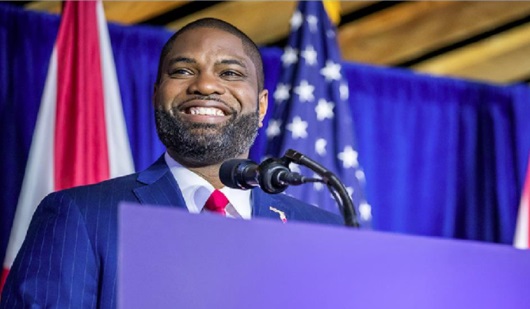
Photo courtesy of Byron Donalds
Byron Donalds
And Florida's
"No Debate" Debate
| published July 30, 2026 |
By R. Alan Clanton
Thursday Review editor
Though there are few certainties about who will be the next steward of the governor's mansion in Tallahassee, one thing is not in dispute: that house has been occupied continuously by Republicans for 27 years.
Since Jeb Bush's election in November 1998, each new cycle essentially brings the next general election win, followed by the coronation: Bush preceded Charlie Crist, who was followed by Rick Scott, who was followed by Ron DeSantis. Some political analysts in the Sunshine State suggest that GOP dominance is unlikely to change with the upcoming gubernatorial election.
The Sunshine State's long, steady shift into the red column has tracked in tandem with Florida's robust population growth. The more Florida booms, the more it seems to tilt Republican. Recent redistricting has in most cases solidified this traction, and that means the challenge for Democrats grows more substantial each year.
For sure, Florida Democrats would like to break that GOP lockout. It's a longshot, but a few Democratic strategists are placing their bets on a street fight—well, let's call it a feud—within the GOP that may, just may, offer hope that the next governor will be a Democrat. And that's good news for Democratic front-runner (and presumptive nominee) David Jolly, the U.S. Representative for the 13th district.
Jolly has all the major endorsements and the heavy backing from Democrats, and he has few—if any—serious Democratic opponents remaining in the field. Most polls show him with a big lead over his next nearest competitors, among them former Orange County mayor Jerry Demmings, who in June withdrew from the race, and educator Dayna Marie Foster, who in most polls pulls-in only about 10-to-12 percent. At the moment, Jolly is the de facto choice for Democrats.
But in Florida, there is always drama on the rather large stage of politics, and Republican Governor Ron DeSantis—who under the Florida constitution cannot seek another term—is exiting the stage without naming his preferred successor. This has left the GOP with a plot right out of King Lear: a departing monarch unwilling to bestow the knightly gift of endorsement upon any one candidate, and instead attempting to divide the kingdom. The resulting fight has been nasty.
Still, the Florida GOP has a clear front-runner, and his name is Byron Donalds.
In a year of shifting concerns and vast uncertainties for the GOP nationally—including approval ratings making things look uncomfortably dicey going into the midterm elections—the endorsement of President Donald Trump can still prove pivotal. That would seem to make the primary more-or-less a slam-dunk for Donalds; the U.S. Representative from Florida's 19th congressional district has already landed Trump's endorsement.
Since the start of the year, Trump's nod has been effective 80% of the time, with the power to sway voters even in races where there was no clear-cut grievance by the president. After a crowded first primary in Texas back in March left incumbent Senator John Cornyn the winner in total votes but still short of the needed majority, Cornyn was shunted into a duel with the next closest voter-getter, State Attorney Ken Paxton. Trump's last-moment endorsement turned what would have been an otherwise narrow race (some polls showed Cornyn ahead; others indicated a closer race) into a landslide upset, and thrusting Paxton to victory.
Cornyn's fate and Paxton's jackpot win are not unique. There have been similar outcomes in Indiana, Louisiana, and in Kentucky, where Trump's endorsement of Ed Gallrein shifted the electorate decisively and forced the ouster of Representative Thomas Massie. Massie had been an irritant to Trump on several key issues, and had frequently sparred with Trump's closest allies in Washington.
Few sitting Presidents have enjoyed so much sway over the outcomes of gubernatorial and congressional primaries. But in the Sunshine State, the place which Trump now calls home, things rarely go precisely as planned, or predicted.
Indeed, Byron Donalds' substantial lead in the polls—most of the aggregate polls show him carrying a sturdy 43-to-48 percent—has itself become a source of contention for many Republicans; Donalds' lead has been deemed so impregnable as to preclude debates. In June, the Florida GOP announced that debates are unneeded since the other major Republican candidates—Lt. Governor Jay Collins, investor and entrepreneur James Fishback, and former Florida Speaker of the House Paul Renner—have all failed to meet the basic "big three" criteria: steady polling above 10%, at least $10 million raised from donors within the state, and at least 10,000 "unique" contributors.
These thresholds seem reasonable enough. But only Donalds has met all three of these requirements, and the Florida Republican Party has basically closed the door on any further discussion of an officially-sanctioned debate. The situation has also forced several TV stations in Florida to cancel their planned debates, especially after Byron Donalds himself declined to participate. Jacksonville's CBS affiliate, WJAX, pulled the plug on its July 15 debate after Donalds rejected the invitation, prompting Collins to also opt-out. Renner, too, saw no point. In the end, WJAX would have had only Fishback on its stage.
The other major Republican candidates—if polling at or below 10% can be considered major—have sharply criticized the GOP's decision and have accused Donalds of cowardice, through Donalds probably prefers to think of himself as following Trump's own preference for ignoring debates altogether.
In the meantime, the lack of any formal face-to-face dog-and-pony show for Republican voters has vexed some media outlets (especially those who stand to gain from the big event), and has left many Florida citizens largely in the dark about how to cast their votes in the August primary. The Miami Herald and the Tampa Bay Times have said the lack of debate equals a failure of the GOP to provide for informed voting. Even current Governor Ron DeSantis is annoyed, pointing out to the Florida GOP that he himself would not have qualified if the Republican Party had enforced such stringent barriers back in 2018.
Of course there is the longer strategic view of such a lopsided primary race. Some within the Donalds campaign have suggested that their candidate—now safely in the lead—would be foolish to waste time and resources contending with other Republican candidates when the real target of their political and policy ordnance should be the Democrat (likely David Jolly) they will face soon enough in November. With neither Collins nor Fishback nor Renner nudging the needle past 10%, Donalds has little motivation to fight an unneeded and risky battle.
So the Donalds campaign seems content to continue its momentum with the Trump endorsement as its centerpiece. Indeed, the President's thumbs-up is referred to on every piece of direct mail which lands in the hands of Florida voters, and Donalds himself rarely misses the chance to remind audiences that he is Trump's pick. Above his name on the campaign website is the bright yellow banner "Trump-Endorsed," just in case anyone misses the point.
Byron Lowell Donalds has a compelling narrative. Born in Brooklyn and raised by a single mom, Donalds attended college first at Florida A&M, and later at Florida State University, where he studied marketing, banking and finance—a career path he followed for a few years with TIB Bank and later with Wells Fargo. Not long after he switched his voter allegiance from Democratic to Republican, in 2010, his interest in politics began to blossom. After a loss in a 2012 run for the 19th District, and a decision to sit out a race in 2014, Donalds was elected to the Florida House of Representatives. His experience in finance and banking landed him quickly in leadership; for several years he served as the chairman of the Subcommittee for Insurance and Banking.
In 2020 Donalds ran for congress again. This time, he prevailed in a tight, complex field which at one point had as many as 14 active GOP candidates (at the time ballots were printed, there were nine Republican names listed). Donalds won the primary by a scant 774 votes, but squeaking past the requirement of a run-off. Then, in November 2020, Donalds trounced his Democratic opponent, Cindy Banyai, 61% to 39%. His subsequent victories in 2022 and 2024 were equally lopsided.
Donalds was an avid Trump supporter from the get-go, and among the things associated with Donalds that won Trump's favor was Donalds' vote to not certify electors from Pennsylvania and Arizona, and Donalds' more-or-less continuous assertion that the election of Joe Biden was not legitimate. As a steady MAGA supporter, Donalds has remained endeared to Trump ever since, and the endorsement by Trump came as no surprise to most political watchers nationally.
Lt. Governor Collins' asserts, however, that Donalds' Presidential endorsement is not enough. Collins—still stinging because he has thus far failed to gain the endorsement of his boss, DeSantis, and lagging in most statewide polls, very badly wants to debate, and Collins has every reason to get on the stage with Donalds. This would surely level the playing field. Collins would prefer to make it a two-candidate race, which means Collins would like for Fishback to cease and desist.
It was Collins and his legal team that challenged the legitimacy of James Fishback's candidacy last month. In court Collins' attorneys argued that Fishback does not meet the residency requirement needed to remain on the ballot; for one, Fishback bought a home in Washington, D.C. back in 2023, claimed a tax exemption on that house, and even voted in D.C. elections. But in Florida court, Fishback said he had never abandoned his Florida residence, and had no intention of making the District of Columbia his permanent home. After much back-and-forth, Leon County Circuit Court Judge David Frank seemed to reluctantly agree with Fishback, and allowed Fishback's name to stay on the primary ballot.
But as Collins sees it, Fishback is a distraction from the real issue: Byron Donalds should not be automatically ordained as the nominee simply because the polls show Donalds with a hefty lead, and—to Collins—the only reason that very lead remains stubbornly in place is that GOP voters have been deprived of a chance to make direct comparisons.
Collins' narrative, like Donalds', is compelling and interesting. A decorated veteran of the wars in both Iraq and Afghanistan, injuries sustained in Afghanistan eventually required the amputation of one leg. Undaunted, Collins re-applied and re-qualified for active duty. His entry into Florida politics by way of his district in Tampa thrust him squarely into the media spotlight. When Jeanette Nunez, DeSantis first Lt. Governor, resigned her office to take on the presidency of Florida International University in 2025, DeSantis tapped Collins to be her replacement.
Under normal circumstances, that might seem enough to earn the endorsement of DeSantis almost by default, notwithstanding Trump's high profile endorsement of Donalds. But there was little honeymoon for the two top chief executives, and things did not go well for their working partnership at first. Wikipedia describes Collins first eleven months as Lt. Governor as "turbulent," which is a polite way of explaining his weekly and biweekly media tempests. Some of these incidents were surely showmanship, notably his attempt to personally extradite an illegal immigrant from California to face charges in Florida (even many Republicans in Tallahassee balked at this).
Collins has also played it fast-and-loose with his social media messages, getting caught—among other things—texting colleagues regarding theories (unfounded) that DeSantis suffers from cognitive disorders, and may suffer from autism.
Collins has become understandably frustrated with some in the governor's office for what he sees as a lack of enthusiasm and support for his candidacy. As a team player, Collins may have reasonably expected some direct support from DeSantis and his team, even if it fell short of an outright endorsement.
Collins has turned to negative advertising, the majority of it aimed at Donalds. The ads suggest that Donalds' reluctance to debate his fellow Republicans is that he (Donalds) has past transgressions worth hiding, including an arrest for marijuana possession when he was 19 (he was fined $150 and the charges were later dismissed), and a no contest plea in Leon County for writing a bad check a year later. The bad check charge was later expunged from his record, which legal analysts point out could not have happened if he had previously been convicted of a felony crime (an article by Amy Sherman on Politifact.com debunks the accusations that Donalds was a felon). For most Americans, this probably seems like a tempest in a teapot: a 19 year old caught with pot, and a single incident of a bad check. But for Collins and his surrogates, those two incidents early in Donalds past seem more than minor blips on the screen for a young person at the start of life.
The vibe of the negative ads—at least one of which was developed by Casey Askar—seem do more to diminish Collins' reputation than to harm Donalds. But the ads in general are in keeping with Florida's frequent no-quarter-offered political street fights in which very little is off limits, even the absurd. In the meantime, Politifact rated Askar's ad as "mostly false." Meaning Collins should have distanced himself from such rubbish.
Still, Collins—the U.S. Army Special Forces veteran, Green Beret—would seem to be made of the sort of right stuff material that many Republicans fawn upon, with his penchant for sticking to the MAGA and Trump talking points working very much in his favor for voters who take their cues from the President. Collins has aligned himself with border security, shrewdly connecting it to national security, and touting the issue's relevance to the movement of dangerous drugs, notably fentanyl.
And in Florida, like many states, Collins' military experience is seen as a powerful draw for all voters, Democrat or Republican. This cross-over appeal will surely matter to the Florida GOP in a year when Trump's handling of foreign affairs, the Iran war, gas prices, and especially the economy may prove problematic on Election Day.
For different reasons, Fishback would also like to stand on the same debate stage with Byron Donalds. Fishback, an outspoken activist and businessman who supports both Trump and DeSantis, began as a star member of his Lauderdale Lakes, Florida high school debate team. He has earned a reputation as an event-crasher and vocal gadfly at symposiums and expositions and gatherings of all kinds—a verbal jouster and provocateur with a penchant for intellectual heckling. This has made him popular with the online and streaming crowds on the right. Historically, in some elections like this one, it does no harm (and may even serve a healthy purpose) to have an assymetrical candidate like Fishback in the room to keep the sparring honest and allow for out-of-the-box thinking.
But Fishback is also accused of being someone who claims to be things he is not, even, at times, a borderline fabulist.
When word spread in Washington in early 2025 that Trump was considering something called the "DOGE Dividend" (named for Elon Musk's temporary Department of Government Efficiency), a plan authored by Fishback which would have fast-tracked demonstrable government savings back into the pockets of taxpayers, Fishback—then CEO of the investment firm Azoria Partners—used the moment to claim credit for the scheme through his close association with Musk and Trump, and through his work with DOGE. Fishback even claimed to have been a part of DOGE. Only later did Musk himself have to dispel the confusion, explaining that Fishback had no role—official or otherwise—with DOGE.
In fact, Fishback's proposal to return at least 20% of those theoretical savings to taxpayers—most likely in the form of a $5,000 check—was devised as a way to motivate average Americans to seek ways to reduce government spending by identifying waste and reporting fraud (in keeping with Trump's often populist approach to economics). In Fishback's view, the plan would have invested every taxpayer with a role in the big feedback loop of taxing-and-spending. It was not, Fishback explained, a simple stimulus check akin to the payments many Americans received during the economic contractions of the Covid-19 pandemic.
Whether the plan would have worked remains unclear, but Fishback's grand claims of close association with DOGE and the White House were soon revealed to be untrue, though it gave him broad traction in the media while he touted his (fake) work with DOGE.
Similar dust-ups have occurred between Fishback and the companies he has worked for in the past, including Greenlight Capital. Lawsuits and countersuits ensued after Fishback repeatedly claimed his job title at Greenlight Capital had been "Head of Macro," a job title and position which Greenlight said had never existed. More legal broadsides erupted in a countersuit when Greenlight demanded that Fishback repay nearly $300,000 in promissory notes—the loans are not uncommon within Wall Street and investment workplaces—which Fishback never repaid after leaving Greenlight. More worrisome—but harder to prove—has been the accusation that Fishback used confidential data and information from Greenlight's portfolio when Fishback went into business for himself with the start-up firm Azoria.
In March 2025 a federal judge in New York ruled in favor of Greenlight Capital, and ordered Fishback to pay Greenlight $229,000. As of early July, Fishback had paid nothing to Greenlight. Adding to Fishback's run of unforced errors, one of his arbitration cases against Greenlight was tossed out after Fishback himself failed to appear.
Fishback's legal fees have continued to pile up, so much so that his own attorneys dumped him back in March. His attorneys told a judge in Manhattan that they wanted to stop representation of Fishback on the grounds that he had not paid his legal fees, which by then had mounted to around $150,000. At that time one of Fishback's lawyers, Justin Kelton, said that Fishback was at least 120 days in arears.
All this has sheared away whatever Fishback might have expected to gain from the mainline Republican crowds. Fishback has stoked the ire even of the White House; Alex Bruesewitz, a member of Trump's press team, has called Fishback a "pathological liar." Florida congressman Randy Fine, a Republican, has called Fishback a "con artist" who is coasting on the generosity of gullible contributors, and has suggested that Fishback's longshot campaign, if successful, would be catastrophic for Floridians.
Still, his vocal enthusiasm for DeSantis probably led Fishback to believe he too deserved an official thumbs-up from the governor (if not Trump himself!). But if DeSantis has been too cagey to endorse either Donalds or Collins, it seems a bigger stretch to imagine the current governor backing Fishback. It may be most telling that among Fishback's most ardent supporters are online personality Andrew Tate and far-right activist Nick Fuentes, along with commentator Tucker Carlson. For the GOP in Florida, this may represent exactly the sort of political risk most likely to trigger calamity in November.
That begs the question: Who would provide the least risk? Paul Renner, the former Florida Speaker of the House, would seem on the face of things to be the most traditional and the safest of all possible bets. Born in Atlanta and raised in Florida, Renner has all the right credentials and many of the ideal attributes to seal the deal: a BA in history from Davidson College, service in the U.S. Navy during the Operation Desert Storm, a law degree from the University of Florida, a stint as a prosecutor handling felony cases, and later corporate law. As a reservist he was mobilized again to serve in support roles during combat operations in Afghanistan.
Renner's entry into politics came with a tough primary fight, with Renner and Julian "Jay" Fant battling literally for every vote in a northeast Florida district which had just been vacated by Daniel Davis (Davis would later run unsuccessfully for mayor of Jacksonville). Very little separated the two candidates ideologically, but the issue of casino gambling somehow found its way into the narrative even though Renner stated repeatedly he was opposed to legalizing gambling in Florida. After several closely-watched recounts, Fant won by a mere two votes in District 15. The narrow outcome sparked the Florida Times-Union to remind its readers that, indeed, every vote does count.
Renner then moved to the neighboring 24th district, where he won easily in the Republican primary, and just as handily in the general election, defeating Democrat Adam Morley, 67% to 33%. Renner served as the Speaker of the House during 2022-24, closely aligning himself with DeSantis goal to "rebrand" Florida as the Free State of Florida, and helping to shepherd some of DeSantis' initiatives forward. Renner's website indicates he is proud of his role in advancing "the nation's most conservative state agenda." These points would seem to land Renner squarely in the right side of DeSantis, and, by extension, Trump as well.
Renner more recently became a member of the Florida Board of Governors, the body which oversees the state's huge publicly-funded university system. But do not mistake Renner for a patsy of mainstream thinking or wokey mindsets: Renner was one of ten members of the Board of Governors who last summer rejected the bid by Santa Ono to become the next President of the University of Florida, Renner's law school stomping grounds. The 10-to-6 vote cast Ono out of contention for the job after Ono had already left his job as President of the University of Michigan and after he had already been unanimously chosen by the U of F board of trustees. That Ono had publicly explained his slow turnaround from DEI—in principle and in practice—as ineffective and misguided, mattered not. Ono's past transgressions were enough to stoke the ire and the worries of the conservatives in the room, operating as they were under DeSantis' widely touted anti-DEI policies. Renner voted with the conservatives, and Ono was sent packing.
Ono's rejection was widely received with shivers within the lofty rooms of academia, where educators worried openly that in conservative states (like Florida) university presidencies may become all too routinely filled by political appointees. Unpopular with academics, however, Renner's vote won over the MAGA crowd and the anti-DEI forces.
Renner's website also cuts no corners on the most conservative talking points: Renner says there should be zero tolerance on the issue of illegal immigration, and endorses "free speech in classrooms" (conservative language for resisting the suppression of pushback on the traditional liberal channeling of classroom conversation), and instruction in American Exceptionalism. Renner also supports the right of Floridians to own guns. Renner takes a hard line on AI data centers and on Flock cameras and other draconian surveillance.
A recent direct mail piece outlines Renner's "Contract With Florida," which includes talking points on affordability and his linkage to DeSantis' controversial plan to eliminate property taxes. Like Collins' military credentials, Renner's 20 years in the U.S. Navy will play well with voters in both parties, and may be an especially likeable trait for Florida's many military retirees. Renner also has that "adult in the room" vibe that should play well with some voters, though this may seem antiquated in an age of political shouting.
For these reasons, Renner would surely like to share some stage time and some television debate time with the other three GOP candidates for governor—most especially the front-runner, Byron Donalds. Renner would be correct to assume that many undecided or uncertain Republican voters may have a chance to decide, and Renner may be also right to assume more than a few supporters of Donalds, Collins and Fishback could change their minds altogether. In the meantime, Renner remains stuck at (or below) ten percent in some polling.
The quandary is significant. All three—Renner, Collins, and Fishback—would like to advance from their undercard placement to a standing alongside Donalds, one which might give them a platform from which to nudge a few votes their way. But Donalds has no compelling reason to lower his shields. In fact, Donalds is so confident of his primary win that he is essentially attempting to publicly place the primary in his rearview mirror now. Just this week, he openly challenged Democrat David Jolly to a series of televised debates between now and November, and his website has already begun to include ordnance aimed at Jolly, just as it has been generally stripped of further articles or mentions of either Collins or Renner.
"David Jolly represents the failed policies of the past," Donalds says on his website. "I welcome three debates so voters can compare and contrast our records, our ideas, and our plans for the Sunshine State."
If Donalds prevails in the General Election in November, he would be the first person of color to occupy the governor's mansion in Florida history. At a first glance level, this reality should swing some Democrats and a fair number of African-American voters into Donalds' column, or at least that may be one hopeful element for the GOP. But the door can unfortunately swing the other way as well, as some Floridians opposed vis-à-vis their bigotry may, at a gut level, decide to deprive Donalds a vote and cast it to David Jolly instead. Indeed, those negative ads run by Collins' backers could be a mere foretaste of what might come.
Apparently ready to debate Jolly, Byron Donalds clearly hopes to overcome that second outcome, and seems intent to roll forward undaunted, his Trump endorsement in one hand, and in his left hand those historical printouts showing how Republicans have prevailed in every gubernatorial election in Florida since 1998.
Related Thursday Review articles:
Paul Rivera's Midnight Ride: A Closer Look at the DNC's Postmortem; By Bob Armstrong, Thursday Review contributor; June 5, 2026.
Lindsey Graham Dies at 71; By R. Alan Clanton, Thursday Review editor; July 12, 2026.