
Image courtesy of Universal Pictures
When Time Travel Was Fun:
Back to the Future at 40
| published December 7, 2025 |
By R. Alan Clanton,
Thursday Review editor
The Brat Pack was a big deal in 1985, so big that it spilled over into more than two dozen movies even as its ranks had grown to include a seemingly ever-expanding galaxy of under-30 stars. At the time, some of these younger actors would have balked at being considered Brat Packers, others famously embraced the label, and still others were indifferent. But one thing was certain, Hollywood had latched on to this business model with a vengeance, creating—at least in the popular imagination—an infinity of movie screens populated by the likes of Emilio Estevez, James Spader, Rob Lowe, Andrew McCarthy, Ally Sheedy, Judd Nelson, Mare Winningham, C. Thomas Howell, and others.
In retrospect, this makes sense: by the mid-1980s, Hollywood was at the apex of one its most risk-averse eras, all-too willing to rehash the same themes and remake the same formula movies, often based solely on the profits of a previous success. If it made money, make it again, and quickly. If the Brat Pack is making us money, then let's add actors to the Brat Pack.
Regardless of quality, many of the movies that season became a blur: Explorers (Ethan Hawke, River Phoenix, Jason Presson), Weird Science (Anthony Michael Hall, Robert Downey, Jr.), Real Genius (Val Kilmer, Gabriel Jarret), Tuff Turf (James Spader, Kim Richards, the aforementioned Robert Downey, Jr.), and St. Elmo's Fire (everyone mentioned in my first paragraph, plus Demi Moore). There was also Vision Quest (Matthew Modine, Daphne Zuniga), The New Kids (James Spader, again, Shannon Presby, Eric Stoltz), Once Bitten (with a very young Jim Carrey in his first film role), Secret Admirer (C. Thomas Howell, Lori Loughlin), and The Goonies (Sean Astin, Josh Brolin, Corey Feldman, Ke Huy Quan, though most of these kids were, well, kids). St. Elmo's Fire was a reunion of sorts of many of the same cast members of previous the Brat Pack hits, notably Sixteen Candles and The Breakfast Club.
Including the latter part of 1984 and all of 1985, some of the so-called Brat Pack films were of above average quality, some were passable, and a few were downright great. Indeed, Sixteen Candles (1984) and The Breakfast Club (1985) are considered classics of the era. Sixteen Candles still makes me laugh my ass off. At the opposite end of the spectrum, Private Resort (Rob Morrow, Johnny Depp) still makes me regret the waste of the time.
Interestingly, on the whole 1984 had been a better year than 1985 for Hollywood; by the start of summer 1985, all film revenues were down by about 15% total over the previous year, an indicator—some industry execs thought—that the repetition and retreading may have already worn thin, and that maybe the obsession with "youth" had been overplayed or perhaps spread too thinly. And to make matters worse, there was a glut of some 45 movies scheduled to be released in the United States at the start of summer 1985, over half of them aimed at the under-age-29 audience (see my partial list above).
There were also a few big budget mega-event arrivals: Rambo: First Blood Part II with Sylvester Stallone, and The Jewel of the Nile, the much-anticipated sequel to Romancing the Stone starring Michael Douglas and Kathleen Turner. Both of these sequel movies were heavily marketed with very big spending. As if those weren't enough, there was Rocky IV (slated for release in November of that year), and with a budget of $28 million, it was to be the biggest-budget of the Rocky franchise to hit screens to that date. And, of course, there was Out of Africa, the sweeping, panoramic, $31 million period piece starring Robert Redford, Meryl Streep, and Klaus Maria Brandauer, which was already expected to be the critics' favorite for the year, and for which much cash was spent in marketing the film to a wide audience.
But, as sometimes happens, expect the unexpected. On July 3, 1985—roughly the mid-decade mark—Back to the Future was released. The film starred a decidedly non-Brat Pack "youth" actor, Michael J. Fox, who was, by that point, a huge star thanks to the popular TV series Family Ties. I'm not spoiling things by telling our readers how this turned out: Back to the Future eclipsed all other films that year, edging out even the heavyweights Rambo: First Blood Part II and Rocky IV, and trampling on The Jewel of the Nile and Out of Africa.
Back to the Future, directed by Robert Zemeckis, took a long time to emerge and develop—years, in fact. Then, it took much longer to shoot and edit than expected, and includes one of those interesting but strange Hollywood stories of why casting is important, and why a director's gut instinct—sometimes first instinct—is often right (more about that later).
The origins of the story go back to its original writers, Robert Zemeckis and Bob Gale, who had been kicking around the idea of a comedic time-travel screenplay off and on for several years. Zemeckis had been a film student at USC, and had collaborated with others of that generation of young California filmmakers, including Steven Spielberg and another USC graduate John Milius. Zemeckis and Gale would go on to write other projects, including 1941, and later, Used Cars. Both films had met with lukewarm reviews and only modest box office success. Indeed, 1941, directed by Spielberg, was at the time generally regarded as a big-budget boondoggle of sorts—a expensive, noisy, elaborate period piece, though it's entertaining overall thread managed to keep it from losing money right out of the gate, and its cast top-heavy with 70s stars (John Belushi, Dan Aykroyd, Nancy Allen, Ned Beatty, John Candy, Tim Matheson, Treat Williams, dozens more) has helped the film retain something of a cult following. It remains one of Spielberg's few misfires
But the writing team of Zemeckis and Gale were already thinking of the future, and the past, pun intended, and began developing ideas for a time travel movie as early as 1980 (only about a year after 1941 had first hit the screen).
By their own admission, neither Gale nor Zemeckis wanted to burn the midnight oil on the hard science or the science fiction of time travel. Likewise, they had no intention of writing one of those stories where the protagonist travels back to some definite point in the past and confronts big real world history, then, risks altering things gravely. In other words, the writers wanted to waste little time picking some important place in history—Napoleon at Waterloo, for example, or the Roman Senate moments before Julius Caesar is stabbed. Further, they sensed—probably rightly—that any such scenario would not merely bore audiences, but make the comedy they sought unworkable. That left them with a conundrum of sorts: how to write a humorous tale of time travel without a lot of heavy science and without the need to explain why moviegoers were charging up San Juan Hill with Teddy Roosevelt or eavesdropping on Cleopatra's seductions of Mark Antony in Egypt. And there was to be no complex discussion of wormholes or dark matter or background radiation or black holes. There would simply be a device—something interesting that somehow came about through shade-tree tinkering and old fashioned tool shed mechanical grit.
Still, Gale and Zemeckis wanted to have a little fun with the central conundrum of all time travel fiction: how does one travel back in time without inevitably altering the future, assuming one does not truly want to alter the future. This was—in fiction, in movies, and in television—a frequent theme. In 1960, the George Pal-directed movie The Time Machine (based on the novel by H.G. Wells) offered the first big budget film treatment of time travel, with Rod Taylor as the intrepid traveler. In 2002, the same basic story was remade, this time with Simon Wells directing and Guy Pearce in the lead role. One of the most award-winning shows of the original Star Trek series was the penultimate episode of season one—City on the Edge of Forever—in which Captain Kirk and science officer Spock must leap into a time portal to travel back to 20th Century Earth to prevent Dr. McCoy from altering history. Only a year before Back to the Future, James Cameron offered his own vision of time travel dystopia in The Terminator, the 1984 movie which launched the whole franchise of time-traveling cyborgs intent on altering the future for the humans they seek to destroy.
Indeed The Terminator was the biggest film to tackle time travel since the classic Planet of the Apes in 1968, when Charlton Heston and crew crash land on a planet—thousands of years into the future, a future—where apes and gorillas are at the apex of the evolutionary pyramid—only to discover at the end of his journey that he has in fact returned home to a post-apocalyptic Earth.
These—and other films and TV programs—took time travel very seriously, deep diving the hard science of it (typically with a device or machine), and presenting the sometimes foolhardy and tragic consequences of altering the past, by accident or by design. But neither Bob Zemeckis nor Bob Gale wanted any of this weighty baggage, and they set about developing and writing what they hoped would be a comedic approach, starting with the most basic: what would happen if a teenager from the 1980s were to suddenly find himself wandering his hometown in 1955? What if he were to accidentally bump into his father in a soda shop? What if he were to wake in the 1955 home of his mother? What if the future—his own future—now hinged upon his making certain his father and his mother fall in love at the high school dance?
In short, what if this time travel fun could be grafted upon some of the same themes and even much of the same small town backdrop as It's A Wonderful Life—a classic movie which explores the nearly infinite outcome of one's existence, or lack thereof, in the case of protagonist George Bailey. Eventually, the writing team of Zemeckis and Gale got enough people on board (among them Steven Spielberg) to agree that this family-comedy version of time travel would be not only a joy, but also bankable.
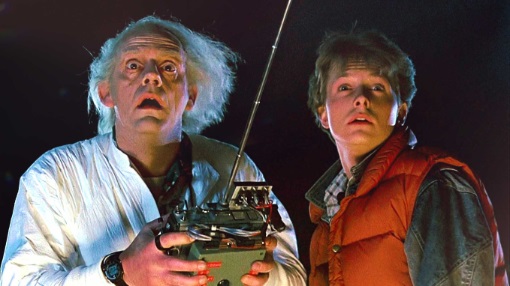
So, in case you slept through the 1980s, here's the summary: Back to the Future tells the story of young Marty McFly (Michael J. Fox), a mediocre high school student with a talent for rock guitar, and Marty's down-in-the-dumps, stuck-in-the-past family eternally mired in a comedic, unobtrusive middle class world. Besides his girlfriend, the restless young Marty's only other close companion is an eccentric science professor and marginally successful part-time inventor, Doc Brown (played by Christopher Lloyd).
Brown, as it turns out, has finally invented something which he believes will work: a time-travel device embedded in a working DeLorean automobile which uses something called a "flux capacitor"—powered by a small quantity of plutonium—to propel the car's occupant through time once the car reaches exactly 88 miles per hour. Late one night, in the parking lot of the local shopping mall, Marty helps the Doc test the machine using Doc's dog Einstein. The test is a success: but minutes later, when a group of Libyan terrorists show up, angry that Brown has bamboozled them out of the stolen plutonium which they intended to use to make a bomb, they shoot the Doc, and Marty must make a hasty escape inside the DeLorean. Forgetting that the car will catapult him through time if it reaches a speed of 88 mph, Marty evades the Libyans, only to be suddenly tossed through time back to 1955—the exact year that Doc Brown first conceived of his flux capacitor.
Within minutes of his arrival in 1955, Marty discovers that the custome-made batteries which power the time-travel DeLorean have died, and Marty must now track down a much younger version of Doc Brown to convince him of several things: Marty is a bona fide traveler from the future; that Doc invented a working time-travel device; and that Marty must return to his life in 1985. It's a tough sell: try explaining to an adult in 1955 that Ronald Reagan has become President of the United States. Or that Jane Wyman is not the First Lady.
The comic possibilities of sending a 1980s teenager back to 1955—with its full service gasoline stations, proto rock and roll, black and white TVs, soda fountains and sock hops—allows Zemeckis to employ a practically endless tool box of visual and audio gags. Zemeckis and Gale make full use of every imaginable time-travel sight gag, achieving a look both atmospheric and hilarious, and continuously placing Marty's assumptions and misunderstandings in comic conflict with the realities of the mid-1950s.
When they first hatched the idea for the movie, much of the plot spilled forth from a meandering, abstract conversation in which Zemeckis and Gale—after happening upon Gale's old high school yearbook upon a visit to his parent's home in St. Louis—wondered aloud if he and his father might have been friends if by chance they were the same age and in the same school. Remarking upon those folks they hated or disdained from their own youths, the bullies and the socialites and the nerds, and contemplating the social mistakes they made and the life-choice do-overs—if only given the chance to go back in time—the story quickly flowed from imagination to paper.
Early incarnations of the script do not employ the DeLorean, but instead use a refrigerator as the implement for time-travel, its departures and arrivals taking place in remote Nevada, on land used by the Army for atomic tests in the 1950s and where ample residual radioactive materials could be found (if this sounds oddly familiar, it is because Spielberg lifted that never-employed plot feature, grafting it, decades later, upon his script for Indiana Jones and the Kingdom of the Crystal Skull).
Another interesting bit of trivia about Back to the Future: though Michael J. Fox was the first and always favorite choice of the directors and producers to fill the role of Marty, Fox was contractually unavailable at the time, and unable to leave the set of the hugely popular TV sitcom Family Ties, which aired on NBC.
So Zemeckis fell back on Eric Stoltz, one of several second choices and the closest-runner-up. But roughly a month into the shooting, Zemeckis and Spielberg each came to the painful conclusion that Stoltz—a method actor impeccably skilled at drama and intensity—was tone deaf to the unique complexities of comedic expression and comic timing. Stoltz's rendering was steadily recasting the film as a sci-fi pseudo-serious drama, even to the point of blunting Lloyd's imposing comedic presence. Stoltz himself reluctantly agreed he was miscast. Though it cost an additional $3 million to halt the project and restart principal shooting from scratch, Spielberg and Zemeckis felt it was necessary. Stoltz was let go, and the filming went into a brief hiatus until early 1985, when Fox's schedule opened up long enough to allow for shooting.
The insistence by Zemeckis and Spielberg to recast their protagonist using Fox as Marty was perhaps one of Hollywood's most famous game-changers. Fox so easily slips into the role of Marty McFly that most people assume the part was written with him in mind (and indeed, to a degree, it was). The chemistry between Lloyd and Fox proves at times to be one of the film's best features, and Fox's television-trained familiarity with the facial expressions, timing and physical rigors of comedy translate deftly into nearly every scene, situation and confrontation.
Rounding out the ensemble cast: Crispin Glover, as Marty's father George McFly, and Lea Thompson as Marty's mother Lorraine, a pair who take on the roles in both the 1985 and 1955 incarnations. In essence, both Glover and Thompson had to play two parts: a young and old version of their characters. Glover's intense method-acting mode gels neatly with his quirky and nerdish character, bullied just as often as a high school student as when he is in adulthood; Thompson's portrayal of a frumpy quasi-alcoholic middle-aged mom of three required several hours of prosthetic make-up, whereas her incarnation as the young 1955 Lorraine is flawless when she appears in pristine period makeup and dress.
Adding to the 1955 and 1985 casts is Thomas F. Wilson as Biff Tannen, the local bully who—along with his henchmen—terrorizes other young people, but most especially the passive and hapless George McFly. The Tannen character, as it turns out, was cleverly modeled after the gregarious studio executive Ned Tannen, and several of the verbal confrontations seen in the film were modelled after real-life incidents between (Ned) Tannen and studio colleagues. Also appearing in the film: James Tolkan, the hard-nosed, uptight high school Dean of Boys, Mr. Strickland, who—with Tolkan's trademark shining bald head—seems humorously unchanged even 30 years later. Mr. Strickland was as much an arch-nemesis of the elder McFly as he is a pestering source of trouble for the young Marty McFly.
The plot of Back to the Future creates boundless fun with the whole space-time-continuum thing, injecting tension by constantly posing the key question of time-travel: if you were to go back in time, would not interference with the events of the past alter the outcome of the future? In fact, wouldn't your mere presence in the past, in some way, alter all possible future events? And knowing this, would one gain anything by attempting to right the wrongs or correct the social mistakes of one's youth?
That hundreds of science fiction books have been written on this subject, and that hundreds of movies have been scripted with these questions in mind makes no difference; Back to the Future approaches the conundrums of time travel with enough pure joy and comedic possibility that it makes the subject seem completely fresh. And the film demands little intellectually in the process, taking no stand on how time travel might be used for great good or great evil—the prevention of war, for example, or the prevention of an assassination (a topic of Stephen King's novel 11/22/63). Marty, after all, just wants to get back to his modest town of Hill Valley in time for his weekend date with his girlfriend. Doc Brown merely wants to invent something of consequence—something that actually works.
Despite the comic advantages of keeping things light, Back to the Future garnered lots of accolades from the sometimes heavy and persnickety sci-fi community. The film won that year's Hugo Award for "Best Dramatic Presentation," and it won the 1985 Saturn Award "Best Science Fiction Film." It also did well with the Hollywood critics, eventually earning six Oscar nominations, winning top honors in the category of Best Sound Editing, and raking in four Golden Globe nominations, including Best Picture, the trophy it won outright.
As for the plot resolution, Marty and Doc must navigate a complex and ever-expanding set of potential problems, not the least of which is a sudden love interest by Marty's mother (Lorraine) in Marty himself, as Marty has now taken center stage by accidentally upending her first meeting with George and already disturbing the space-time continuum. This requires Marty and Doc to engineer a variety of social encounters between Lorraine and George to insure that they meet in a proper context and that sparks fly—all the while delicately circumventing the constant bullying of Biff, who has himself developed a crass, oafish lust for Lorraine. Meanwhile, lacking sufficient plutonium in 1955, Doc Brown must figure out a way to replicate the raw energy required to send the DeLorean time machine back, to the future (thus the film's title) and safely return Marty to his beloved 1985. Using a small 1985 brochure regarding repairs to the town's iconic clock tower as his guide, Brown correctly calculates that he can jumpstart the DeLorean's power cells by channeling the energy of the massive lightning strike which famously damages the clock in 1955.
There's no spoiler alert required for those who, by chance, never saw this classic sci-fi comedy adventure. Marty resolves the oedipal conundrum with his mother through one final matchmaking coup, linking George and Lorraine at the high school dance and sparking the romance of his parents. Marty makes his way successfully back to 1985, intact, and better for the wear, save for his new knowledge of the past, and his semi-creepy, deeply comedic look at his parents at the time they were mere teens.
But in time travel, there is always a wrinkle. The final frames set the stage for what would become the start of the franchise—a series of sequels, some better than others.
The film also had fun with the musical possibilities. Marty is, after all, a mid-1980s rocker and a fan of groups like Van Halen and Def Leppard. At the penultimate 1955 high school dance, Marty gets to display his guitar and vocal skills on stage, pinch-hitting for another guitarist whose hand was injured only minutes earlier. Marty performs "Johnny B. Goode," the Chuck Berry early rock and roll classic. The teens in the auditorium respond enthusiastically to the infectious riffs. But when Marty begins to morph the performance into 70s and 80s hard rock—including feedback, guitar distortions, chord screeches, and even a Pete Townshend-style kicking of the amplifier—the 1950s era kids are stupefied and silent.
The movie also features as its title theme the Huey Lewis & The News classics "The Power of Love," (written especially for the movie) and "Back in Time."
Comparisons between Back to the Future and the Frank Capra classic It's a Wonderful Life (1946) were inevitable. As some critics and film historians pointed out, the films share a remarkable number of themes and concepts. For one, the two fictional towns (Hill Valley; Bedford Falls) and their center squares bear a striking resemblance, and include the jarring paradox of dramatic changes to each—in Marty's case because of a 30-year difference; in George Bailey's (Jimmy Stewart) case, a city seen under the circumstances of his never having been born at all, a theme which overlaps with the imponderable outcomes of time travel. Each town features local cinema houses now converted for the purposes of pornography or lustful entertainment, just as each town features similarly changed gas stations and diners. Each film features a dumbfounded protagonist walking and running through the city center, aghast at the staggering changes set against the familiar backdrop. Each film features a central character suddenly all-too-clearly aware of how their life impacts their world, for worse, for middling, for better—we hope.
Back to the Future, now 40 years old, was the surprise winner at the box office that year. It became the summer's biggest blockbuster, edging out other high-value movies, including its closest comedy and youth-themed rivals. Raking in some $389 million that year, it trounced even the mega-films Rambo, Rocky IV, The Color Purple, and the critically acclaimed Out of Africa. Back to the Future spent more than 11 weeks as the top box office film of 1985. The movie also became an enduring staple of VHS, DVD and Blu-ray sales, and replays often on premium channels, thereby keeping the revenue stream alive and introducing the adventure to subsequent generations of sci-fi lovers.
But its durability and legacy quickly proved greater than the sum of its numbers. Then-President Ronald Reagan quoted from the film twice during his 1986 State of the Union Address. The American Film Institute in 2008 ranked Back to the Future on its list of 10 best sci-fi films of all time, placing it in an elite group with 2001: A Space Odyssey, Star Wars, E.T., and Blade Runner. And the Library of Congress declared Back to the Future a national treasure, placing the film in its coveted National Film Registry.
Back to the Future also proved that science fiction, comedy, and whimsy could exist comfortably on the same plane, while also producing a timeless classic. One criterion for a movie's greatness is its durability among subsequent generations of movie-watchers. In that sense, Back to the Future has all the timeless qualities—endearing and relatable characters, universal themes of youth and age and romance, love of family and friends, and that strangely compelling human desire to see into one's future, or to understand one's past.
Related Thursday Review articles:
2001: A Space Odyssey: Fifty Years Ago Science Fiction Changed Our World; R. Alan Clanton; Thursday Review; April 12, 2018.
Die Hard at 30: Come Out to the Coast, Have a Few Laughs; R. Alan Clanton; Thursday Review; Sept. 19, 2018.